The largest ships ever built before the 20th century — naval architecture, navigation, and the voyages that almost changed history.
The Admiral
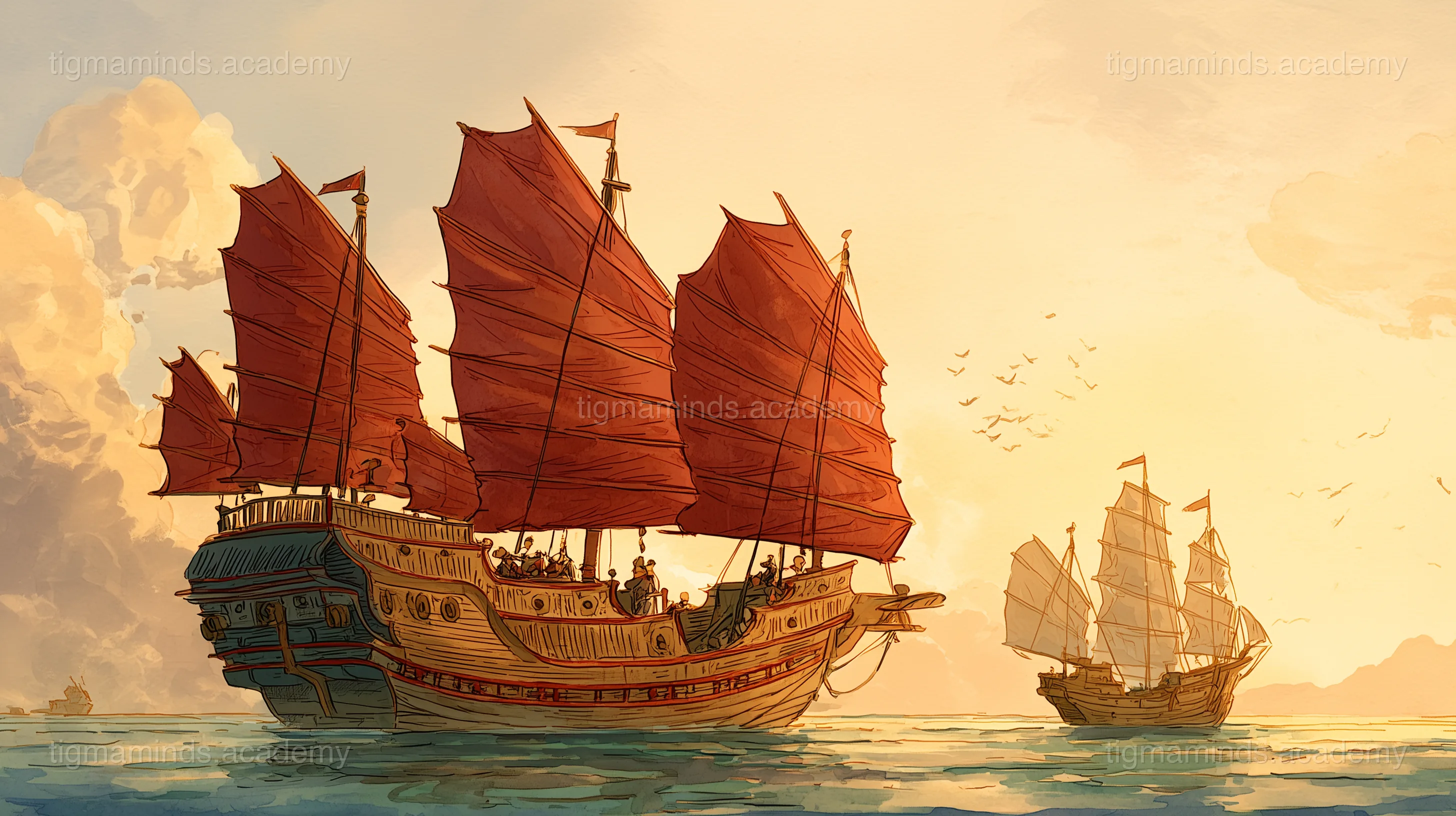
In the year 1405, a fleet sailed from the port of Nanjing, China, and turned south into the open sea. It was the largest fleet the world had ever seen — or would see for another five hundred years.
The fleet contained 317 ships. The largest of them — the treasure ships (baochuan) — were approximately 120 metres long and 50 metres wide. For comparison, Columbus's largest ship, the Santa María, was 19 metres long. Zheng He's flagship was six times longer than anything Europe would produce for another century.
The admiral of this fleet was Zheng He — a Muslim eunuch from the province of Yunnan, captured as a boy during the Ming conquest of the south, castrated, and raised in the imperial court. He rose through the ranks through intelligence, loyalty, and physical imposingness (contemporary accounts describe him as over 2 metres tall).
Between 1405 and 1433, Zheng He commanded seven voyages across the Indian Ocean, visiting Southeast Asia, India, the Persian Gulf, the Red Sea, and the east coast of Africa. His fleet carried silk, porcelain, tea, and lacquerware for trade. It also carried 28,000 men — soldiers, sailors, translators, doctors, and merchants.
These were not voyages of exploration in the European sense — Zheng He wasn't looking for new worlds. The routes were known. The purpose was diplomacy and trade — to project Ming Dynasty power across the Indian Ocean and establish China as the centre of a tribute-based international order.
The Ships
The treasure ships were engineering marvels. Their size alone — if the Chinese accounts are accurate — represents a shipbuilding achievement not matched until the steel-hulled ships of the late 19th century.
The key innovation was the watertight bulkhead. Chinese shipwrights divided the hull into separate sealed compartments using transverse walls (bulkheads) that ran from the keel to the deck. If one compartment was holed — by a reef, a collision, or enemy action — water flooded only that compartment. The others remained dry, and the ship stayed afloat.
This technology did not reach European shipbuilding until the early 19th century, four hundred years later. When it did, it was inspired by observation of Chinese junks. Benjamin Franklin, who examined a Chinese-built ship, wrote in 1787 that European ships should adopt the bulkhead system. The technology was finally widely adopted after the sinking of the Titanic in 1912 — though even the Titanic's bulkheads didn't extend to the top deck, which is why the flooding cascaded over them.
The treasure ships also featured centreline rudders (which provide better steering than the side-mounted steering oars used by European ships), multiple masts (up to nine, carrying square and lateen sails for different wind conditions), and a flat bottom that allowed them to navigate shallow coastal waters and sit upright when beached for repairs.
Navigation
Zheng He's navigators used a combination of techniques:
The magnetic compass: China had been using magnetic compasses for navigation since the 11th century — two hundred years before the compass reached Europe. Zheng He's navigators used a 48-point compass (compared to the European 32-point compass), giving finer directional resolution.
Star altitude: Navigators measured the altitude of Polaris and other stars above the horizon using a simple device — a wooden board held at arm's length, with a string attached to the centre. The string was held between the teeth, ensuring a consistent distance between the eye and the board. Different marks on the board corresponded to different star altitudes, and thus different latitudes.
Sailing directions: Zheng He's expeditions produced detailed rutters (written sailing directions) called hǎidào zhēnjīng — "compass needle classics." These gave the compass bearing and number of watches (time periods) between successive waypoints, along with descriptions of landmarks, depths, and hazards. They were essentially medieval GPS coordinates — bearing and distance, in a pre-digital format.
The Cancellation
After Zheng He's death in 1433, the voyages stopped. The new emperor's Confucian advisors argued that the expeditions were wasteful — they cost the treasury enormous sums and brought back exotic gifts (giraffes, ostriches, zebras) but no meaningful revenue. The court faction that favoured northern land defence won out over the maritime faction.
In 1525, the Chenghua Emperor ordered the destruction of all records of Zheng He's voyages. The great ships were burned or left to rot. The technology was abandoned. China turned inward.
Within sixty years, European ships — tiny by comparison — would round Africa and begin building colonial empires across the very ocean that Zheng He had once dominated. Portuguese, Dutch, and British traders would establish the trade routes that Zheng He had pioneered, but with a very different purpose: not diplomacy but extraction.
The Engineering Question
The great unresolved question about Zheng He's fleet is: were the treasure ships really 120 metres long?
The Chinese historical sources consistently report this size. But no treasure ship has ever been found by archaeologists (a massive rudder post found in Nanjing in 1957 is the strongest physical evidence). Modern naval architects are divided: some argue that a wooden ship longer than about 70 metres would be structurally unsound — the forces of waves and wind would cause the hull to flex and the seams to open, a problem called hogging and sagging.
Others point out that the flat-bottomed junk design, with its watertight bulkheads acting as internal structural reinforcement, distributes forces differently than a European ship hull, and that 120-metre wooden ships might have been feasible with this design — though barely.
The debate is a lesson in naval architecture — the science of making a structure that is strong enough to survive the dynamic forces of the ocean, flexible enough not to crack, and light enough to float. Every ship is a compromise between these competing requirements, and the maximum size of a wooden ship is determined by the material properties of wood — its tensile strength, compressive strength, and resistance to shear — pushed to their absolute limits.
The end.
Choose your level. Everyone starts with the story — the code gets deeper as you go.
Here is a taste of what Level 1 looks like for this lesson:
import numpy as np
import matplotlib.pyplot as plt
# Your first data analysis with Python
data = [45, 52, 38, 67, 41, 55, 48] # measurements
mean = np.mean(data)
plt.bar(range(len(data)), data)
plt.axhline(mean, color='red', linestyle='--', label=f'Mean: {mean:.1f}')
plt.xlabel("Sample")
plt.ylabel("Value")
plt.title("Naval Architecture & Structural Engineering — Sample Data")
plt.legend()
plt.show()This is just the first of 6 coding exercises in Level 1. By Level 4, you will build: Build a Ship Design Calculator.
Free
Level 0: Listener
Stories, science concepts, diagrams, quizzes. No coding.
You are here
Level 0 is always free. Coding levels (1-4) are part of our 12-Month Curriculum.
The engineering of the largest wooden ships ever built — bulkheads, buoyancy, structural limits, and why size matters in ship design.
The big idea: "Zheng He's Treasure Fleet" teaches us about Naval Architecture & Structural Engineering — and you don't need to write a single line of code to understand it.
A steel nail sinks. A steel ship floats. Both are made of the same metal. So what's different?
The nail is solid steel — its density is about 7.8 g/cm³, much heavier than water (1.0 g/cm³). But a ship is a hollow shell of steel enclosing a vast volume of air. If you calculated the average density of the entire ship — steel hull, air inside, cargo, everything — it comes out to about 0.3 g/cm³. Less than water. So it floats.
Archimedes' principle (discovered around 250 BCE) explains exactly how much a ship sinks: it sinks until the weight of water it pushes aside (displaces) equals its own weight. A 10,000-tonne ship pushes aside exactly 10,000 tonnes of water. If you add cargo, the ship sinks deeper — it needs to displace more water to support the extra weight.
Zheng He's treasure ships reportedly displaced over 3,000 tonnes — colossal for the 15th century. By comparison, Columbus's largest ship, the Santa María, displaced about 100 tonnes. The Chinese ships were 30 times heavier — which tells you they needed an enormous hull volume to remain afloat.
Try this: Take a ball of modelling clay and drop it in water — it sinks. Now flatten the same clay into a boat shape (thin walls, open interior) and place it on the water. It floats. Same material, same mass. The only thing you changed was the shape — spreading the mass over a larger volume, reducing the average density below water's.
Key idea: Ships float because their average density (hull + air inside) is less than water. Archimedes' principle: a floating object sinks until it displaces its own weight in water. Zheng He's ships displaced 3,000+ tonnes — 30 times more than Columbus's largest ship — requiring massive hull volume.
Imagine your house has one giant room — no internal walls. Now imagine a water pipe bursts. Water floods the entire house. Everything is ruined.
Now imagine the same house divided into six sealed rooms with watertight doors. The pipe bursts in room 3. Water floods room 3 — but rooms 1, 2, 4, 5, and 6 stay dry. You've lost one-sixth of your house instead of all of it.
This is the principle of watertight bulkheads — internal walls that divide a ship's hull into sealed compartments. Chinese shipbuilders had been using this technology since at least the 2nd century CE — about 1,700 years before it reached European ship design.
Each compartment is structurally independent. If the hull is holed — by a reef, a collision, or enemy action — water floods only that compartment. The adjacent compartments remain dry, the ship stays afloat, and the crew has time to make repairs.
European ships didn't adopt bulkheads until the early 19th century — and even then, they didn't always do it right. The Titanic (1912) had bulkheads, but they didn't extend all the way to the top deck. When the bow compartments flooded, water spilled over the top of each bulkhead into the next compartment, like dominoes. If the bulkheads had been full-height — as Chinese junks had been for centuries — the Titanic might have survived.
Check yourself: A submarine has even more watertight compartments than a surface ship. Why? (Because at depth, a hull breach lets in water under enormous pressure. Multiple sealed compartments limit flooding to one section and give the crew time to surface.)
Key idea: Watertight bulkheads divide a hull into sealed compartments, so flooding in one area doesn't sink the ship. Chinese ships had this technology 1,700 years before European ships adopted it. The Titanic's bulkheads failed because they didn't reach the top deck — a design flaw Chinese shipbuilders had already solved.
Access all 130+ lessons, quizzes, interactive tools, and offline activities
Hold a ruler by both ends and press down on the middle. It bends — the middle sags downward, the ends rise. Now support the ruler only in the middle a...
Hold a compass (even the one on your phone). The needle points north. But *why* does it point north? Because the Earth has a **magnetic field** — gene...