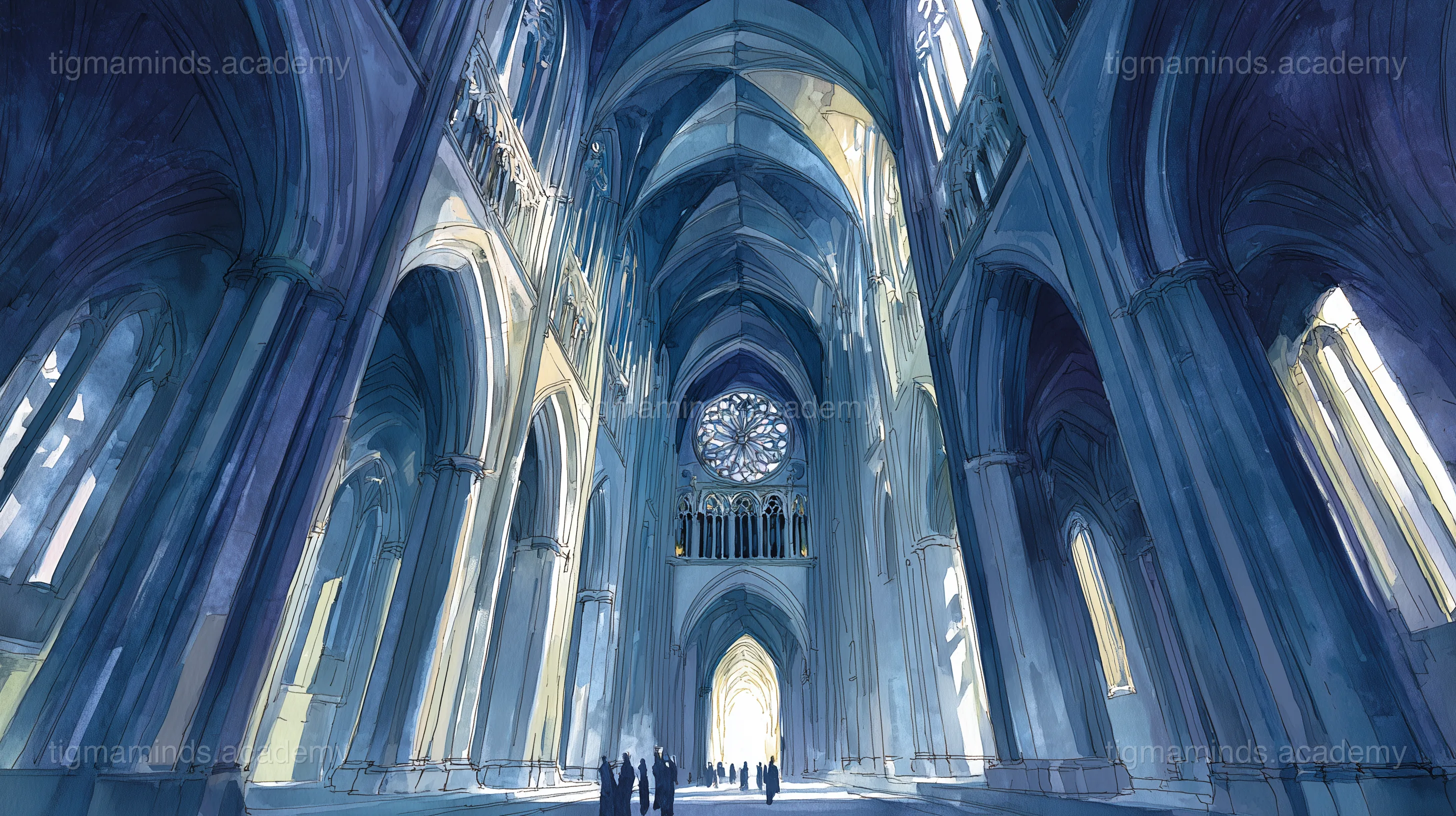
Flying buttresses, pointed arches, and the structural engineering that made stone walls dissolve into light.
The Problem of Light
For a thousand years, churches in Europe were dark. The Romanesque style that dominated from the 6th to the 12th century relied on thick stone walls and small windows. The walls had to be thick because they were load-bearing — they supported the entire weight of the stone roof above. Making the windows larger would weaken the walls. So churches were dim, heavy, and cave-like.
Then, around 1140, Abbot Suger of the abbey of Saint-Denis near Paris had a theological insight that became an engineering revolution. Suger believed that light was divine — that God was literally present in light, and that a church filled with light was closer to heaven than a church filled with shadow.
He wanted to build a church where the walls were mostly glass. The stonemasons told him it was impossible. You can't make a wall out of glass and have it hold up a stone roof. The physics doesn't work.
Suger's response was to hire engineers who would change the physics.
The Three Innovations
The Gothic revolution rested on three structural innovations, each of which solved a specific problem:
1. The pointed arch. A Romanesque round arch distributes its weight downward and outward — it pushes sideways against the walls, which is why Romanesque walls had to be so thick. A pointed arch (two arcs meeting at a peak) directs more of the weight straight down, reducing the outward thrust. This meant the walls below could be thinner.
The pointed arch also solved a geometric problem. In a round arch, the height is fixed by the span — a wider arch must be taller. But a pointed arch can be any height at any span, by adjusting the angle of the point. This allowed builders to create arches of different widths that all reached the same height — essential for creating a uniform ceiling over a rectangular floor plan.
2. The ribbed vault. Instead of a solid stone ceiling (barrel vault), Gothic builders created a skeleton of stone ribs — arched beams that crossed the ceiling diagonally. The spaces between the ribs were filled with thin stone panels (webbing) that bore almost no weight. The ribs carried all the load and channeled it down to specific support points (columns), rather than spreading it evenly along the walls.
This was the critical insight: concentrate the forces at specific points, then deal with those points, rather than trying to support the load everywhere at once.
3. The flying buttress. With the ribs channelling the roof's weight to specific columns, the walls between those columns were no longer load-bearing. They could be removed entirely and replaced with glass. But the columns still experienced outward thrust from the arches — they wanted to topple outward.
The flying buttress was an external stone arm that reached from a heavy pier (a thick support column outside the building) up to the point on the interior column where the thrust was greatest. It transferred the outward force away from the thin wall and down into the massive pier, which was heavy enough to resist it.
The result was a building where the walls seemed to disappear. Notre-Dame de Paris, Chartres Cathedral, Sainte-Chapelle — these buildings are more glass than stone. Sainte-Chapelle's upper chapel is essentially a glass box held up by slender stone ribs and external buttresses. Standing inside it on a sunny day is like standing inside a jewel.
The Mathematics of Force
Every Gothic cathedral is a solution to a force-balance problem. The weight of the stone vault pushes down (gravity) and out (arch thrust). The buttresses push inward and down. The columns resist compression. The foundations spread the load over the ground.
The master builders didn't know the word "vector" or "moment of force." But they understood the principles intuitively — and they tested them empirically. We know this because some cathedrals collapsed during construction. The choir vault of Beauvais Cathedral — the tallest Gothic vault ever attempted, at 48 metres — collapsed in 1284, twelve years after completion. The builders had pushed the limits of stone too far. The outward thrust exceeded what the buttresses could handle.
Beauvais was never completed. Its partial ruin stands today as a reminder that engineering has limits, and that the courage to push those limits must be matched by the humility to understand them.
The Sound of Stone
Gothic cathedrals were designed not just for light but for sound. The tall, narrow nave creates a natural reverberation chamber — sound bounces off the hard stone surfaces and takes 4-8 seconds to decay (compared to 1-2 seconds in a modern room). This long reverberation is what gives Gregorian chant its distinctive ethereal quality — each note blends into the next, creating a continuous wash of harmony.
The cathedral builders didn't know the term "reverberation time" (that was calculated by Wallace Sabine in 1895). But they knew, from centuries of experience, that tall narrow spaces with hard surfaces made music sound heavenly. They designed the architecture to serve the sound as much as the structure.
What They Built
Between 1140 and 1300, more than 80 Gothic cathedrals were built in France alone. The construction of a single cathedral typically took 100-200 years — meaning that the workers who laid the foundation would never see the finished building. Their grandchildren might not see it either.
This is perhaps the most remarkable thing about the Gothic cathedrals: they were built by people who knew they would never use them. They were acts of multigenerational engineering — projects that required each generation to trust that the next would continue the work, maintain the standards, and complete what had been started.
In an age of quarterly earnings reports and two-year product cycles, the cathedrals remind us what humans can build when they think in centuries.
The end.
Choose your level. Everyone starts with the story — the code gets deeper as you go.
Here is a taste of what Level 1 looks like for this lesson:
import numpy as np
import matplotlib.pyplot as plt
# Your first data analysis with Python
data = [45, 52, 38, 67, 41, 55, 48] # measurements
mean = np.mean(data)
plt.bar(range(len(data)), data)
plt.axhline(mean, color='red', linestyle='--', label=f'Mean: {mean:.1f}')
plt.xlabel("Sample")
plt.ylabel("Value")
plt.title("Structural Engineering & Acoustics — Sample Data")
plt.legend()
plt.show()This is just the first of 6 coding exercises in Level 1. By Level 4, you will build: Build a Cathedral Force Simulator.
Free
Level 0: Listener
Stories, science concepts, diagrams, quizzes. No coding.
You are here
Level 0 is always free. Coding levels (1-4) are part of our 12-Month Curriculum.
The physics of Gothic cathedrals — force vectors, arch geometry, flying buttresses, and the acoustics of reverberant spaces.
The big idea: "The Gothic Cathedrals" teaches us about Structural Engineering & Acoustics — and you don't need to write a single line of code to understand it.
Stone is strong in compression (you can stack enormous weight on it) but weak in tension (it cracks easily if you try to stretch it). This is a fundamental problem for builders: how do you span a gap — a doorway, a window, a river — using a material that can't handle stretching?
A flat stone beam (lintel) spanning a gap bends under its own weight and any load placed on it. The bottom surface stretches (tension) while the top compresses. Since stone fails in tension, the lintel cracks at the bottom. This limits stone lintels to short spans — about 2-3 metres before they break.
An arch solves this elegantly. An arch is made of wedge-shaped stones (voussoirs) that lean against each other. Each stone is in compression only — squeezed between its neighbours. No stone is being stretched. The forces flow through the arch in a smooth curve from the top (keystone) to the base (springing points), always in compression.
This is why ancient arches are still standing after 2,000 years (think of Roman bridges), while flat stone beams crack and fail. The arch converts the problem from tension (which stone can't handle) to compression (which stone handles brilliantly).
Try this: Stack books in an arch shape over a gap between two tables. Each book leans against its neighbours. The stack holds itself up — no glue, no nails. Now try laying a single book flat across the gap and stacking weight on it. It bends and falls. You've just demonstrated why arches work and flat beams don't.
Key idea: Stone is strong in compression but weak in tension. A flat beam bends and cracks because the bottom is stretched. An arch keeps every stone in compression — the forces flow through the curve, never creating tension. This is why arches can span much larger gaps than flat beams.
A round arch (Roman style) is a perfect semicircle. It's strong, but it has two limitations. First, the width determines the height — a wider arch must be taller, because it's always a half-circle. This makes it hard to create arches of different widths that reach the same height (which you need for a uniform ceiling over a rectangular room).
Second, a round arch pushes outward as well as downward. The curve of the semicircle directs forces at roughly 45° — half downward, half sideways. These sideways forces (thrust) push the walls apart. To resist this thrust, the walls must be thick and massive — which means small windows and dark interiors.
The pointed arch (Gothic style) solves both problems. By adjusting the angle of the point, you can create arches of any height at any width — a narrow arch and a wide arch can reach the same peak. And the steeper curves direct more force straight downward, reducing the outward thrust by as much as 50%.
Less outward thrust meant the walls could be thinner. Thinner walls could have larger windows. Larger windows meant more light. This single geometric change — from round to pointed — is what transformed dark Romanesque churches into the luminous glass palaces of Notre-Dame and Chartres.
Check yourself: If you push straight down on a table, it holds. If you push at a 45° angle, the table slides. Which push is easier to resist? (Straight down — the floor prevents downward motion. The angled push has a sideways component that must be resisted by friction or a wall. Same principle: pointed arches push more straight down.)
Key idea: Round arches push heavily sideways, requiring thick walls. Pointed arches direct more force straight down, reducing outward thrust by up to 50%. This allowed thinner walls, bigger windows, and the flood of light that defines Gothic architecture.
Access all 130+ lessons, quizzes, interactive tools, and offline activities
Even with pointed arches, some outward thrust remains. The vault pushes outward on the columns, and the columns want to topple. In a Romanesque church...
Clap your hands in a small, carpeted room. The sound stops almost instantly — the carpet, curtains, and furniture **absorb** the sound waves. Now clap...