Persian Ice Houses
Thermodynamics & Passive Cooling

Persian Ice Houses

Making and storing ice in the desert — thermodynamics, evaporative cooling, and architecture as engineering.

Thermodynamics & Passive Cooling12-Month Curriculum 12h

The Story

Ice in the Desert

In the summer of 400 BCE, in the city of Isfahan, in the heart of the Persian Empire, a merchant poured his guest a glass of cold water with ice. The temperature outside was 42°C. There was no electricity, no refrigerant gas, no freezer. The nearest mountain snow was 200 kilometres away.

The ice had been made here, in the desert, using nothing but water, wind, and the night sky.

This was not magic. It was thermodynamics — understood intuitively by Persian engineers two thousand years before the science was named.

The Yakhchāl

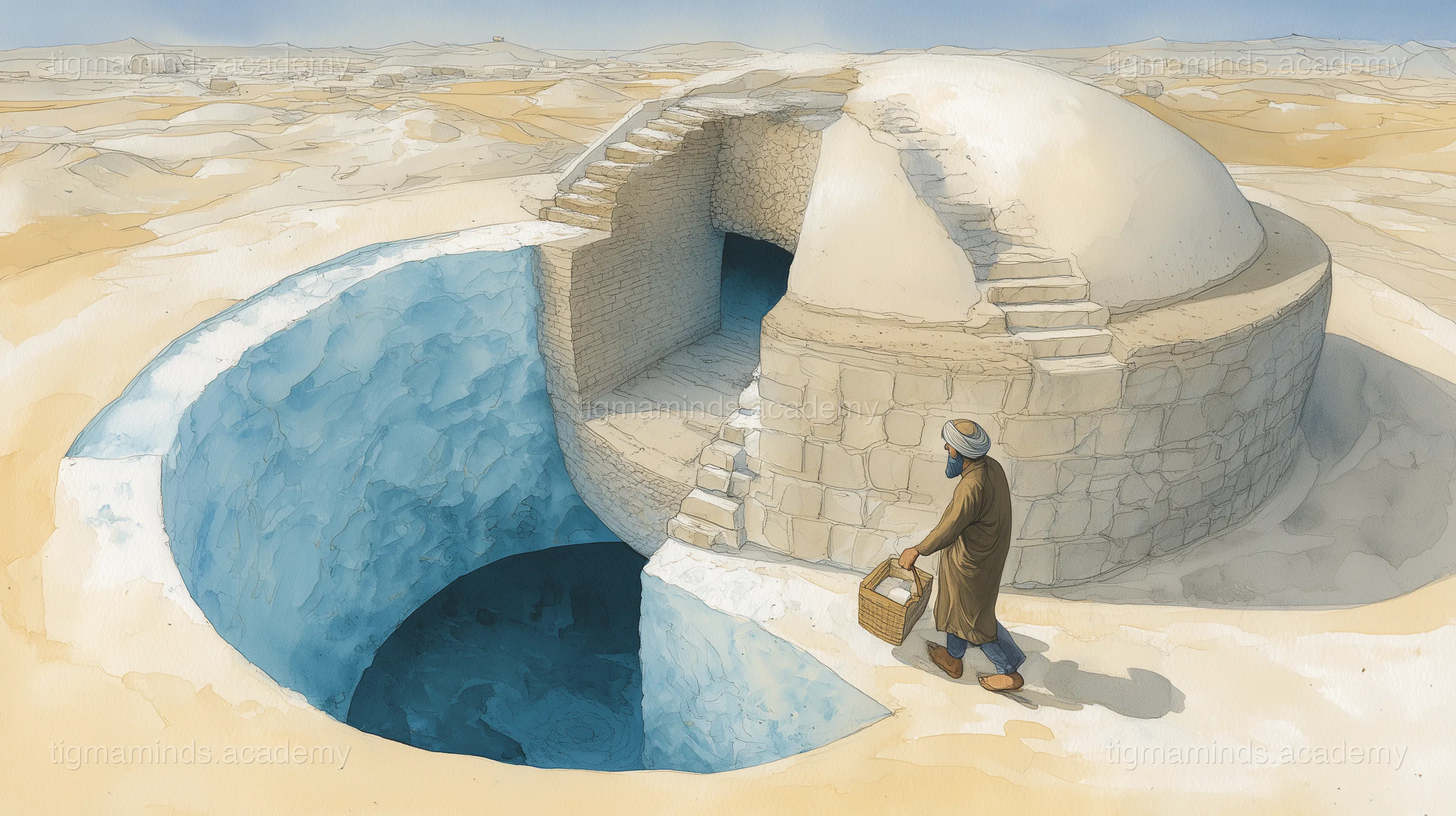
The structure that stored the ice was called a yakhchāl — literally "ice pit" in Persian. From the outside, it looked like a giant mud-brick dome, sometimes 18 metres tall and 15 metres in diameter. Below ground, a storage chamber extended 5 metres deep, insulated from the desert heat by walls up to 2 metres thick.

The walls were built from sārooj — a mortar made from sand, clay, egg whites, lime, goat hair, and ash, mixed in specific proportions. This composite material was waterproof, insect-resistant, and had remarkably low thermal conductivity — it conducted heat far more slowly than ordinary brick or stone. A wall of sārooj 2 metres thick could maintain the interior at near-freezing temperatures while the exterior baked at 40°C.

But the yakhchāl was only the storage. The real engineering marvel was how the ice was made.

Making Ice Without a Freezer

In the Iranian plateau, winter nights are cold — temperatures can drop to -5°C even in desert regions. But the Persians didn't simply wait for water to freeze on a cold night. That would produce a thin, fragile layer of ice that melted quickly.

Instead, they built shallow canals — long, narrow channels 30-50 centimetres deep and sometimes hundreds of metres long — fed by qanats (underground aqueducts). At night, the water in these canals was exposed to the clear desert sky.

Here is where the physics gets beautiful. A clear night sky has an effective radiative temperature of approximately -40°C to -60°C. This is because the atmosphere is largely transparent to infrared radiation in the 8-13 micrometre wavelength band — the so-called atmospheric window. Water in the canal radiates heat directly into the cold of space, bypassing the relatively warm air above it.

This is radiative cooling — the same process that causes frost to form on grass on clear nights even when the air temperature is above freezing. The water loses heat by radiation faster than it gains heat from the air, and its temperature drops below the air temperature — sometimes by 5-8°C.

On a night when the air temperature is -2°C, radiative cooling can drop the water temperature to -8°C — well below freezing. The water freezes from the surface down, forming sheets of ice 5-10 centimetres thick by morning.

The Shade Wall

To enhance the cooling, the Persians built tall walls on the south side of the ice-making canals. These walls, oriented east-west, did two things: they blocked sunlight from warming the canals during the early morning (when the ice was most fragile), and they blocked warm southerly winds that would transfer heat to the water surface.

The wall is a deceptively sophisticated piece of engineering. Its height, length, and orientation were calculated to maximise the duration of shade on the canal — keeping the water in shadow from sunrise until the ice was thick enough to harvest.

Evaporative Cooling

The yakhchāl dome had one more trick: wind catchers — vertical towers with openings at the top that caught prevailing breezes and channelled them down into the ice storage chamber.

But the air wasn't just moved — it was cooled. At the base of the wind catcher, water trickled over porous surfaces. As the breeze passed over this wet surface, the water evaporated, absorbing heat from the air. This is evaporative cooling — the same principle that makes you feel cold when you step out of a swimming pool.

The amount of cooling is determined by the wet-bulb temperature — the lowest temperature achievable through evaporation at a given humidity. In the dry Iranian climate (relative humidity often below 20%), evaporative cooling can reduce air temperature by 10-15°C. Hot, dry desert air at 40°C could be cooled to 25-28°C before it entered the ice chamber — cold enough to slow the melting of the stored ice dramatically.

The Qanat Connection

The water for ice-making came from qanats — underground aqueducts that tapped groundwater from mountain aquifers and carried it, by gravity, through gently sloping tunnels to cities and farms on the plains. Some qanats are 70 kilometres long and reach depths of 200 metres.

The qanat water was naturally cold — groundwater temperature is approximately equal to the annual average air temperature of the region, typically 15-20°C. This cold water served double duty: it was the raw material for ice-making, and it provided passive cooling for buildings through a system of underground channels and cisterns.

The entire system — qanat, ice canal, shade wall, yakhchāl, wind catcher — was a masterpiece of passive thermal engineering. No moving parts (except wind). No fuel. No electricity. Just a deep understanding of how heat moves — by radiation, conduction, convection, and evaporation — and how to manipulate each pathway to move heat away from where you don't want it.

The Legacy

Yakhchāls were used in Iran from at least 400 BCE until the early 20th century — roughly 2,300 years of continuous operation. Some are still standing, their domes visible from kilometres away across the flat desert landscape.

Today, with air conditioning consuming 10% of global electricity and refrigerants like HFCs contributing to climate change, engineers are looking back at passive cooling techniques with renewed interest. The principles behind the yakhchāl — radiative cooling, evaporative cooling, thermal mass, and intelligent orientation — are being incorporated into modern net-zero buildings and off-grid cooling systems for developing countries.

The Persians solved a problem we're still working on: how to stay cool without burning the planet.

The end.

Try It Yourself

Choose your level. Everyone starts with the story — the code gets deeper as you go.

Story Progress

0%

Ready to Start Coding?

Here is a taste of what Level 1 looks like for this lesson:

Level 1: Explorer — Python
import numpy as np
import matplotlib.pyplot as plt

# Your first data analysis with Python
data = [45, 52, 38, 67, 41, 55, 48]  # measurements
mean = np.mean(data)

plt.bar(range(len(data)), data)
plt.axhline(mean, color='red', linestyle='--', label=f'Mean: {mean:.1f}')
plt.xlabel("Sample")
plt.ylabel("Value")
plt.title("Thermodynamics & Passive Cooling — Sample Data")
plt.legend()
plt.show()

This is just the first of 6 coding exercises in Level 1. By Level 4, you will build: Build a Passive Cooling Simulator.

Free

Level 0: Listener

Stories, science concepts, diagrams, quizzes. No coding.

You are here

Enrolled

Levels 1-4

Python, NumPy, Matplotlib, real projects, mentorship.

Sign Up Free

Stay Updated

Join Waitlist

Get notified when enrollment opens for your area.

Notify Me

Level 0 is always free. Coding levels (1-4) are part of our 12-Month Curriculum.