Mayan Astronomy
Astronomy & Calendar Mathematics

Mayan Astronomy

The most precise astronomical observations in the ancient world — eclipse prediction, the Venus cycle, and a calendar more accurate than Europe's.

Astronomy & Calendar Mathematics12-Month Curriculum 12h

The Story

The Observatory

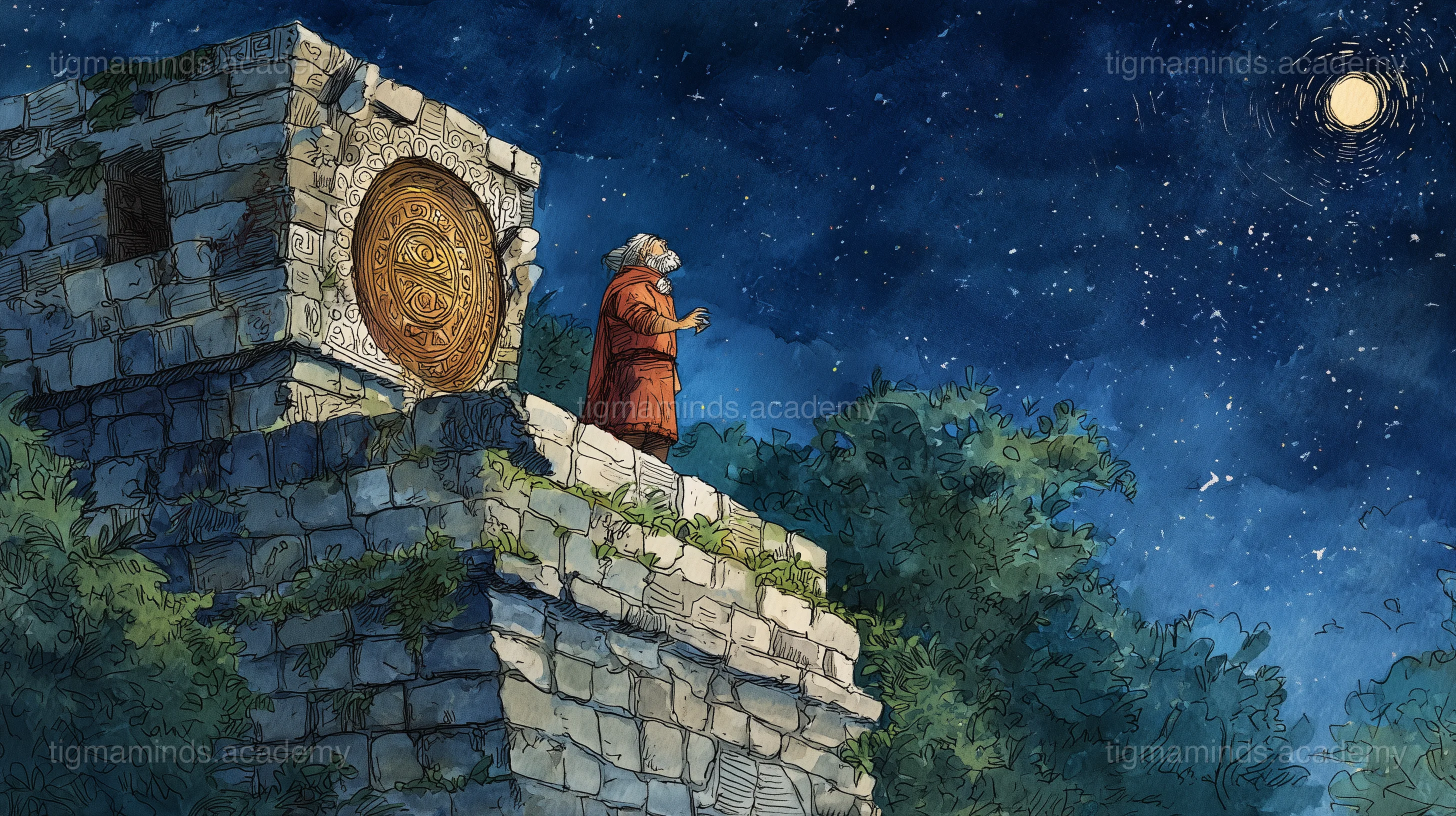
In the city of Chichén Itzá, on the Yucatán Peninsula of Mexico, there stands a round tower called El Caracol — "The Snail" — named for the spiral staircase inside it. Built around 900 CE, it is one of the few circular buildings in Maya architecture, and it looks nothing like the pyramids and temples that surround it.

El Caracol was an astronomical observatory. Its windows are aligned not with the cardinal directions but with specific points on the horizon where Venus rises and sets at its extreme positions — the northernmost and southernmost points it reaches during its 584-day cycle. Other windows align with the solstice sunrise and the equinox sunset.

The Maya were not stargazers in the romantic sense. They were precision astronomers — rigorous, mathematical, obsessed with accuracy. They tracked the movements of the Sun, Moon, Venus, Mars, and Jupiter with a precision that, in some cases, exceeded European astronomy of the same era by a factor of ten.

And they did it without telescopes — using only naked-eye observation, crossed sticks for sighting, and a number system that was, in one crucial respect, more advanced than anything in Europe.

The Zero

The Maya independently invented the concept of zero — a mathematical placeholder that represents "nothing" in a positional number system. They did this by approximately 36 BCE, at least 600 years before the concept appeared in Indian mathematics (which is the source of our modern zero).

The Maya number system was vigesimal — base-20, compared to our base-10. They represented numbers using three symbols: a dot for 1, a bar for 5, and a shell for 0. Numbers were written vertically, with the lowest place value at the bottom.

The zero was essential for their astronomical calculations. Without a placeholder, you cannot distinguish between 20 and 200 or between 1 and 100. The Maya needed this precision because their astronomical tables — inscribed in bark-paper books called codices — tracked planetary positions over thousands of years. A single arithmetic error would compound across centuries, destroying the prediction's accuracy.

The Venus Table

The most spectacular achievement of Maya astronomy is the Venus Table in the Dresden Codex — one of only four surviving Maya manuscripts.

Venus has a synodic period of 583.92 days — the time between successive appearances as the "evening star." The Maya calculated this period as 584 days — an error of just 0.08 days, or about two hours over a 584-day cycle. Over the 104-year span of their Venus table, the accumulated error is less than one day.

For comparison, the European value for Venus's synodic period, as late as the 16th century, was less accurate than the Maya calculation made six hundred years earlier.

The Venus table doesn't just track Venus's position — it predicts specific events: the first appearance of Venus as an evening star, its disappearance into the Sun's glare, its reappearance as a morning star, and its final disappearance before the cycle repeats. Each prediction includes a correction factor to keep the table accurate over centuries — the Maya astronomers knew their 584-day value was an approximation and built in periodic adjustments of exactly the right magnitude.

Eclipse Prediction

The Dresden Codex also contains an eclipse table that spans 405 lunations (about 33 years). The table lists dates on which solar eclipses are possible — not when they will definitely occur (because solar eclipses are only visible from specific locations), but the dates when the Sun and Moon are in the right alignment for an eclipse to happen somewhere on Earth.

The Maya eclipse table is based on the eclipse cycle of 11,960 days (approximately 32.75 years), which is the period after which eclipse patterns repeat. This is close to — but not identical with — the Saros cycle of 6,585.3 days used by Babylonian and Greek astronomers. The Maya cycle is actually more convenient for long-term prediction because it is a near-perfect multiple of both the synodic month (29.53 days) and the eclipse year (346.62 days).

The Calendar

The Maya used multiple interlocking calendars:

The Tzolkin (260 days) — a ritual calendar combining 13 numbers with 20 day-names. Its origin may be astronomical (close to the human gestation period of 266 days and to the interval between zenith passages of the Sun at Maya latitudes) or agricultural (close to the growing season for maize).

The Haab (365 days) — a solar calendar of 18 months of 20 days plus 5 unlucky days. The Maya knew the solar year was actually closer to 365.2420 days — their value, implied by their calendar corrections, is accurate to within 0.0002 days of the modern measurement (365.2422 days). The Gregorian calendar, introduced in 1582, uses the value 365.2425 — less accurate than the Maya value calculated centuries earlier.

The Long Count — a linear count of days from a mythological starting point (August 11, 3114 BCE in our calendar), used for historical dating. It was this calendar that gave rise to the "2012 apocalypse" myth — the Long Count completed a cycle of approximately 5,125 years on December 21, 2012. The Maya never predicted the world would end; they simply started a new count, the way our calendar starts a new year on January 1.

What the Maya Teach Us

The Maya astronomical achievement is remarkable not for any single observation but for the systematic, multigenerational program that produced it. Individual observers made careful measurements. Scribes recorded them in codices. Mathematicians analyzed the data, found patterns, and built predictive models. Errors were identified and corrected over centuries.

This is the scientific method — observation, recording, analysis, prediction, verification — practiced consistently for a thousand years, without any of the instruments (telescopes, clocks, mathematical notation) that European scientists would later rely on.

The Maya prove that science is not a product of technology. It is a product of discipline — the willingness to observe carefully, record honestly, and test your predictions against reality, generation after generation.

The end.

Try It Yourself

Choose your level. Everyone starts with the story — the code gets deeper as you go.

Story Progress

0%

Ready to Start Coding?

Here is a taste of what Level 1 looks like for this lesson:

Level 1: Explorer — Python
import numpy as np
import matplotlib.pyplot as plt

# Your first data analysis with Python
data = [45, 52, 38, 67, 41, 55, 48]  # measurements
mean = np.mean(data)

plt.bar(range(len(data)), data)
plt.axhline(mean, color='red', linestyle='--', label=f'Mean: {mean:.1f}')
plt.xlabel("Sample")
plt.ylabel("Value")
plt.title("Astronomy & Calendar Mathematics — Sample Data")
plt.legend()
plt.show()

This is just the first of 6 coding exercises in Level 1. By Level 4, you will build: Build a Maya Astronomy Calculator.

Free

Level 0: Listener

Stories, science concepts, diagrams, quizzes. No coding.

You are here

Enrolled

Levels 1-4

Python, NumPy, Matplotlib, real projects, mentorship.

Sign Up Free

Stay Updated

Join Waitlist

Get notified when enrollment opens for your area.

Notify Me

Level 0 is always free. Coding levels (1-4) are part of our 12-Month Curriculum.