
Gravity, gradient, and the engineering that brought water to a million people.
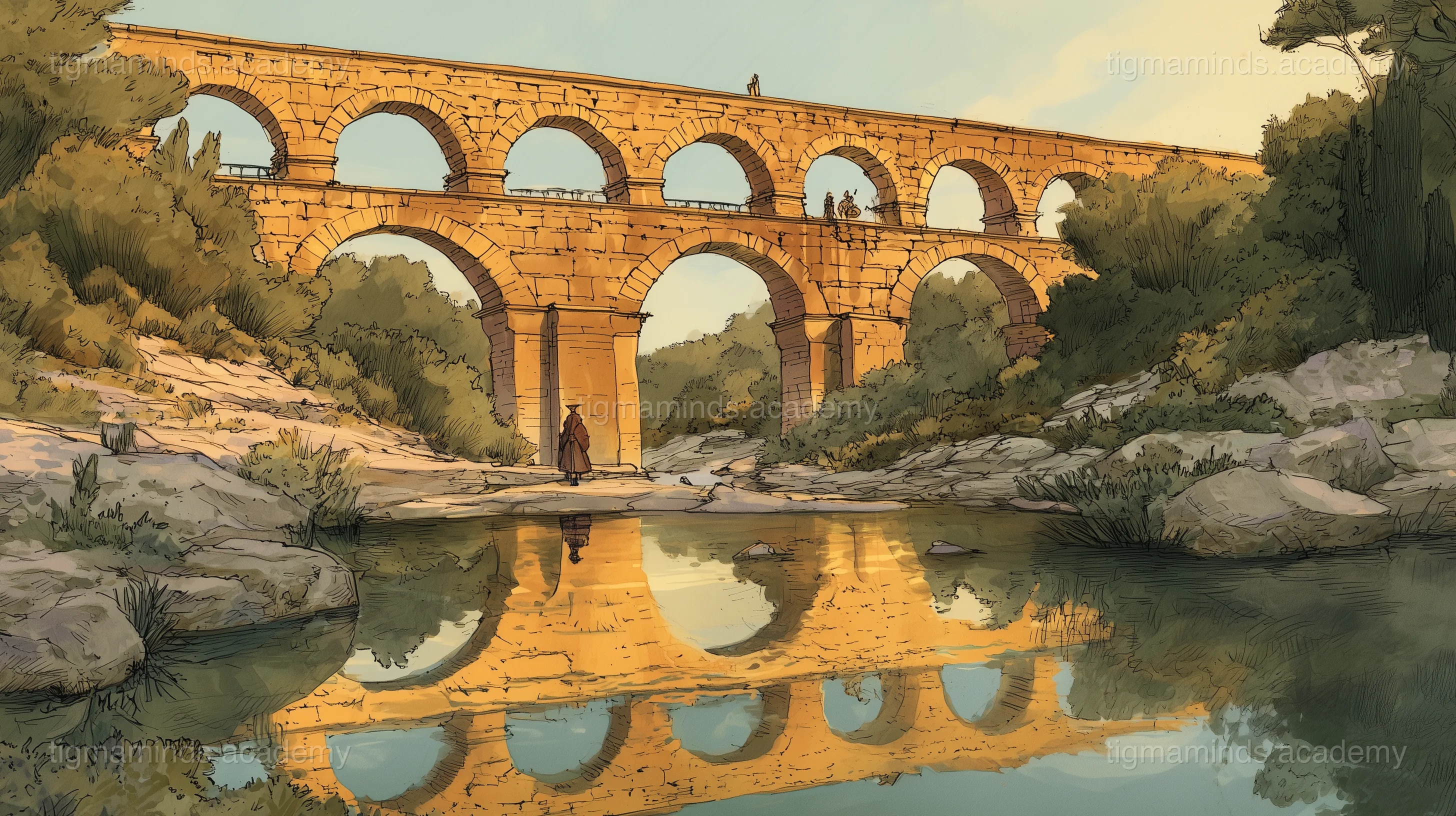
A City That Drinks
By the first century CE, Rome had a problem that no city had ever faced before: it had one million inhabitants. No city in human history had reached this size. And every one of those million people needed water — to drink, to bathe, to flush the sewers, to supply the public fountains, and to fill the ornamental pools of the wealthy.
The River Tiber flowed through Rome, but its water was muddy, polluted, and increasingly insufficient. The springs within the city walls had been tapped out centuries ago. Rome needed water from elsewhere — from the clean mountain springs in the hills surrounding the city, some as far as 90 kilometres away.
The solution was the aqueduct — one of the most remarkable engineering achievements in human history. Over five centuries, the Romans built 11 major aqueducts that delivered a combined one million cubic metres of water per day to the city. That's roughly 1,000 litres per person per day — more water per capita than most modern cities provide.
And they did it using nothing but gravity.
The Gradient
An aqueduct is, at its most basic, a channel that carries water downhill from a source to a city. The genius is in the gradient — the slope of the channel.
The Romans understood that water flows downhill, and that the speed of flow depends on how steep the hill is. Too steep, and the water rushes too fast, eroding the channel. Too gentle, and the water barely moves, allowing silt to accumulate and block the flow. The ideal gradient for an aqueduct is approximately 1 metre of drop per 1,000 metres of length — a slope of 0.1%.
This means that for the Aqua Marcia — Rome's longest aqueduct at 91 kilometres — the total drop from source to city was only about 90 metres. The water took roughly 24 hours to travel the full length, flowing at a gentle walking pace.
Achieving this precise gradient over 91 kilometres of varied terrain — across valleys, around hills, through mountains — required surveying skills of extraordinary accuracy. The Romans used a tool called the chorobates — a 6-metre-long wooden bench with plumb lines at each end and a water-filled groove along the top for checking level. By sighting along this instrument, Roman surveyors could establish a gradient accurate to within a few centimetres per kilometre.
Arches and Siphons
The most iconic image of Roman aqueducts is the multi-tiered stone arch bridge — like the Pont du Gard in southern France, which carried water 50 metres above the Gardon River valley on three levels of arches.
But these grand bridges were the exception, not the rule. Most of the aqueduct's length ran underground, in covered channels cut through rock or laid in trenches. Only about 5% of the typical aqueduct was carried on arched bridges — only where the terrain dipped so low that a tunnel or trench couldn't maintain the gradient.
Where a valley was too deep for a bridge, the Romans used an inverted siphon — a U-shaped pipe that carried water down one side of the valley and up the other. The water was driven upward by the pressure of the water column behind it, following the principle that water in a U-tube will rise to the same level on both sides (Pascal's principle, though Pascal wouldn't be born for 1,600 years).
The siphon pipes were made of lead — the Latin word for lead, plumbum, is where we get the word "plumbing." These lead pipes could withstand pressures of several atmospheres, enough to push water up the far side of a valley that might be 30 or 40 metres deep.
The Distribution System
When the water reached Rome, it entered a castellum divisorium — a distribution tank at the edge of the city. From there, it was divided into three channels: one for public fountains, one for public baths, and one for private subscribers (wealthy households that paid for a direct water connection).
The public fountains were the backbone of the system. Rome had over 1,300 public fountains, placed so that no citizen had to walk more than 80 metres to reach fresh water. The fountains ran continuously — there were no taps. Water flowed day and night, and the overflow fed the sewers, flushing waste into the Tiber.
This continuous flow was not wasteful — it was deliberate engineering. The constant movement prevented stagnation (which breeds mosquitoes and bacteria), kept the channels clear of sediment, and maintained water pressure throughout the system.
Frontinus and the Science of Flow
In 97 CE, the Emperor Nerva appointed Sextus Julius Frontinus as the water commissioner of Rome — essentially the head of the city's water department. Frontinus was an engineer, a soldier, and a meticulous record-keeper. He wrote De Aquaeductu Urbis Romae — "On the Aqueducts of the City of Rome" — the most detailed technical manual to survive from the ancient world.
Frontinus measured the flow rate of each aqueduct by measuring the cross-sectional area of the water in the channel and its velocity. He discovered that the aqueducts were delivering more water than was being officially distributed — the difference was being stolen by illegal taps. He estimated that 40% of Rome's water supply was being diverted by unauthorized connections, many of them installed by the very workers who maintained the aqueducts.
Frontinus's work represents one of the earliest examples of systems engineering — analyzing a complex infrastructure system, measuring its performance, identifying inefficiencies, and implementing reforms. His methods — flow measurement, audit, standardization of pipe sizes — are still used by water engineers today.
The Legacy
The Roman aqueducts operated for over 500 years. Some continued to function, with repairs, into the medieval period. The Aqua Virgo, built in 19 BCE, was restored in the Renaissance and still feeds the Trevi Fountain in Rome today — delivering the same mountain spring water through essentially the same channel, more than two thousand years after it was built.
When the aqueducts stopped working — when the Goths cut them during the sieges of the 6th century — Rome's population collapsed from one million to fewer than 30,000. The city couldn't survive without its water.
This is the lesson of the aqueducts: civilization is infrastructure. The poetry, the philosophy, the law, the art — all of it depended on the unglamorous fact that someone had figured out how to move water downhill at a gradient of one metre per kilometre, across ninety kilometres of mountains and valleys, and deliver it to a fountain within eighty metres of every citizen's home.
The end.
Choose your level. Everyone starts with the story — the code gets deeper as you go.
Here is a taste of what Level 1 looks like for this lesson:
import numpy as np
import matplotlib.pyplot as plt
# Your first data analysis with Python
data = [45, 52, 38, 67, 41, 55, 48] # measurements
mean = np.mean(data)
plt.bar(range(len(data)), data)
plt.axhline(mean, color='red', linestyle='--', label=f'Mean: {mean:.1f}')
plt.xlabel("Sample")
plt.ylabel("Value")
plt.title("Hydraulic Engineering & Fluid Flow — Sample Data")
plt.legend()
plt.show()This is just the first of 6 coding exercises in Level 1. By Level 4, you will build: Build an Aqueduct Flow Simulator.
Free
Level 0: Listener
Stories, science concepts, diagrams, quizzes. No coding.
You are here
Level 0 is always free. Coding levels (1-4) are part of our 12-Month Curriculum.
How gravity and gradient moved a million cubic metres of water per day — flow dynamics, pressure, and infrastructure design.
The big idea: "The Roman Aqueducts" teaches us about Hydraulic Engineering & Fluid Flow — and you don't need to write a single line of code to understand it.
Put a ball at the top of a slope. What happens? It rolls downhill. You didn't push it, no motor turned on, no battery was needed. Gravity pulled it from high to low — and it will do this forever, for free.
Water does the same thing. It flows downhill, always seeking the lowest point. The Roman aqueducts exploited this simple fact to deliver water from mountain springs to a city 90 kilometres away. The entire system — serving one million people — ran on nothing but gravity pulling water downhill.
The key is the gradient — how steep the downhill slope is. Too steep and the water rushes destructively. Too gentle and the water barely moves, allowing silt to clog the channel. The Roman engineers found the sweet spot: about 1 metre of drop per 1,000 metres of length — a 0.1% slope. So gentle you couldn't see it with the naked eye, but enough to keep the water flowing at a walking pace.
At this gradient, water in the Aqua Marcia (Rome's longest aqueduct at 91 km) took about 24 hours to travel from the mountain spring to the city. Patient, steady, unstoppable — powered by gravity alone.
Check yourself: Your kitchen tap works on the same principle. Where is the water tank or reservoir relative to your house? (Usually on a hill or elevated tower above the neighbourhood — gravity pushes the water down through the pipes to your tap.)
Key idea: Water flows downhill by gravity — no pumps needed. The Roman aqueducts used a precisely controlled gradient of about 0.1% (1 metre drop per 1,000 metres) to deliver water over 90 km. The energy source was free and inexhaustible: the height difference between the mountain spring and the city.
Fill a U-shaped tube with water. The water level is the same on both sides — it doesn't matter how wide, narrow, or oddly shaped the tube is. Water in connected vessels always seeks the same level. This is Pascal's principle.
The Romans used this to cross valleys. When the aqueduct channel reached a deep valley, they couldn't build an arch bridge high enough (some valleys were 50 metres deep). Instead, they ran a sealed pipe down one side of the valley and up the other. The water descending on one side built up pressure at the bottom, which pushed the water up the other side to (almost) the same height.
This is called an inverted siphon — and it seems like magic. Water going uphill! But it's not defying gravity. The weight of the water on the descending side pushes down, creating pressure at the bottom that drives the water up the ascending side. The water ends up slightly lower on the far side (because of friction losses in the pipe), but it crosses the valley without a bridge.
The pipes were made of lead (Latin: plumbum — the origin of the word "plumbing"). Lead was soft enough to bend into shape, waterproof, and strong enough to handle the pressures — several atmospheres at the bottom of a deep valley.
Try this: Get a clear flexible tube (aquarium tubing works well). Fill it with water, hold both ends up, and form a U shape. The water level is the same on both sides. Now raise one end higher — water flows from the high side to the low side until the levels match again. This is how a siphon works.
Key idea: Water in connected vessels seeks the same level (Pascal's principle). The Romans used inverted siphons — sealed pipes running down one valley wall and up the other — to cross valleys without bridges. The pressure from the descending column pushes water up the far side.
Access all 130+ lessons, quizzes, interactive tools, and offline activities
When the water reached Rome, it flowed into a **castellum divisorium** — a distribution tank that split the flow into three channels: one for public f...