
Nuclear physics, chain reactions, and the science that changed the meaning of power.
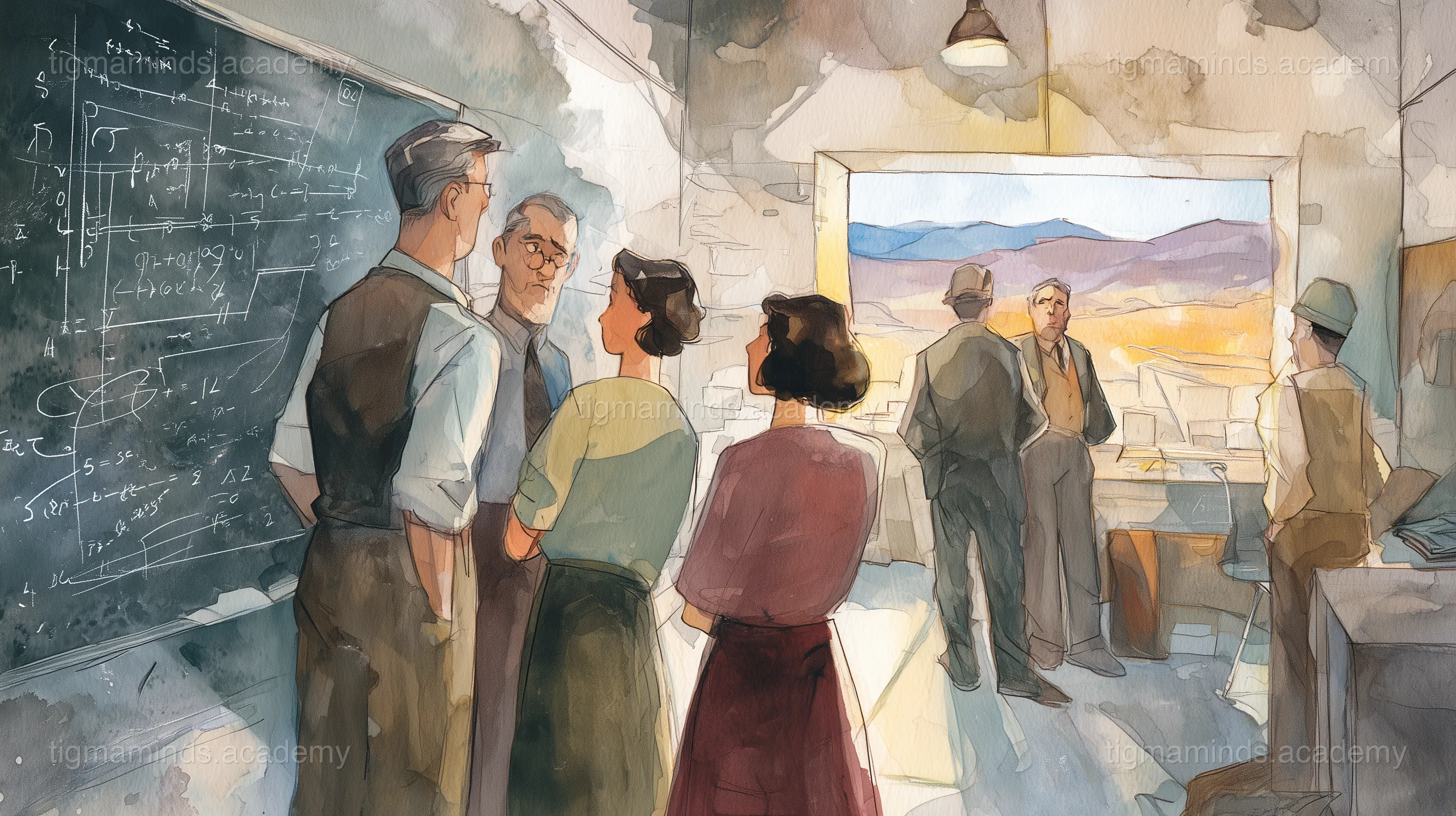
The Letter
On August 2, 1939, Albert Einstein signed a letter to President Franklin D. Roosevelt. The letter, drafted by physicist Leo Szilard, warned that recent advances in nuclear physics made it possible to build a weapon of unprecedented destructive power — and that Nazi Germany might already be working on one.
"A single bomb of this type," the letter said, "carried by boat and exploded in a port, might very well destroy the whole port together with some of the surrounding territory."
Einstein later called signing this letter "the one great mistake" of his life. But in 1939, the threat seemed real. German physicists had discovered nuclear fission just months earlier. The race was on.
Fission
In December 1938, German chemists Otto Hahn and Fritz Strassmann had bombarded uranium atoms with neutrons and found something impossible: barium. Barium has an atomic number of 56. Uranium has an atomic number of 92. Where had the barium come from?
The answer, worked out by physicists Lise Meitner and Otto Frisch over Christmas 1938, was that the uranium nucleus had split in half. A neutron had struck the uranium-235 nucleus, made it unstable, and it had divided into two smaller nuclei — barium and krypton — releasing a burst of energy and two or three additional neutrons.
This was nuclear fission.
The energy released was enormous. When a uranium-235 nucleus fissions, it converts about 0.1% of its mass into energy, according to Einstein's equation E = mc². That 0.1% doesn't sound like much, but because c² is such an enormous number (the speed of light squared: 9 × 10¹⁶ m²/s²), the energy from fissioning a single kilogram of uranium-235 equals the energy from burning 3,000 tonnes of coal.
But fission alone isn't a weapon. A single fission event releases energy equivalent to about 200 million electron volts — powerful at the atomic scale, but invisible to the human eye. What makes a bomb possible is the chain reaction.
The Chain Reaction
When a uranium-235 nucleus fissions, it releases 2-3 neutrons. Each of those neutrons can strike another uranium-235 nucleus, causing it to fission and release 2-3 more neutrons. Each of those neutrons can cause another fission. And so on.
In mathematical terms, this is exponential growth: 1 → 3 → 9 → 27 → 81 → 243... After just 80 generations of fission (which takes about one microsecond in a bomb), a single neutron has multiplied into 6 × 10²³ fission events — roughly Avogadro's number, about one kilogram of uranium fissioned.
But there's a catch. For a chain reaction to sustain itself, each fission must produce, on average, at least one neutron that goes on to cause another fission. Many neutrons escape from the surface of the material without hitting another nucleus. Many are absorbed by uranium-238 (which doesn't fission) or by impurities.
The critical mass — the minimum amount of fissile material needed for a self-sustaining chain reaction — depends on geometry and purity. A sphere has the smallest surface-area-to-volume ratio of any shape, which means fewer neutrons escape. For a sphere of pure uranium-235, the critical mass is about 52 kilograms — roughly the size of a grapefruit.
The Secret City
In 1942, the US Army Corps of Engineers established the Manhattan Engineer District — the bureaucratic name for what became known as the Manhattan Project. The military director was General Leslie Groves. The scientific director was J. Robert Oppenheimer, a theoretical physicist from the University of California, Berkeley.
Oppenheimer chose a remote boys' school on a mesa in New Mexico — Los Alamos — as the site for the weapons laboratory. Over the next two years, he assembled the greatest concentration of scientific talent in history: Enrico Fermi (who had built the world's first nuclear reactor under a squash court at the University of Chicago), Richard Feynman (22 years old, a genius at computation), Hans Bethe (who had figured out how stars generate energy), Niels Bohr (the father of quantum mechanics), and dozens more.
They faced two problems. First: getting enough fissile material. Natural uranium is 99.3% uranium-238 (which doesn't fission easily) and only 0.7% uranium-235 (which does). Separating these two isotopes — chemically identical, differing only by three neutrons — required industrial processes on a staggering scale. The enrichment plants at Oak Ridge, Tennessee employed 75,000 workers and consumed more electricity than New York City.
Second: making it explode. Simply bringing two pieces of uranium-235 together wouldn't work — the chain reaction would start before the pieces were fully assembled, producing a "fizzle" rather than an explosion. The solution for the uranium bomb ("Little Boy") was a gun-type design: one piece of uranium was fired down a gun barrel into another piece at high speed, assembling the critical mass in a fraction of a millisecond.
For the plutonium bomb ("Fat Man"), the problem was harder. Plutonium's fission rate is so high that even a gun-type assembly would fizzle. The solution was implosion: a sphere of plutonium was surrounded by precisely shaped explosive charges that, when detonated simultaneously, compressed the plutonium from all sides, increasing its density and reducing the critical mass. The explosive charges had to detonate within one microsecond of each other — a precision that required months of testing and the invention of new detonator technology.
Trinity
On July 16, 1945, at 5:29 AM, the world's first nuclear device — a plutonium implosion bomb called "The Gadget" — was detonated at the Trinity test site in the Jornada del Muerto desert, New Mexico.
The flash was visible 290 kilometres away. The mushroom cloud rose to 12 kilometres. The steel tower that held the device was vaporized — not melted, not destroyed, but converted to gas. The sand beneath the tower was fused into a glassy substance called trinitite — green, mildly radioactive, and found nowhere else on Earth.
Oppenheimer, watching from a bunker ten kilometres away, recalled a line from the Hindu scripture, the Bhagavad Gita: "Now I am become Death, the destroyer of worlds."
Test director Kenneth Bainbridge turned to Oppenheimer and said something less poetic but equally true: "Now we are all sons of bitches."
The Aftermath
Three weeks later, on August 6, 1945, a uranium bomb was dropped on Hiroshima. Three days after that, a plutonium bomb was dropped on Nagasaki. Together, they killed approximately 200,000 people — most of them civilians.
Many of the scientists who built the bomb had signed a petition — organized by Leo Szilard — urging the government to demonstrate the weapon to Japan rather than use it on a city. The petition never reached President Truman.
After the war, many Manhattan Project scientists became vocal advocates for nuclear arms control. Einstein, Szilard, and others founded the Bulletin of the Atomic Scientists, which established the Doomsday Clock — a symbolic measure of how close humanity stands to self-destruction. In 1947, it was set at 7 minutes to midnight. As of 2024, it stands at 90 seconds — the closest it has ever been.
The Manhattan Project proved that physics is not neutral. The same equation — E = mc² — that explains how stars shine also explains how cities burn. The science doesn't choose sides. The people who wield it do.
The end.
Choose your level. Everyone starts with the story — the code gets deeper as you go.
Here is a taste of what Level 1 looks like for this lesson:
import numpy as np
import matplotlib.pyplot as plt
# Your first data analysis with Python
data = [45, 52, 38, 67, 41, 55, 48] # measurements
mean = np.mean(data)
plt.bar(range(len(data)), data)
plt.axhline(mean, color='red', linestyle='--', label=f'Mean: {mean:.1f}')
plt.xlabel("Sample")
plt.ylabel("Value")
plt.title("Nuclear Physics & Chain Reactions — Sample Data")
plt.legend()
plt.show()This is just the first of 6 coding exercises in Level 1. By Level 4, you will build: Build a Chain Reaction Simulator.
Free
Level 0: Listener
Stories, science concepts, diagrams, quizzes. No coding.
You are here
Level 0 is always free. Coding levels (1-4) are part of our 12-Month Curriculum.
Fission, critical mass, exponential growth, and the physics that changed the meaning of power forever.
The big idea: "The Manhattan Project" teaches us about Nuclear Physics & Chain Reactions — and you don't need to write a single line of code to understand it.
Everything around you — the air, the water, your body, this screen — is made of atoms. An atom is the smallest unit of a chemical element. A gold ring is made of gold atoms. The oxygen you breathe is made of oxygen atoms. There are 118 known elements, and everything in the universe is built from combinations of these atoms.
An atom has three parts: protons (positively charged, in the nucleus), neutrons (no charge, also in the nucleus), and electrons (negatively charged, orbiting the nucleus). The number of protons defines the element: hydrogen has 1, carbon has 6, iron has 26, uranium has 92.
The nucleus — protons and neutrons packed together — is incredibly small. If an atom were the size of a football stadium, the nucleus would be a marble on the center spot. Yet the nucleus contains 99.95% of the atom's mass. Almost all the atom is empty space.
The protons and neutrons are held together by the strong nuclear force — the most powerful force in nature. It's about 100 times stronger than the electromagnetic force that holds electrons in orbit. Breaking a nucleus apart — or forcing two nuclei together — involves enormous energies.
Check yourself: Carbon-12 has 6 protons and 6 neutrons. Carbon-14 has 6 protons and 8 neutrons. They're both carbon (same element, same chemistry). What's different? (The number of neutrons. Different versions of the same element are called isotopes.)
Key idea: Atoms consist of a tiny, dense nucleus (protons + neutrons) surrounded by orbiting electrons. The nucleus contains 99.95% of the mass but occupies a billionth of the volume. The strong nuclear force binds the nucleus together — overcoming it releases enormous energy.
Most atomic nuclei are stable — the strong nuclear force holds them together and they stay that way forever. But some very large nuclei — particularly uranium-235 — are barely stable. They're like a water balloon filled almost to bursting: one more drop and it pops.
When a neutron strikes a uranium-235 nucleus, it's that extra drop. The nucleus absorbs the neutron, becomes uranium-236 for a fraction of a second, then splits into two smaller nuclei (typically barium and krypton, though the exact products vary). This splitting is called nuclear fission.
When the nucleus splits, two things happen. First, the two smaller nuclei fly apart at enormous speed — this is the kinetic energy of fission, and it's what produces the heat. Second, 2-3 free neutrons are released, each capable of hitting another uranium-235 nucleus and causing another fission.
The energy released is enormous because of Einstein's equation E = mc². The total mass of the products (barium + krypton + neutrons) is about 0.1% less than the mass of the original uranium. That missing mass has been converted to energy. And because c² (the speed of light squared) is such a huge number — 9 × 10¹⁶ — even a tiny amount of mass produces an enormous amount of energy.
Think about it: Fissioning 1 kilogram of uranium-235 releases as much energy as burning 3,000 tonnes of coal. That's the same ratio as a match to a thousand bonfires — from a piece of metal the size of a golf ball.
Key idea: Nuclear fission splits a heavy nucleus (like uranium-235) into two lighter nuclei, releasing about 0.1% of the original mass as energy via E = mc². The energy from 1 kg of uranium equals 3,000 tonnes of coal. Fission also releases 2-3 neutrons, which can cause further fissions.
Access all 130+ lessons, quizzes, interactive tools, and offline activities
One fission event releases energy equivalent to about 200 million electron volts — powerful at the atomic scale but invisible to the human eye. A sing...
In 1905, Albert Einstein published a paper showing that **mass and energy are the same thing**, related by the equation **E = mc²**. Energy equals mas...