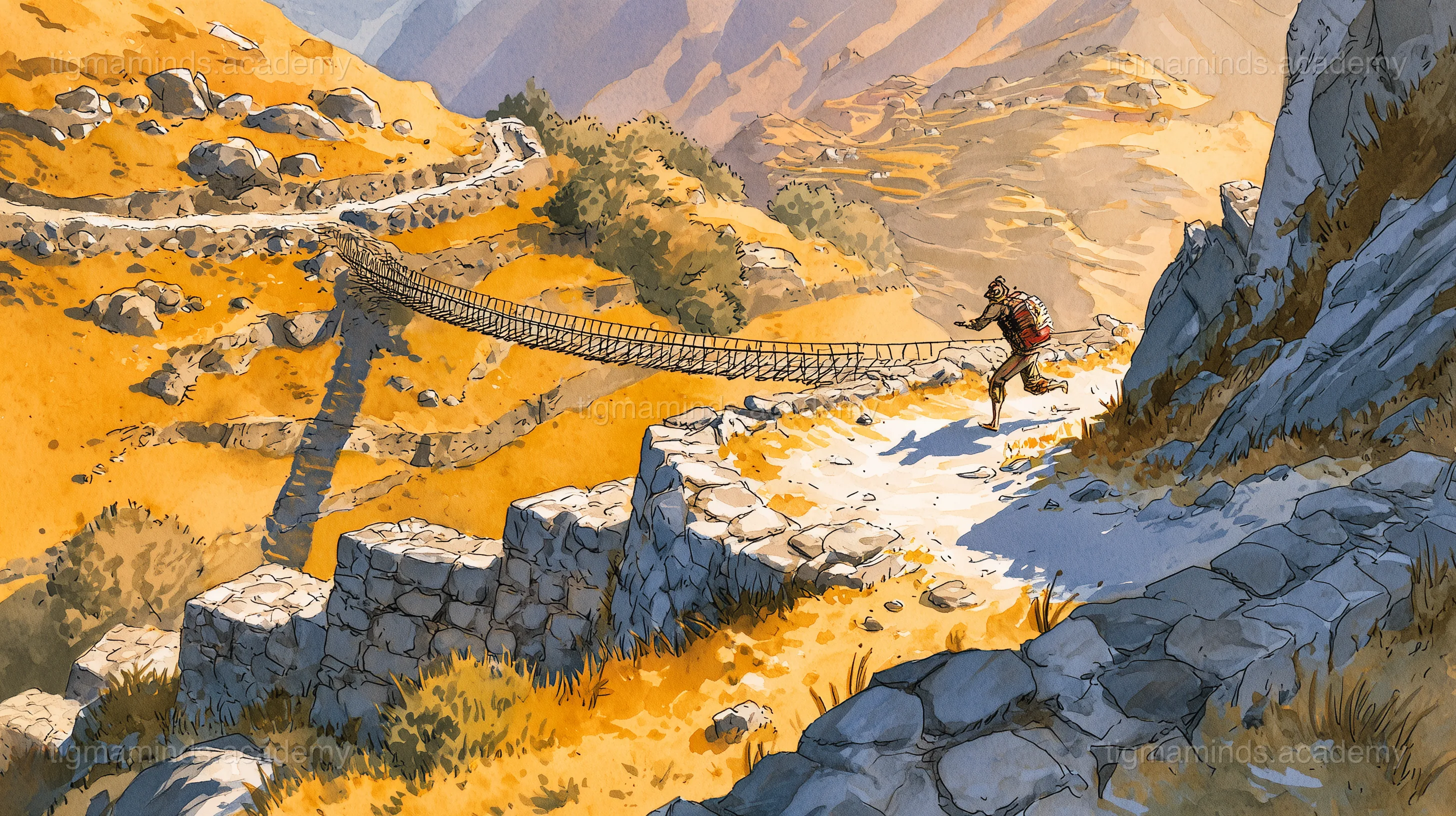
Suspension bridge physics, graph theory, and a knotted-string database that recorded an empire.
Forty Thousand Kilometres
The Inca Empire — or Tawantinsuyu, "The Four Regions Together" — stretched 4,000 kilometres along the spine of South America, from modern Colombia to Chile. It encompassed coastal deserts, Andean peaks above 5,000 metres, tropical rainforests, and everything in between.
And it was held together by roads.
The Qhapaq Nan — the Royal Road — was not one road but a network of approximately 40,000 kilometres of paths, highways, tunnels, causeways, and bridges. It connected every corner of the empire to the capital at Cusco. And it was built without wheels, without horses, without iron tools, and without a written language.
The Chasqui Runners
In the absence of horses, the Inca used something faster: relay runners.
The chasqui were trained runners stationed at relay posts called chaskiwasi, placed every 6 to 9 kilometres along the main roads. When a message needed to be sent, a chasqui would sprint to the next post, shout the message to the next runner (who was already watching for his approach), and pass a quipu — the knotted-string record — to him. The next runner would sprint to the next post. And so on.
The system could move a message 240 kilometres in a single day — faster than a horse could cover the same distance over Andean terrain. A message could travel from Cusco to Quito — 2,400 kilometres — in five days.
But the chasqui didn't just carry messages. They carried fresh fish from the Pacific coast to the Emperor's table in Cusco, 3,400 metres above sea level and 200 kilometres inland. The fish arrived still fresh — before refrigeration, before ice trucks, before any technology except human legs and an extraordinarily well-designed road network.
The Rope Bridges
The greatest engineering challenge was the gorges. The Andes are cut by deep river valleys — canyons hundreds of metres deep with vertical walls. The Inca couldn't go around them (too far) or through them (too steep). They had to go over them.
The solution was suspension bridges made from braided ichu grass — a tough, fibrous grass that grows abundantly in the highlands. Three thick cables, each braided from hundreds of smaller cords, formed the floor of the bridge. Two more cables served as handrails. Cross-sticks woven between the floor cables created a walkable (if terrifying) surface.
The longest of these bridges — the Q'eswachaka bridge over the Apurímac River — spanned 28 metres across a gorge so deep you couldn't see the bottom. It swayed in the wind. It bounced with every step. It was rebuilt every year by local communities, using the same techniques passed down for five centuries.
The physics of a suspension bridge is the physics of the catenary curve — the shape a chain or rope naturally takes when suspended from two points. This curve distributes the tension evenly along the cable, so no single point bears a disproportionate load.
The tension at the endpoints (where the cables are anchored to the cliff) depends on three things: the weight of the bridge, the span (distance between anchors), and the sag (how far the cable dips below the anchor points). More sag means less tension — a bridge that dips deeply is under less stress than one pulled taut. The Inca builders understood this intuitively: their bridges sagged significantly, reducing the tension on the grass cables and extending their lifespan.
The Quipu: A Database in Knots
The Inca had no written language. They had something arguably more efficient for their purposes: the quipu (pronounced "key-poo").
A quipu is a set of coloured strings hanging from a main cord, with knots tied at specific positions along each string. The position of a knot on the string indicates its place value — ones, tens, hundreds, thousands — using a base-10 positional number system. The type of knot indicates the digit: a single knot for 1, a long knot (multiple loops) for 2-9.
The colour of each string encoded the category of information. A census quipu might use yellow strings for gold, red for soldiers, green for grain. A tax quipu recorded what each province owed and what it had paid.
The most complex surviving quipus have thousands of strings with tens of thousands of knots — databases recording everything from population counts to warehouse inventories to historical narratives.
Modern researchers have decoded the numerical quipus with confidence. But many quipus contain patterns that don't correspond to numbers — arrangements of colours, twists, and knot types that appear to encode narrative information. If these are ever fully decoded, the quipu would be revealed as not just a database but a writing system — one of the most unusual ever devised.
The Altitude Problem
The Qhapaq Nan crossed passes above 5,000 metres. At that altitude, the air contains only 50% of the oxygen available at sea level. An unacclimatized person climbing to 5,000 metres will experience headache, nausea, confusion, and potentially fatal pulmonary or cerebral oedema — fluid leaking into the lungs or brain.
The Inca solved this biologically. Generations of living at altitude produced a population with larger lung capacity, more red blood cells, and higher levels of haemoglobin than lowland peoples. Inca runners could sprint at altitudes that would incapacitate a European explorer.
They also used coca leaves — chewed or brewed into tea — which contain compounds that suppress hunger, reduce fatigue, and improve oxygen efficiency at altitude. This was not recreation; it was a biochemical tool for survival in thin air.
The Network
The Qhapaq Nan was not just a road. It was a network — and understanding it requires graph theory, the mathematics of connected systems.
Each city, relay post, and storage depot was a node. Each road segment was an edge connecting two nodes. The Inca road network formed a graph with thousands of nodes and edges, optimized not for the shortest total distance but for the fastest message delivery and most reliable supply chain.
The network had redundancy — multiple paths between important cities, so that if a landslide or flood destroyed one road, messages could still get through. It had hierarchy — the main Royal Road along the mountain spine connected to secondary roads that descended to the coast and the eastern jungle. And it had storage — warehouses called qollqa at regular intervals, stocked with dried food, wool, weapons, and sandals for the chasqui runners.
This is the same architecture used in modern computer networks: redundant paths, hierarchical routing, and distributed storage. The Inca built the Internet in stone, grass, and knots — five hundred years before TCP/IP.
The end.
Choose your level. Everyone starts with the story — the code gets deeper as you go.
Here is a taste of what Level 1 looks like for this lesson:
import numpy as np
import matplotlib.pyplot as plt
# Your first data analysis with Python
data = [45, 52, 38, 67, 41, 55, 48] # measurements
mean = np.mean(data)
plt.bar(range(len(data)), data)
plt.axhline(mean, color='red', linestyle='--', label=f'Mean: {mean:.1f}')
plt.xlabel("Sample")
plt.ylabel("Value")
plt.title("Civil Engineering, Graph Theory & Altitude Physiology — Sample Data")
plt.legend()
plt.show()This is just the first of 6 coding exercises in Level 1. By Level 4, you will build: Build a Road Network Optimizer.
Free
Level 0: Listener
Stories, science concepts, diagrams, quizzes. No coding.
You are here
Level 0 is always free. Coding levels (1-4) are part of our 12-Month Curriculum.
Suspension bridge physics, network optimization, the quipu database, and the biology of life at 5,000 metres.
The big idea: "The Inca Road System" teaches us about Civil Engineering, Graph Theory & Altitude Physiology — and you don't need to write a single line of code to understand it.
Hold a piece of string between your two hands, letting it hang naturally. The shape it makes is called a catenary curve — from the Latin catena, meaning "chain." Every rope, chain, cable, or wire hanging freely under its own weight takes this exact shape.
The catenary is not a semicircle or a parabola (though it looks similar). It's a specific mathematical curve defined by the hyperbolic cosine function. Its special property: at every point, the tension in the rope is perfectly distributed. No single point bears more than its share of the load.
This is why the Inca rope bridges worked. A bridge made from braided ichu grass, spanning a 28-metre gorge, sags into a deep catenary. That sag is not a flaw — it's what keeps the bridge alive. A taut, flat bridge would concentrate enormous tension at the anchor points, snapping the grass. A sagging bridge distributes the tension along the entire length.
The deeper the sag, the lower the tension. The Inca bridges sagged dramatically — walking across one meant descending into a deep curve and climbing back up the other side. Terrifying, but structurally sound.
Try this: Hold a string between your hands and let it sag deeply. Now try to pull it perfectly straight (horizontal). Feel how the tension in the string increases enormously as it approaches horizontal. A perfectly straight horizontal string would require infinite tension. This is why all suspension bridges sag.
Key idea: A rope or cable hanging under its own weight forms a catenary curve — the shape that distributes tension evenly along its length. More sag means less tension. The Inca bridges sagged deeply, reducing stress on the grass cables and extending their lifespan.
Imagine you need to travel from your home to school. There are three possible routes: one goes straight through the city centre (short but traffic-heavy), one goes around the park (longer but faster), and one follows the river (scenic but winding). Which is fastest?
This is a shortest path problem — one of the most important problems in mathematics and computer science. The Inca road network, with its thousands of cities and relay posts connected by roads of different lengths and difficulty, is a giant version of this problem.
Mathematicians model road networks as graphs: cities are nodes (points), roads are edges (lines connecting points), and each edge has a weight (the time, distance, or difficulty of traveling it). Finding the shortest path through a graph is solved by algorithms like Dijkstra's algorithm (1956) — but the Inca solved it empirically, through centuries of route optimization.
The Inca network also had redundancy: multiple paths between important cities, so that if one road was blocked by a landslide, messages could still get through. This is the same principle behind the Internet — data packets can take multiple routes to reach their destination.
Check yourself: If you have 5 cities and want to connect all of them with direct roads, how many roads do you need? (Answer: 10 — each city connects to the other 4, giving 5 × 4 = 20, but each road connects two cities, so 20 ÷ 2 = 10.) What if you only want every city to be reachable from every other, not directly connected?
Key idea: A road network is a graph — cities are nodes, roads are edges. Finding the best path through a graph is a fundamental problem in mathematics. The Inca network was optimized for message speed, supply chain reliability, and redundancy against natural disasters — the same principles as modern computer networks.
Access all 130+ lessons, quizzes, interactive tools, and offline activities
The Inca had no written language — no alphabet, no characters, no paper. Instead, they recorded information on **quipus**: sets of coloured strings wi...
Stand up and take a deep breath. You just inhaled air that is about **21% oxygen** — plenty for your body's needs. Now imagine breathing the same air,...