
Metallurgy, mechanics, and the information revolution that changed everything.
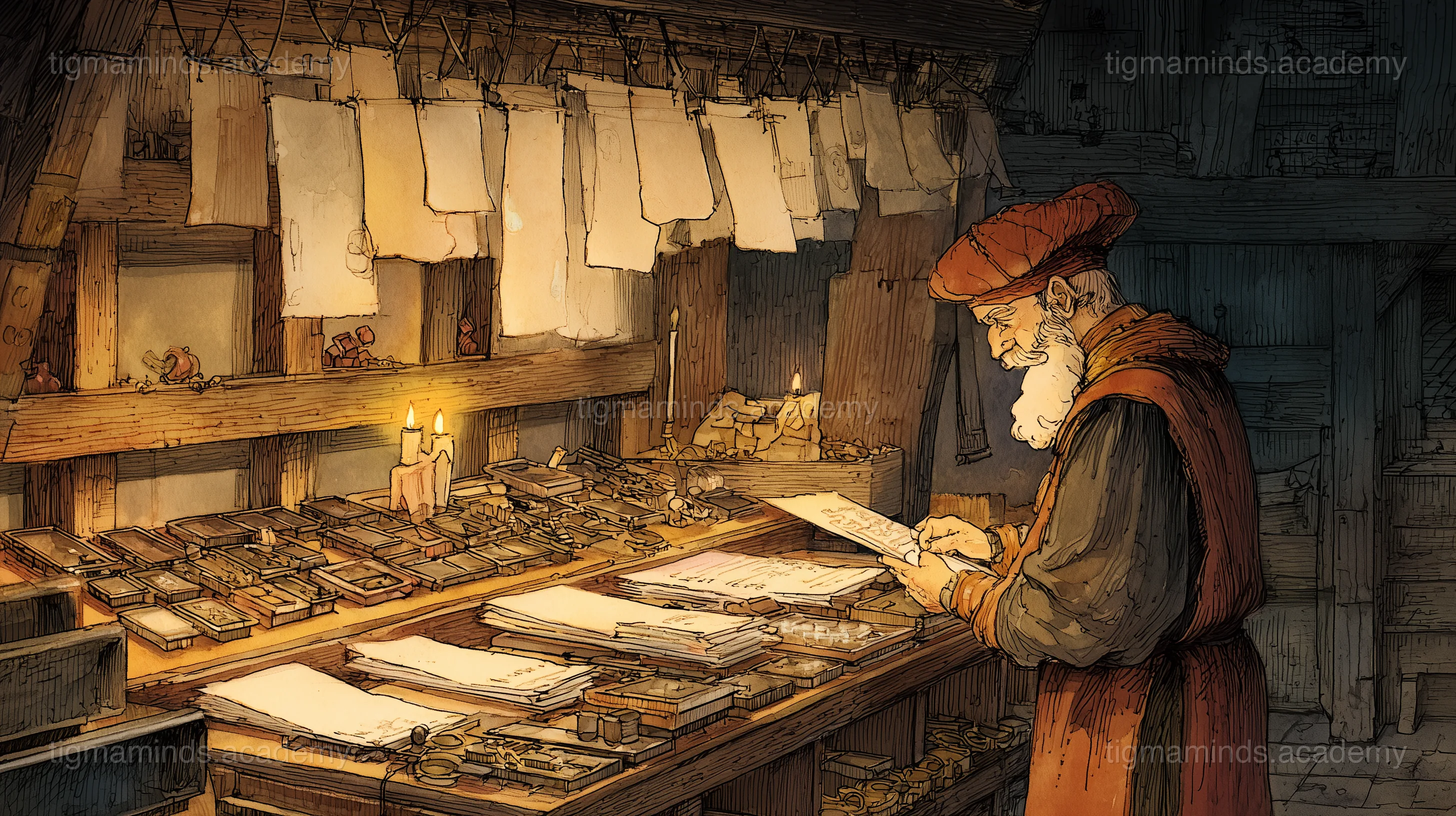
The Cost of a Book
In the year 1440, in the city of Mainz, Germany, a book was the most expensive object most people would never own.
A single copy of the Bible — the most popular book in Europe — took a scribe three years to copy by hand. The parchment alone (made from the skins of approximately 250 sheep) cost more than a year's wages for a skilled craftsman. The completed book cost the equivalent of a small house.
A university library might own a hundred books. A wealthy nobleman might own twenty. Most people owned zero. Knowledge was a luxury, hoarded by the Church and the aristocracy, locked behind the impossibly high cost of manual reproduction.
A goldsmith named Johannes Gutenberg was about to change this.
Four Old Ideas, One New Machine
Gutenberg did not invent any single technology. Everything he used already existed. What he did — and this is the mark of true engineering genius — was combine four existing technologies into a system that was greater than the sum of its parts.
Technology 1: The screw press. Used for centuries to press olives and grapes. A large wooden screw turned by a handle drives a flat plate downward with enormous force — enough to crush grapes into juice or press a sheet of paper against an inked surface.
Technology 2: Oil-based ink. Water-based inks (used for handwriting) soak into paper unevenly. But oil-based inks (used by painters) sit on the surface and can be transferred by pressure from one surface to another. Gutenberg developed a specific formulation using linseed oil, soot, and turpentine that was viscous enough to cling to raised metal type but fluid enough to transfer cleanly to paper.
Technology 3: Paper. Invented in China in 105 CE, it reached Europe via the Islamic world in the 12th century. By Gutenberg's time, paper mills were operating across Germany. Paper was far cheaper than parchment — a Bible's worth of paper cost a fraction of 250 sheepskins.
Technology 4: Movable type. The concept of printing with individual, reusable characters was invented in China by Bi Sheng around 1040 CE, using characters carved from baked clay. But Chinese has thousands of characters, making movable type impractical. European alphabets have fewer than 30 letters — a manageable set for a type system.
Gutenberg's breakthrough was not the concept of movable type but the material. Clay type broke easily. Wooden type warped. Gutenberg, drawing on his training as a goldsmith, developed a metal alloy for his type that solved every problem at once.
The Perfect Alloy
Gutenberg's type metal was a mixture of lead (80%), tin (5%), and antimony (15%). Each element contributed a critical property:
Lead provided mass and softness — the type was heavy enough to sit firmly in the press and soft enough to be cast easily.
Tin lowered the melting point, making the alloy easy to melt and pour into molds.
Antimony was the secret ingredient. Most metals shrink when they solidify — they contract by 2-5% as they cool from liquid to solid. Antimony does the opposite: it expands slightly when it solidifies. Mixed with lead and tin, it created an alloy that expanded just enough to fill every detail of the mold perfectly, producing type with sharp, clean edges and a perfectly flat printing face.
This alloy — essentially unchanged — was used in printing for the next 500 years.
The Economics of Revolution
The Gutenberg Bible, completed around 1455, was printed in an edition of approximately 180 copies. Each one was produced in a fraction of the time a scribe would have taken.
Here is the economics: a scribe produces one book at a cost of C. A printing press produces n books at a cost of S (setup: typesetting, proofreading, ink preparation) plus n × M (materials: paper and ink per copy). The critical insight is that S is high but M is very low. This means:
- For 1 copy, printing is more expensive than scribing (the setup cost exceeds the hand-copying cost) - For 10 copies, they're about equal - For 100 copies, printing is ten times cheaper per copy - For 1,000 copies, printing is a hundred times cheaper per copy
This is the mathematical signature of a phase transition — a point where a system changes its fundamental behavior. Below 10 copies, the old system (scribes) is more efficient. Above 10 copies, the new system (printing) is overwhelmingly superior. And once printing is cheaper, the number of books that can be produced is limited only by demand — which, it turned out, was virtually infinite.
The Cascade
Within 50 years of Gutenberg's Bible, there were printing presses in every major European city. By 1500, an estimated 20 million volumes had been printed — more books than had been produced by all the scribes of Europe in the previous thousand years combined.
The effects cascaded through every aspect of European civilization:
1517: Martin Luther's 95 Theses were printed and distributed across Germany within two weeks. The Protestant Reformation — which split Christianity and reshaped European politics — would have been impossible without printing. Luther himself said: "Printing is God's highest and ultimate gift of grace, by which He carries on the business of the Gospel."
1543: Copernicus's De Revolutionibus was printed, proposing that the Earth orbits the Sun. For the first time, a revolutionary scientific idea could be distributed to hundreds of scholars simultaneously, making it impossible for any single authority to suppress it.
1687: Newton's Principia Mathematica was printed in an edition of 300 copies. Within a decade, every major scientist in Europe had read it. The Scientific Revolution — from Galileo through Newton to the Enlightenment — was powered by the printing press.
The Information Theory View
From an information theory perspective, Gutenberg's press changed the cost function of copying from O(n) to O(1).
In a scribal culture, the cost of producing n copies is n × C — linear in the number of copies. Each copy requires the same amount of labor as the first. This means information spreads slowly and remains scarce.
In a print culture, the cost is S + n × M, where M << C. For large n, the per-copy cost approaches M — a tiny fraction of the scribal cost. This means information becomes cheap and abundant. And when information is cheap, everything changes: literacy rises, education spreads, innovation accelerates, and political power shifts from those who hoard knowledge to those who use it.
Gutenberg didn't just invent a machine. He changed the economics of knowledge itself. And the world has never been the same.
The end.
Choose your level. Everyone starts with the story — the code gets deeper as you go.
Here is a taste of what Level 1 looks like for this lesson:
import numpy as np
import matplotlib.pyplot as plt
# Your first data analysis with Python
data = [45, 52, 38, 67, 41, 55, 48] # measurements
mean = np.mean(data)
plt.bar(range(len(data)), data)
plt.axhline(mean, color='red', linestyle='--', label=f'Mean: {mean:.1f}')
plt.xlabel("Sample")
plt.ylabel("Value")
plt.title("Materials Science & Information Theory — Sample Data")
plt.legend()
plt.show()This is just the first of 6 coding exercises in Level 1. By Level 4, you will build: Build an Information Spread Model.
Free
Level 0: Listener
Stories, science concepts, diagrams, quizzes. No coding.
You are here
Level 0 is always free. Coding levels (1-4) are part of our 12-Month Curriculum.
The metallurgy of type, the mechanics of the press, and the economics that triggered the information revolution.
The big idea: "Gutenberg's Printing Press" teaches us about Materials Science & Information Theory — and you don't need to write a single line of code to understand it.
How long would it take you to copy this entire story by hand? Not type it — write it, letter by letter, in neat handwriting on lined paper. This story is about 1,200 words. At a comfortable handwriting speed, it would take you roughly 45 minutes.
Now imagine copying the entire Bible — about 780,000 words. At the same speed, with no breaks, it would take about 490 hours — more than 12 weeks of full-time work. A professional scribe, working carefully to produce a beautiful copy, typically took three years.
The parchment (made from animal skins) for a single Bible required the hides of approximately 250 sheep. The ink had to be hand-mixed. Each decorated initial letter was a tiny painting. The finished book cost the equivalent of a small house.
This is why, before printing, books were the most expensive objects most people would never own. A monastery might have 100 books. A king might have 200. Most humans lived their entire lives without ever holding a book.
Check yourself: If a scribe charges 1 gold coin per page and a Bible has 1,200 pages, how much does the copying alone cost — not counting the parchment, binding, or decoration?
Key idea: Before printing, every book was copied by hand — a process that took months or years per copy. This made books extremely rare and expensive, limiting literacy and knowledge to the wealthy elite. The cost of copying determined the speed of civilization.
Gutenberg's printing breakthrough wasn't the idea of movable type (China had that 400 years earlier). It was the material he made the type from.
The problem: you need to cast thousands of identical metal letters, each with a perfectly flat face that makes clean contact with paper. If the metal shrinks as it cools (most metals do — they contract by 2-5% when solidifying), the face will be concave (dished inward), and the print will be uneven.
Gutenberg's solution was an alloy of lead (80%), tin (5%), and antimony (15%). The secret ingredient was antimony, which is one of the few elements that expands when it solidifies (like water expanding when it freezes). Mixed with lead and tin, the antimony expansion exactly compensates for the lead's contraction, producing type that fills the mold perfectly and has a flat, sharp face.
This alloy also had a low melting point (about 250°C — achievable in a simple charcoal furnace), cast easily into molds, and was durable enough to print thousands of copies before wearing out. It was essentially unchanged for 500 years of printing history.
Think about it: Can you think of another material whose unusual expansion property is important? (Water: it expands when freezing, which is why ice floats, pipes burst, and rocks crack in winter.)
Key idea: Most metals shrink when they cool, creating uneven printing surfaces. Gutenberg's alloy included antimony — which expands on solidification — compensating for lead's shrinkage and producing type with perfectly flat faces. The right material was as important as the right idea.
Access all 130+ lessons, quizzes, interactive tools, and offline activities
Here's a thought experiment. Suppose you want to distribute a message to 100 people. You have two options: (A) write 100 handwritten copies, or (B) ca...
Within 50 years of Gutenberg's first Bible (1455), there were **printing presses in every major European city**. By 1500, an estimated **20 million vo...