Greek Fire
Combustion Chemistry & Thermodynamics

Greek Fire

The secret weapon of Byzantium — combustion chemistry, flamethrowers, and the original weapons mystery.

Combustion Chemistry & Thermodynamics12-Month Curriculum 12h

The Story

The Burning Sea

In the summer of 678 CE, the Arab fleet — the most powerful navy in the world — sailed through the Sea of Marmara toward Constantinople, the capital of the Byzantine Empire. The fleet carried thousands of soldiers. The city's walls had never been breached by sea. But the Arabs had a plan: they would blockade the city, starve it, and force a surrender.

They never got the chance.

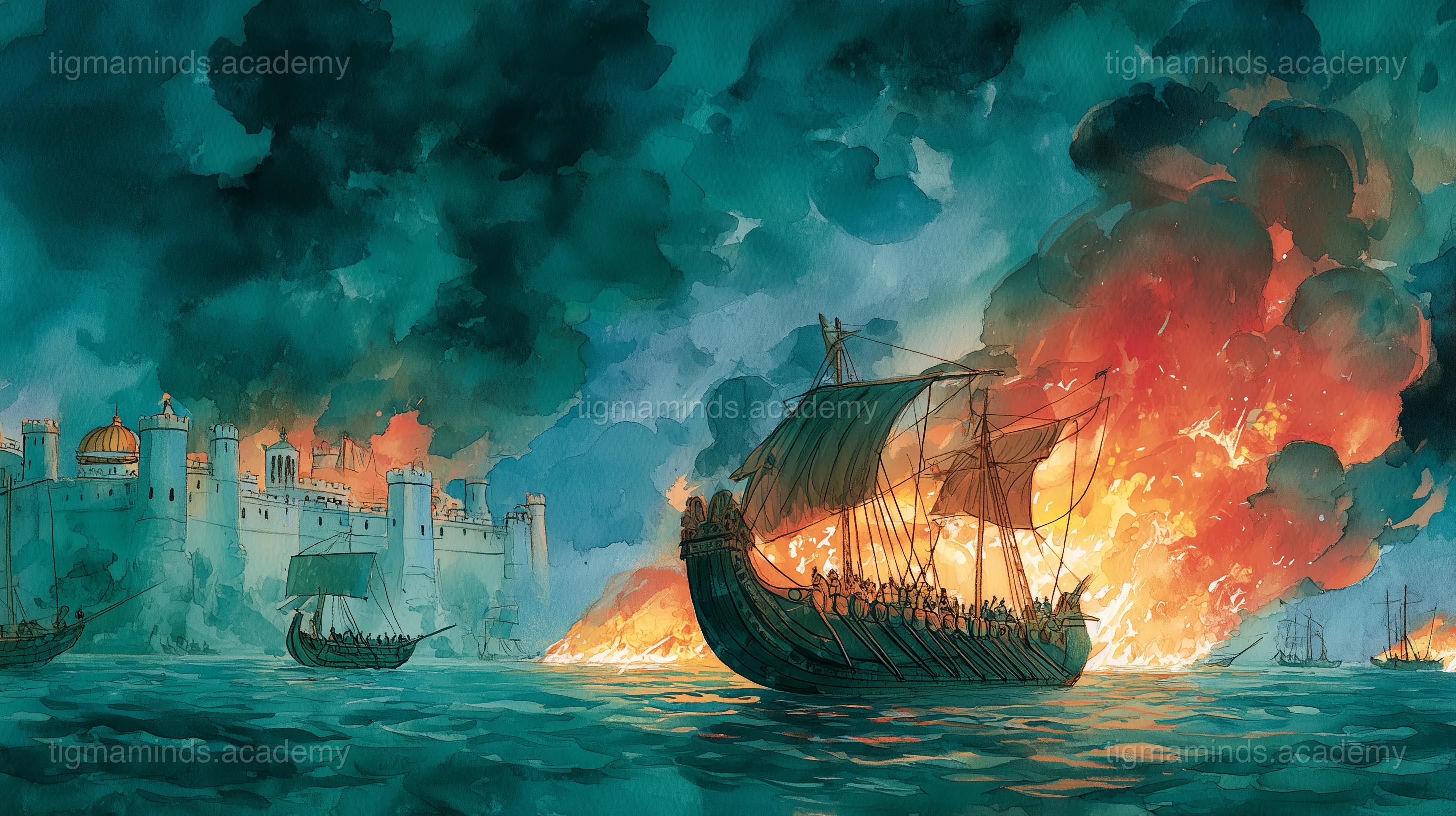
As the Arab ships approached the sea walls, Byzantine warships — small, fast dromons — raced out to meet them. Mounted on the prow of each dromon was a device that looked like a bronze lion's head with its mouth open. From that mouth came a jet of liquid fire — a stream of burning fluid that arced through the air and splashed across the Arab ships.

The fire stuck to everything it touched. It could not be put out with water. In fact, water made it burn harder. It floated on the surface of the sea, turning the water itself into a burning field. Sailors who jumped overboard to escape burning ships found themselves swimming through fire.

The Arab fleet was destroyed. The siege was broken. Constantinople would survive for another 775 years.

The weapon was called Greek Fire, and it was the most closely guarded military secret in the ancient world.

What Was It?

We don't know. And that's not a failure of modern chemistry — it's a testament to how well the Byzantines kept their secret.

The recipe for Greek Fire was known only to the Kallinikos family — its inventors — and the reigning Emperor. It was passed down through generations under an oath of secrecy. When the Byzantine Empire finally fell in 1453, the secret died with it.

What we do know, from contemporary descriptions and modern chemical analysis of residues, is that Greek Fire had several extraordinary properties:

1. It burned on water. This rules out any purely alcohol-based or oil-based incendiary. Ordinary oil floats and burns on water, but it can be smothered or diluted.

2. Water intensified the burning. This suggests a component that reacts exothermically with water — meaning the reaction with water produces heat, which feeds the fire.

3. It was projected as a liquid stream from pressurized siphons, like a modern flamethrower.

4. It adhered to surfaces — hulls, sails, skin — and could not be easily scraped off.

Modern chemists have proposed several candidate recipes. The most widely accepted theory is that Greek Fire was based on crude petroleum (naphtha), thickened with pine resin to make it sticky, and possibly combined with quicklime (calcium oxide) — a substance that reacts violently with water, producing intense heat.

The Chemistry of Combustion

To understand Greek Fire, you need to understand combustion — the chemical reaction that produces fire.

Combustion is an exothermic oxidation reaction. A fuel (a substance containing carbon and hydrogen) reacts with oxygen, producing carbon dioxide, water, and energy in the form of heat and light:

Fuel + O₂ → CO₂ + H₂O + Energy

The key requirement is the fire triangle: fuel, oxygen, and heat. Remove any one, and the fire goes out.

Ordinary fires can be extinguished by removing oxygen (smothering with a blanket), removing heat (pouring water), or removing fuel (creating a firebreak). Greek Fire was terrifying because none of these methods worked:

- Water didn't cool it — the quicklime reacted with water exothermically, adding heat. - Smothering didn't work because the naphtha was liquid and spread across any surface that tried to cover it. - Removing fuel was impossible because the sticky resin adhered to whatever it touched.

Quicklime and Water

The reaction between quicklime and water is one of the most dramatic in everyday chemistry:

CaO + H₂O → Ca(OH)₂ + Heat (65 kJ/mol)

Calcium oxide (quicklime) reacts with water to produce calcium hydroxide (slaked lime) and a large amount of heat — enough to raise the temperature of the surrounding material above the flash point of naphtha, reigniting any fire that water might have temporarily cooled.

This reaction is so energetic that quicklime was used for centuries as a heat source in situations where fire was impractical. During World War I, soldiers heated their food using cans of quicklime activated by water. Today, self-heating coffee cans and military ration heaters use the same chemistry.

The Siphon

The delivery system was as remarkable as the fuel. The Byzantines projected Greek Fire through bronze tubes using air pressure — essentially a pump-action flamethrower.

The mechanism was a force pump (similar to a bicycle pump) connected to a heated, pressurized tank of Greek Fire. A fire was kept burning beneath the tank to keep the mixture liquid and to increase the internal pressure. When the operator worked the pump lever, pressurized air forced the liquid through a narrow bronze nozzle, creating a jet that could reach 15 to 20 metres.

The nozzle was often shaped like an animal's head — a lion, a dragon, a serpent — both for psychological effect and because the narrow throat of the animal shape created a natural nozzle that accelerated the liquid stream, increasing its range.

The Mystery Endures

Despite centuries of research, no one has conclusively recreated Greek Fire. Several teams have come close — producing sticky, water-resistant incendiary mixtures based on naphtha and quicklime — but none has matched all the described properties simultaneously.

The mystery is part of the lesson. Greek Fire teaches us that chemistry is power — and that the people who understood combustion, pressure, and chemical reactions 1,300 years ago wielded that understanding as effectively as any modern weapons engineer.

It also teaches us something about secrets: the Byzantines kept this one for 800 years. In an age of instant information, it's worth remembering that the most powerful technology in the medieval world was protected not by encryption, not by patents, but by a family oath and the silence of emperors.

The end.

Try It Yourself

Choose your level. Everyone starts with the story — the code gets deeper as you go.

Story Progress

0%

Ready to Start Coding?

Here is a taste of what Level 1 looks like for this lesson:

Level 1: Explorer — Python
import numpy as np
import matplotlib.pyplot as plt

# Your first data analysis with Python
data = [45, 52, 38, 67, 41, 55, 48]  # measurements
mean = np.mean(data)

plt.bar(range(len(data)), data)
plt.axhline(mean, color='red', linestyle='--', label=f'Mean: {mean:.1f}')
plt.xlabel("Sample")
plt.ylabel("Value")
plt.title("Combustion Chemistry & Thermodynamics — Sample Data")
plt.legend()
plt.show()

This is just the first of 6 coding exercises in Level 1. By Level 4, you will build: Build a Combustion Simulator.

Free

Level 0: Listener

Stories, science concepts, diagrams, quizzes. No coding.

You are here

Enrolled

Levels 1-4

Python, NumPy, Matplotlib, real projects, mentorship.

Sign Up Free

Stay Updated

Join Waitlist

Get notified when enrollment opens for your area.

Notify Me

Level 0 is always free. Coding levels (1-4) are part of our 12-Month Curriculum.