Egyptian Embalming
Biochemistry & Preservation Science

Egyptian Embalming

Biochemistry, preservation, and a 3,000-year experiment in stopping decay.
Biochemistry & Preservation Science12-Month Curriculum 12h

The Story

Seventy Days

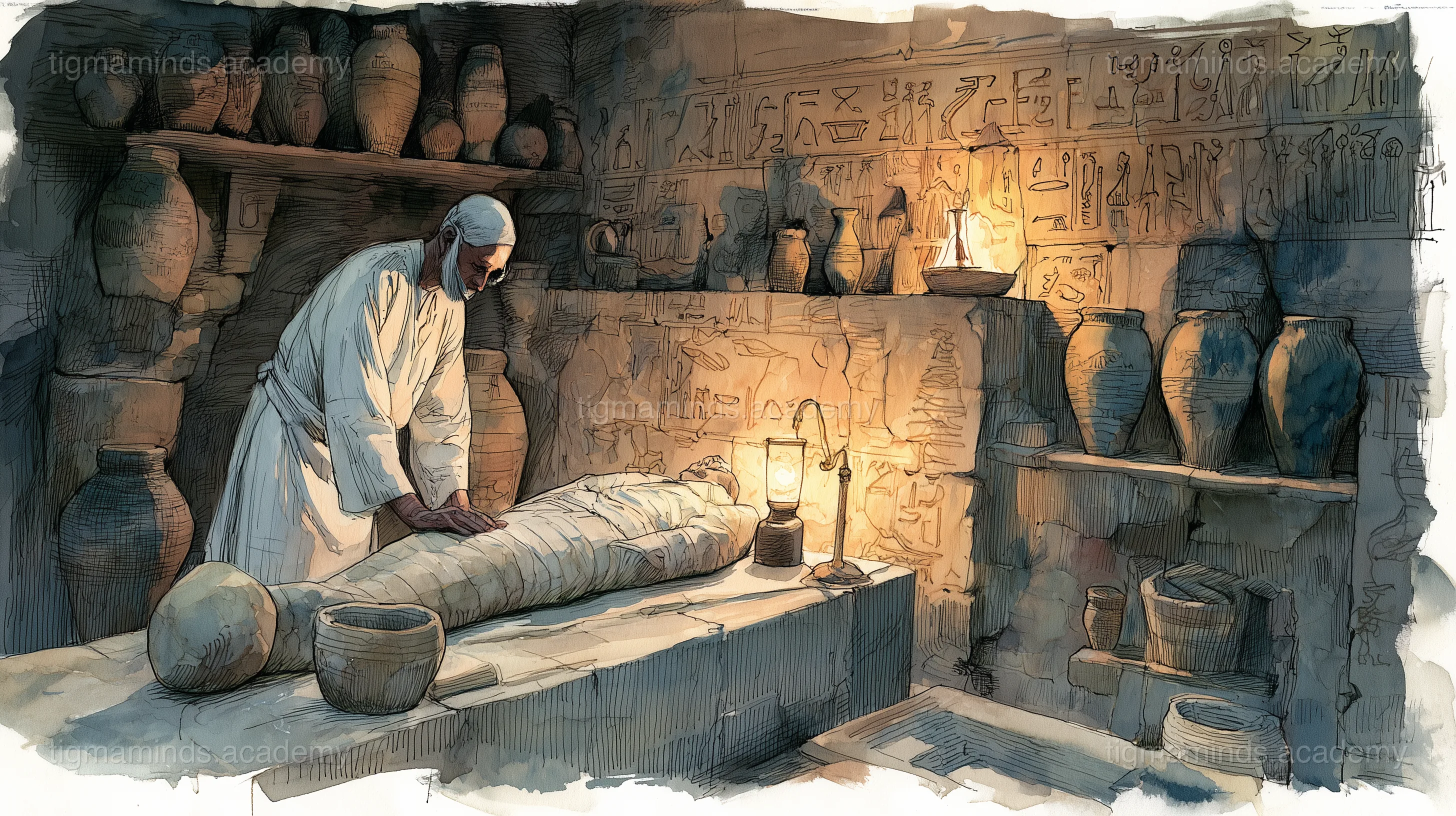
When a pharaoh of Egypt died, the clock started. The embalmers had seventy days to transform a body that would rot within a week in the Egyptian heat into a preserved form that would last — they believed — for eternity.

The embalmers of ancient Egypt were not priests performing a mystical ritual. They were applied chemists — practitioners who, through thousands of years of trial and error, had developed a sophisticated understanding of the biochemistry of decomposition and how to prevent it.

Their methods worked. Mummies from 3,000 years ago — older than the Roman Empire, older than the Greek city-states, older than the Buddha — still have recognizable features, intact skin, and even identifiable DNA. No other preservation technology in human history has achieved comparable results over such timescales.

Why Bodies Decay

To understand mummification, you first need to understand decomposition. When an organism dies, its cells stop producing ATP — the molecule that powers all cellular processes. Without ATP, the cell membranes lose their integrity and begin to leak. The cell's own digestive enzymes — lysozymes and proteases — are released from their compartments and begin digesting the cell from the inside. This process is called autolysis — literally, "self-eating."

Within hours, bacteria that were harmlessly living in the gut and on the skin begin to invade the tissues. These bacteria feed on the dead cells, producing gases (hydrogen sulphide, methane, ammonia) that cause bloating, and enzymes that liquefy tissues. This is putrefaction — and in the Egyptian climate, at temperatures above 35°C, it can reduce a body to skeleton in as little as two weeks.

The embalmers' task was to stop both autolysis and putrefaction. Their solution targeted the one thing both processes need: water.

Natron: The Key

The primary preservative used by Egyptian embalmers was natron — a naturally occurring mineral salt found in dried lake beds throughout Egypt, especially at Wadi el-Natrun in the western desert.

Natron is a mixture of sodium carbonate (Na₂CO₃), sodium bicarbonate (NaHCO₃), sodium chloride (NaCl), and sodium sulphate (Na₂SO₄). This combination is a powerful desiccant — it absorbs water from any material it contacts.

The process was straightforward in concept but required precise execution. After the internal organs were removed (the brain through the nose using a hooked bronze tool, the organs through an incision in the left side), the body cavity was packed with natron, and the entire body was covered in a mound of natron crystals.

Over the next 40 days, the natron drew water out of the body tissues through osmosis. The high concentration of sodium ions outside the cells created an osmotic gradient that pulled water outward, across the cell membranes, and into the salt crystals. The body lost approximately 75% of its weight in water.

Without water, the enzymes that drive autolysis cannot function. Without water, bacteria cannot metabolize and reproduce. The body was effectively frozen in chemical time — not by cold, but by dryness.

The Resin Seal

Drying alone wasn't enough. Dried tissue is hygroscopic — it will reabsorb moisture from the air. In humid seasons along the Nile, an unprotected mummy would rehydrate and begin decaying again.

The embalmers solved this by coating the dried body in layers of tree resin — primarily from Pistacia trees (related to pistachios) and coniferous trees (pine, cedar). The resin was heated until liquid, applied to the skin, and allowed to harden into a waterproof, airtight seal.

Modern analysis has revealed that these resins contained antibacterial compounds — terpenes and terpenoids that actively inhibit microbial growth. The embalmers may not have known the mechanism, but they knew from experience that resin-treated bodies lasted longer than uncoated ones.

Recent studies using gas chromatography-mass spectrometry (GC-MS) on samples from mummies have identified complex mixtures of plant oils, animal fats, beeswax, and tree resins — each contributing specific preservative properties. Some mummies show evidence of treatment with bitumen (natural asphalt), which provides additional waterproofing and antimicrobial protection.

Canopic Jars and Organ Chemistry

The internal organs — liver, lungs, stomach, and intestines — were removed because they decay fastest. They contain the highest concentration of digestive enzymes and bacteria.

Each organ was treated separately with natron, wrapped in linen, and stored in one of four canopic jars, each protected by a different son of Horus. The heart was left in place — the Egyptians believed it was the seat of intelligence and identity, needed for the afterlife.

The brain was considered unimportant. It was extracted through the nose using a long bronze hook that broke through the cribriform plate (a thin bone at the top of the nasal cavity) and stirred the brain tissue until it liquefied enough to drain out. This may seem crude, but it demonstrates a practical understanding of cranial anatomy that was not matched in European medicine until the Renaissance.

What We've Learned

The study of mummies has produced genuine scientific discoveries. Analysis of mummy DNA has revealed the genetic relationships between ancient Egyptian populations and modern ones. CT scanning of mummies has identified diseases — atherosclerosis, cancer, tuberculosis — in individuals who lived millennia ago, proving that these conditions are not exclusively modern.

In 2023, researchers identified the specific chemicals used at an embalming workshop at Saqqara by analyzing residues in labeled jars. For the first time, they could match the ancient Egyptian names for substances to their actual chemical identities — bridging a gap of 2,600 years between ancient practice and modern chemistry.

Egyptian embalming was not magic. It was applied biochemistry — a 3,000-year experiment in understanding and manipulating the chemistry of life and death. The embalmers didn't know the word "osmosis" or "enzyme" or "bacterium." But they understood the principles well enough to produce results that modern science can barely improve upon.

The end.

Try It Yourself

Choose your level. Everyone starts with the story — the code gets deeper as you go.

Story Progress

0%

Ready to Start Coding?

Here is a taste of what Level 1 looks like for this lesson:

Level 1: Explorer — Python
import numpy as np
import matplotlib.pyplot as plt

# Your first data analysis with Python
data = [45, 52, 38, 67, 41, 55, 48]  # measurements
mean = np.mean(data)

plt.bar(range(len(data)), data)
plt.axhline(mean, color='red', linestyle='--', label=f'Mean: {mean:.1f}')
plt.xlabel("Sample")
plt.ylabel("Value")
plt.title("Biochemistry & Preservation Science — Sample Data")
plt.legend()
plt.show()

This is just the first of 6 coding exercises in Level 1. By Level 4, you will build: Build a Preservation Simulator.

Free

Level 0: Listener

Stories, science concepts, diagrams, quizzes. No coding.

You are here

Enrolled

Levels 1-4

Python, NumPy, Matplotlib, real projects, mentorship.

Sign Up Free

Stay Updated

Join Waitlist

Get notified when enrollment opens for your area.

Notify Me

Level 0 is always free. Coding levels (1-4) are part of our 12-Month Curriculum.