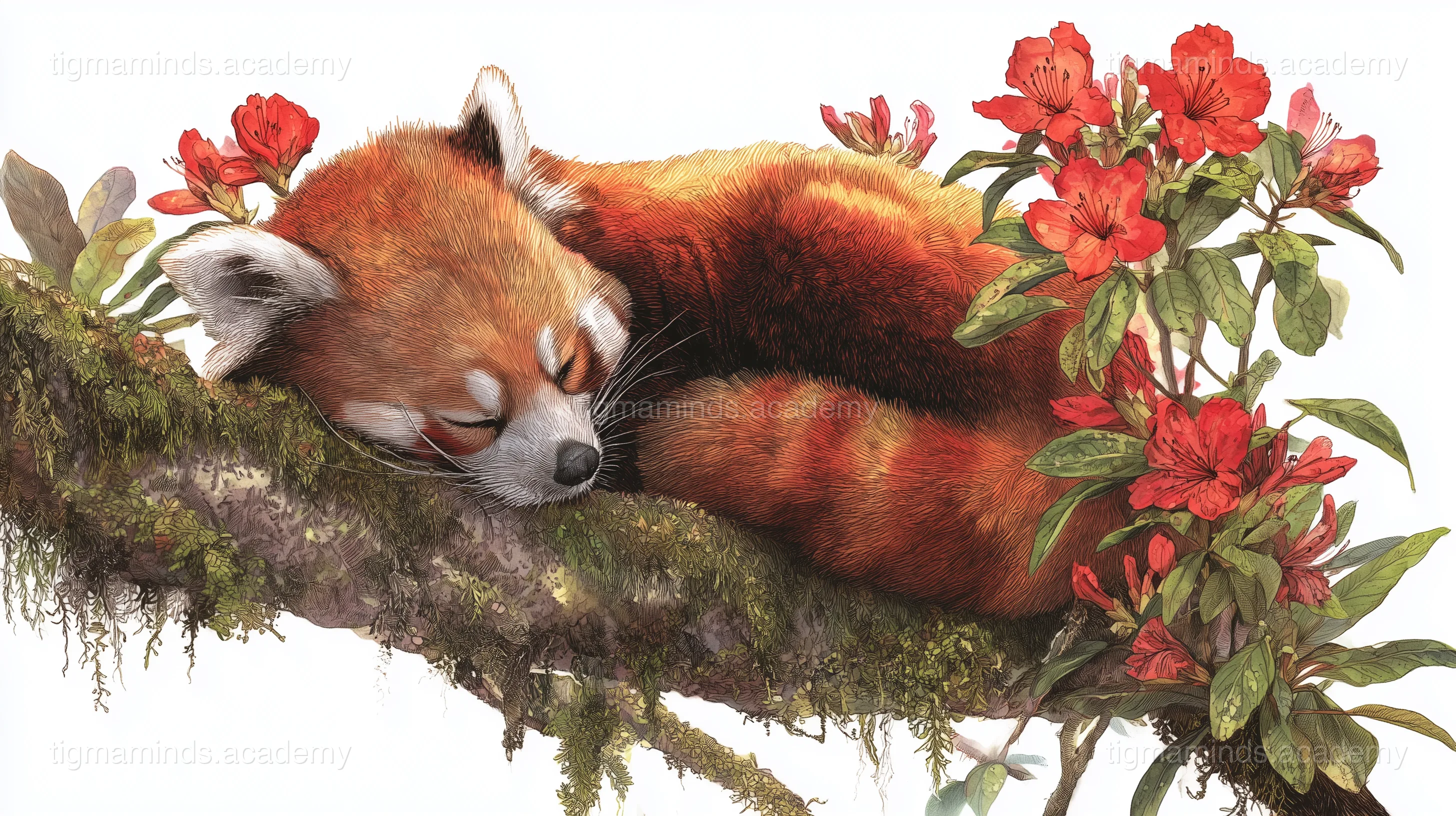
The Red Panda of the Rhododendron Forest
Thermoregulation & Heat Transfer

The Red Panda of the Rhododendron Forest

How Sikkim's elusive mascot stays warm in freezing forests — the physics of thermoregulation.

Thermoregulation & Heat Transfer12-Month Curriculum 10h

The Story

The Ghost of the Canopy

In the rhododendron forests of western Sikkim, between 2,500 and 4,500 metres elevation, lives an animal so elusive that most Sikkimese have never seen one in the wild. The red panda (Ailurus fulgens) — Sikkim's state animal — spends most of its life in the canopy, wrapped in a thick tail, eating bamboo leaves and quietly avoiding everyone.

Karma Doma Bhutia, a fourteen-year-old girl from Pelling, had seen red pandas exactly once — a flash of russet fur high in a moss-draped fir tree during a school trek. That glimpse made her obsessed.

"I want to know how it survives up there," she told her biology teacher, Sir Mingma. "It's 3,000 metres. It's freezing. And the red panda eats bamboo — the lowest-calorie food in the forest."

"That," said Sir Mingma, "is exactly the right question."

The Thermoregulation Problem

Red pandas are endotherms — they generate their own body heat through metabolism, maintaining a core temperature of about 38°C regardless of external conditions. At 3,000 metres in winter, the ambient temperature can drop to −15°C. That's a 53°C difference between the panda's body and the air.

Heat flows from hot to cold. The greater the temperature difference, the faster the heat loss. The red panda must continuously generate enough metabolic heat to replace what it loses to the cold air — or it dies of hypothermia.

Sir Mingma drew a diagram. "Heat loss has three pathways: conduction (direct contact with cold surfaces), convection (cold air flowing over the body), and radiation (infrared energy radiating from warm body to cold surroundings). A red panda at 3,000 metres in winter fights all three."

The Solutions

1. Dense fur. The red panda's fur is one of the densest of any mammal relative to body size. Even the soles of its feet are furred — unique among members of the order Carnivora. The fur traps a layer of still air against the body. Still air is an excellent insulator (thermal conductivity = 0.024 W/m·K — lower than wood, fabric, or even snow).

2. Tail as blanket. The red panda's tail is nearly as long as its body (30–50 cm) and extraordinarily bushy. When sleeping, it wraps the tail around its body and over its face, creating an additional insulating layer. This reduces the exposed surface area and blocks convective heat loss from its most vulnerable area — the face, where blood vessels are close to the skin surface.

3. Low metabolic rate. Surprisingly, the red panda has one of the lowest metabolic rates of any mammal its size. This seems counterintuitive — wouldn't you want a high metabolic rate to generate more heat? But a high metabolic rate requires a lot of food. The red panda's bamboo diet provides very few calories (bamboo leaves are about 80% fibre), so it cannot afford a fast metabolism. Instead, it minimises heat loss (thick fur, tail blanket, reduced activity) rather than maximising heat production.

4. Reduced activity. Red pandas are crepuscular — active mainly at dawn and dusk when temperatures are moderate. During the coldest parts of winter nights, they enter a state of torpor — a temporary reduction in metabolic rate and body temperature that conserves energy. Torpor is not hibernation (which lasts months); it lasts only hours and the panda wakes easily.

Surface Area to Volume Ratio

Sir Mingma introduced a key concept. "Heat loss is proportional to surface area. Heat production is proportional to volume (which correlates with body mass). The ratio of surface area to volume determines how easily an animal loses heat."

Small animals have high surface-area-to-volume ratios — they lose heat quickly. A mouse must eat almost constantly to fuel its furnace. Large animals have low ratios — an elephant loses heat slowly.

The red panda weighs about 5 kg — small by mammal standards. Its SA:V ratio is relatively high, meaning it should lose heat fast. Its fur compensates: by trapping a thick layer of insulating air, it effectively reduces its SA:V ratio, making its thermal behaviour closer to that of a much larger animal.

"The red panda has the body of a small animal with the insulation of a big one," said Sir Mingma. "That's how it survives."

Karma Doma pictured the red panda she had glimpsed — curled in a ball, tail wrapped around its face, fur dense as a winter coat. Not fragile at all. A survival machine, precisely calibrated for life in the frozen rhododendron forest.

The end.

Try It Yourself

Choose your level. Everyone starts with the story — the code gets deeper as you go.

Story Progress

0%

Ready to Start Coding?

Here is a taste of what Level 1 looks like for this lesson:

Level 1: Explorer — Python
# Red Panda Heat Budget
body_temp = 38      # °C
ambient = -15       # °C (winter night)
fur_R = 5.0         # thermal resistance (°C·m²/W)
surface_area = 0.15 # m² (small animal)
metabolism = 3.5    # Watts (normal)
metabolism_torpor = 1.2  # Watts (torpor)

heat_loss = (body_temp - ambient) * surface_area / fur_R
print(f"Heat loss rate: {heat_loss:.1f} W")
print(f"Normal metabolism: {metabolism:.1f} W")
print(f"Deficit (normal): {heat_loss - metabolism:.1f} W")
print(f"In torpor: deficit = {heat_loss * 0.6 - metabolism_torpor:.1f} W")

This is just the first of 6 coding exercises in Level 1. By Level 4, you will build: Build a Thermoregulation Model.

Free

Level 0: Listener

Stories, science concepts, diagrams, quizzes. No coding.

You are here

Enrolled

Levels 1-4

Python, NumPy, Matplotlib, real projects, mentorship.

Sign Up Free

Stay Updated

Join Waitlist

Get notified when enrollment opens for your area.

Notify Me

Level 0 is always free. Coding levels (1-4) are part of our 12-Month Curriculum.