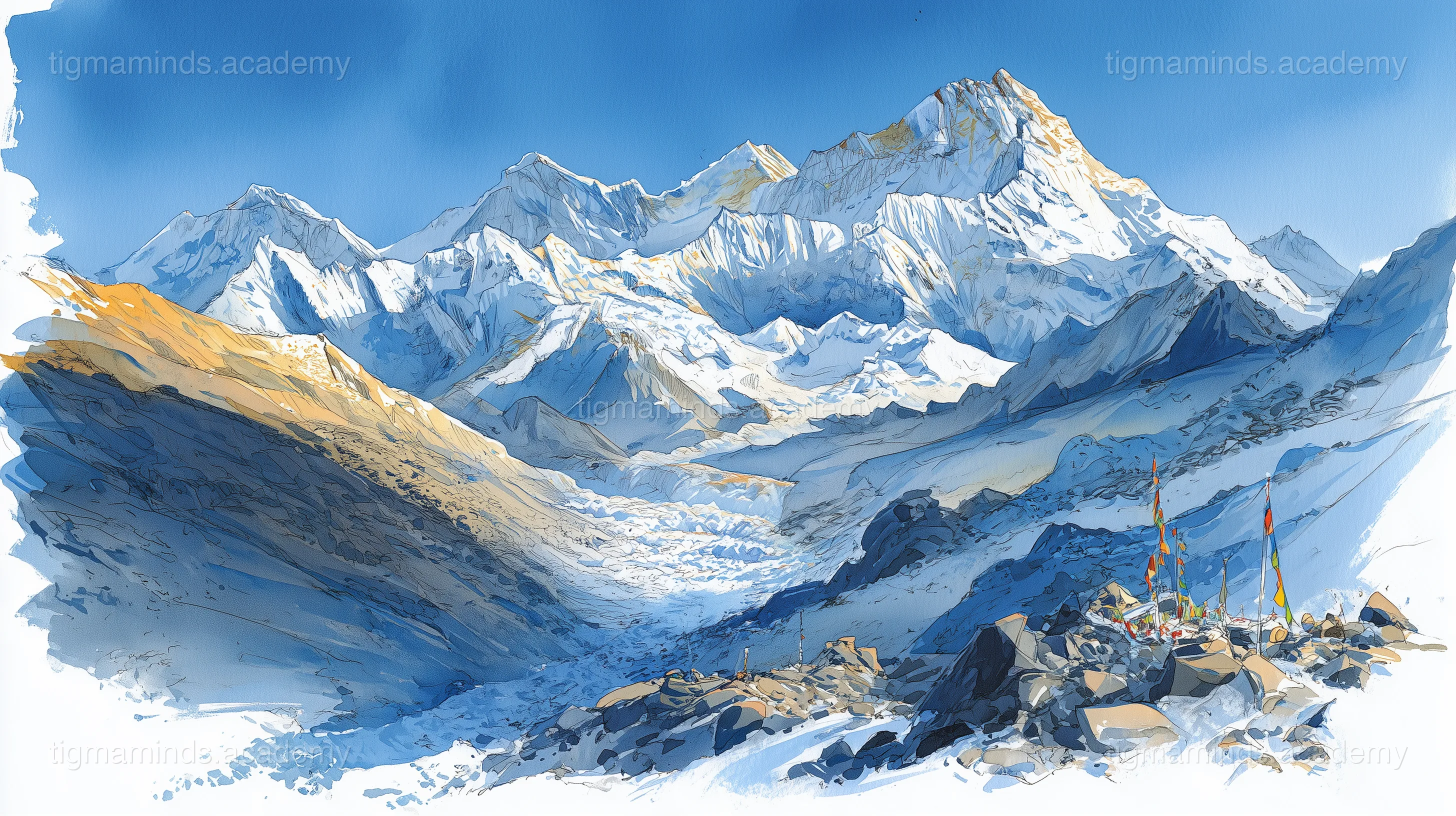
The Five Treasures of Kanchenjunga
Glaciology & Climate Science

The Five Treasures of Kanchenjunga

What lies inside the world's third-highest mountain — glaciology, ice cores, and climate science.

Glaciology & Climate Science12-Month Curriculum 10h

The Story

The Sacred Peak

The people of Sikkim call Kanchenjunga the "Five Treasures of the Great Snow." At 8,586 metres, it is the third-highest mountain on Earth, and its five peaks represent five treasures: gold, silver, gems, grain, and holy scriptures. The Sikkimese consider it sacred and refuse to climb to the very summit — every expedition that has reached the top has stopped a few metres short, out of respect.

Diki Lama Sherpa, a seventeen-year-old girl from Yuksom — the first capital of Sikkim — wanted to understand Kanchenjunga not through myth but through science. Her school was 40 km from the mountain's base, and she could see it from her classroom window on clear days: a massive wall of white against blue sky.

"Ama," she asked her mother, "what are the five treasures really?"

"Ice, rock, and time," said her mother, who had trekked to Kanchenjunga Base Camp as a porter. "Millions of years of ice, sitting on billions of years of rock."

The Glacier

Kanchenjunga holds over 500 glaciers — rivers of ice that flow downhill under their own weight at speeds of 10–100 metres per year. The largest, Zemu Glacier, is 26 km long and over 500 metres deep at its thickest point.

Diki's geography teacher, Sir Tshering Bhutia, explained how glaciers form.

"Snow falls on the mountain. In most places, it melts in summer. But above the snowline — about 5,000 metres on Kanchenjunga — more snow falls each year than melts. The snow accumulates year after year, compressing under its own weight. Old snow recrystallises into dense, blue glacier ice. Over centuries, the weight of the ice above pushes the ice below downhill. This flowing river of ice is a glacier."

The process creates layers — each year's snowfall preserved as a distinct band. A 500-metre-deep glacier contains hundreds of thousands of years of snowfall, layered like pages in a book.

"And those layers," said Sir Tshering, "contain something extraordinary: trapped air bubbles. When snow compresses into ice, tiny bubbles of the atmosphere are sealed inside. These bubbles preserve the exact composition of the air at the time the snow fell — a frozen record of Earth's atmosphere going back millennia."

Ice Cores: Reading Earth's Diary

Scientists drill into glaciers and extract long cylinders of ice called ice cores. By analysing the trapped air bubbles, they can measure:

- CO₂ concentration: How much carbon dioxide was in the atmosphere at each point in history - Temperature: The ratio of oxygen-18 to oxygen-16 isotopes in the ice correlates with temperature at the time of snowfall - Volcanic eruptions: Layers of ash and sulfuric acid mark specific eruptions - Air pollution: Lead from Roman-era lead smelting has been found in Alpine ice cores

Ice cores from Antarctica have provided a continuous climate record going back 800,000 years. The Kanchenjunga glaciers, while not as old as the Antarctic ice sheet, contain records relevant to the Asian monsoon, Himalayan weather patterns, and regional climate change.

"An ice core is a time machine," said Sir Tshering. "Every centimetre of ice is a chapter of Earth's history."

The Melting

Diki noticed something disturbing in the photos. The Zemu Glacier was smaller now than in photographs from 50 years ago. The terminus (the lower end) had retreated by nearly 2 kilometres since 1976.

"The glaciers are melting," said Sir Tshering. "Average temperatures in the Himalayas have risen by about 1.5°C since 1900. This means more snowfall melts in summer, and the equilibrium line (where accumulation equals melting) is moving higher up the mountain."

The consequences cascade:

Short-term: Increased meltwater feeds rivers like the Teesta, which flows through Sikkim. More water in summer, less in winter — making floods worse and droughts longer.

Medium-term: As glaciers shrink, less ice remains to feed the rivers during dry season. Communities downstream that depend on glacial meltwater face water shortages.

Long-term: If the glaciers disappear entirely, the rivers become entirely rain-fed. The steady, year-round flow that glaciers provide (acting as giant water storage tanks) is gone. Over a billion people in South Asia depend on Himalayan rivers.

"The five treasures of Kanchenjunga are melting," said Diki. "And we can measure exactly how fast."

Sir Tshering nodded. "That's why ice core research matters. We're reading the planet's diary to understand what's happening now — and what might happen next."

The end.

Try It Yourself

Choose your level. Everyone starts with the story — the code gets deeper as you go.

Story Progress

0%

Ready to Start Coding?

Here is a taste of what Level 1 looks like for this lesson:

Level 1: Explorer — Python
# Simple Glacier Mass Balance Model
accumulation = 2.0   # metres of ice per year (snowfall)
base_melt = 1.8      # metres of ice melted per year
warming = 0.02       # °C per year

glacier_length = 26.0  # km (Zemu Glacier)

for year in range(0, 101, 10):
    temp_rise = warming * year
    melt = base_melt + temp_rise * 0.5  # 0.5m extra melt per °C
    balance = accumulation - melt
    glacier_length += balance * 0.1     # simplified response
    glacier_length = max(0, glacier_length)
    print(f"Year {year:>3}: Δ{temp_rise:+.1f}°C  balance={balance:+.2f}m  length={glacier_length:.1f}km")

This is just the first of 6 coding exercises in Level 1. By Level 4, you will build: Build a Glacier Mass Balance Calculator.

Free

Level 0: Listener

Stories, science concepts, diagrams, quizzes. No coding.

You are here

Enrolled

Levels 1-4

Python, NumPy, Matplotlib, real projects, mentorship.

Sign Up Free

Stay Updated

Join Waitlist

Get notified when enrollment opens for your area.

Notify Me

Level 0 is always free. Coding levels (1-4) are part of our 12-Month Curriculum.