The Naga Dao
Metallurgy & Edge Engineering

The Naga Dao

How Nagaland's iconic machete encodes centuries of metallurgical knowledge — the science of forging a blade.

Metallurgy & Edge Engineering12-Month Curriculum 10h

The Story

The Blade

Every Naga man carries a dao — a heavy, single-edged machete that serves as tool, weapon, and symbol. Daos clear jungle, split firewood, butcher game, build houses, and — in the old days — took heads. They are the most important material object in Naga culture.

But not all daos are equal. A factory-made dao from Dimapur costs ₹300 and lasts a year before the edge dulls permanently. A hand-forged dao from a master smith in Mon — the heartland of the Konyak Naga — costs ₹3,000 and holds its edge for decades.

Longwa Nokchang, a sixteen-year-old Konyak boy, apprenticed under his uncle, Sheangha, who was the last master dao-smith in their village. Sheangha made perhaps 30 daos per year, each one individually forged from scrap iron — old car springs, railway spikes, truck axle shafts — materials that, by coincidence, contained the perfect carbon content for blade steel.

"Why springs?" Longwa asked.

"Because spring steel has exactly the right carbon," said Sheangha. "Between half a percent and one percent. Factory iron is too soft — no carbon. Cast iron is too brittle — too much carbon. Spring steel is the sweet spot."

The Forging Process

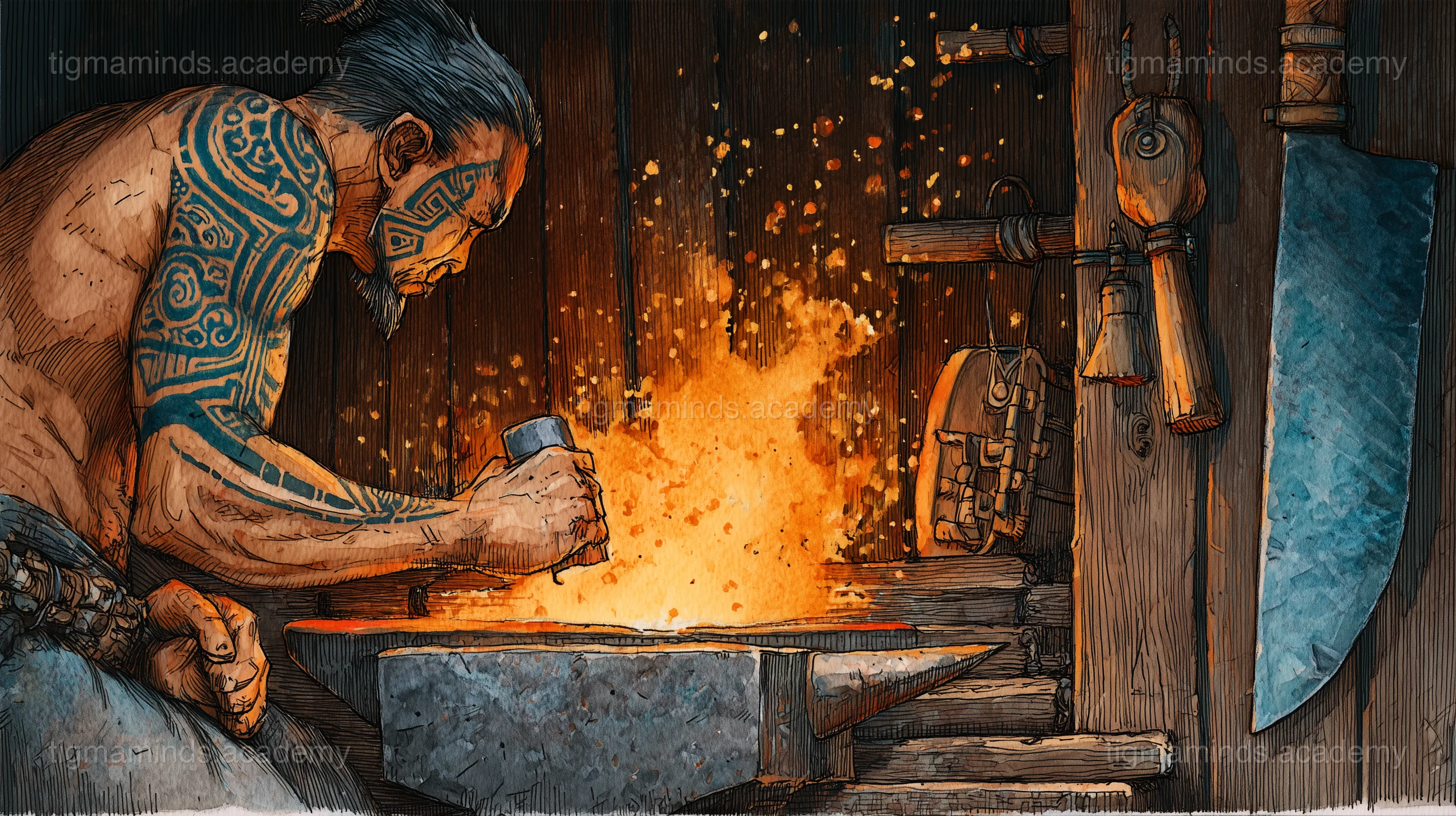
Sheangha's forge was a charcoal-fired brick hearth with a hand-cranked blower. The process took a full day for one dao:

Step 1: Heating. The spring was heated to cherry-red (~800°C) in the charcoal forge. At this temperature, the steel becomes soft enough to deform but not liquid. The carbon atoms are dissolved evenly in the iron crystal structure — a phase called austenite.

Step 2: Drawing out. Using a 3 kg hammer on a flat anvil, Sheangha drew the spring into a long, thin blade shape. Each blow compressed and stretched the metal, also welding shut any internal cracks or voids. This process — called forge welding — creates a blade with no internal weaknesses.

Step 3: Bevelling. The edge was hammered to a thin wedge — about 1 mm thick at the cutting edge, tapering to 6 mm at the spine. This differential thickness gives the dao its characteristic balance: heavy at the spine (for chopping power) and thin at the edge (for cutting sharpness).

Step 4: Hardening. The blade was heated to bright cherry-red and plunged into a trough of water mixed with plant sap (the sap controlled the cooling rate). The rapid cooling transformed the austenite into martensite — extremely hard but brittle crystal structure.

Step 5: Tempering. The hardened blade was reheated to about 200°C (straw-yellow colour) and allowed to cool slowly. This relieved internal stress while preserving most of the martensite hardness.

Step 6: Grinding and sharpening. The edge was ground on a sandstone wheel and finished on a fine river stone. A good dao edge can shave hair.

The Science of the Edge

"The edge is the whole point," said Sheangha. "Everything else — the weight, the balance, the handle — exists to deliver the edge."

Longwa's physics teacher later explained why sharp edges cut better. A sharp edge concentrates force on a tiny area. If you swing a 1 kg dao at a branch and apply 500 N of force:

With a blunt edge (contact area 10 mm² = 0.00001 m²): Pressure = 500 / 0.00001 = 50,000,000 Pa = 50 MPa

With a sharp edge (contact area 0.1 mm² = 0.0000001 m²): Pressure = 500 / 0.0000001 = 5,000,000,000 Pa = 5,000 MPa = 5 GPa

5 GPa is enough to cut through almost any biological material (wood, bone, muscle). It exceeds the compressive strength of hardwood (40–60 MPa) by a factor of 100. The blade doesn't so much cut the wood as crush it at the molecular level along a razor-thin line.

"Your uncle doesn't know gigapascals," said the teacher. "But he knows that thinner is sharper, and sharper cuts cleaner. The physics and the experience agree."

Edge Retention

The difference between a ₹300 factory dao and Sheangha's ₹3,000 dao is edge retention — how long the blade stays sharp under use.

Factory daos use low-carbon steel (0.1–0.2% C). The steel is soft and easy to grind to a sharp edge, but the edge deforms quickly with use — it rolls, bends, and dulls.

Sheangha's daos use medium-high-carbon steel (0.5–0.8% C), properly heat-treated. The martensite structure is much harder and resists deformation. The edge stays sharp through thousands of cuts. When it does eventually dull, it can be resharpened on a stone — and it will be just as sharp as new.

"A dao should last a lifetime," said Sheangha. "A man's dao should outlive him and pass to his son. That's what good steel does."

The end.

Try It Yourself

Choose your level. Everyone starts with the story — the code gets deeper as you go.

Story Progress

0%

Ready to Start Coding?

Here is a taste of what Level 1 looks like for this lesson:

Level 1: Explorer — Python
# Blade Edge Pressure Calculator
force = 500       # Newtons (chopping swing)
edge_width_mm = 0.05  # mm (sharp dao)
blade_length_mm = 250 # mm

area_mm2 = edge_width_mm * blade_length_mm
area_m2 = area_mm2 * 1e-6

pressure_Pa = force / area_m2
pressure_MPa = pressure_Pa / 1e6
pressure_GPa = pressure_Pa / 1e9

print(f"Edge area: {area_mm2:.1f} mm²")
print(f"Pressure: {pressure_MPa:,.0f} MPa = {pressure_GPa:.1f} GPa")
print(f"Wood strength: ~50 MPa → blade wins by {pressure_MPa/50:.0f}×")

This is just the first of 6 coding exercises in Level 1. By Level 4, you will build: Build a Blade Edge Pressure Calculator.

Free

Level 0: Listener

Stories, science concepts, diagrams, quizzes. No coding.

You are here

Enrolled

Levels 1-4

Python, NumPy, Matplotlib, real projects, mentorship.

Sign Up Free

Stay Updated

Join Waitlist

Get notified when enrollment opens for your area.

Notify Me

Level 0 is always free. Coding levels (1-4) are part of our 12-Month Curriculum.