How a tiny spice packs enormous flavour — the chemistry of essential oils and steam distillation.
The Scent
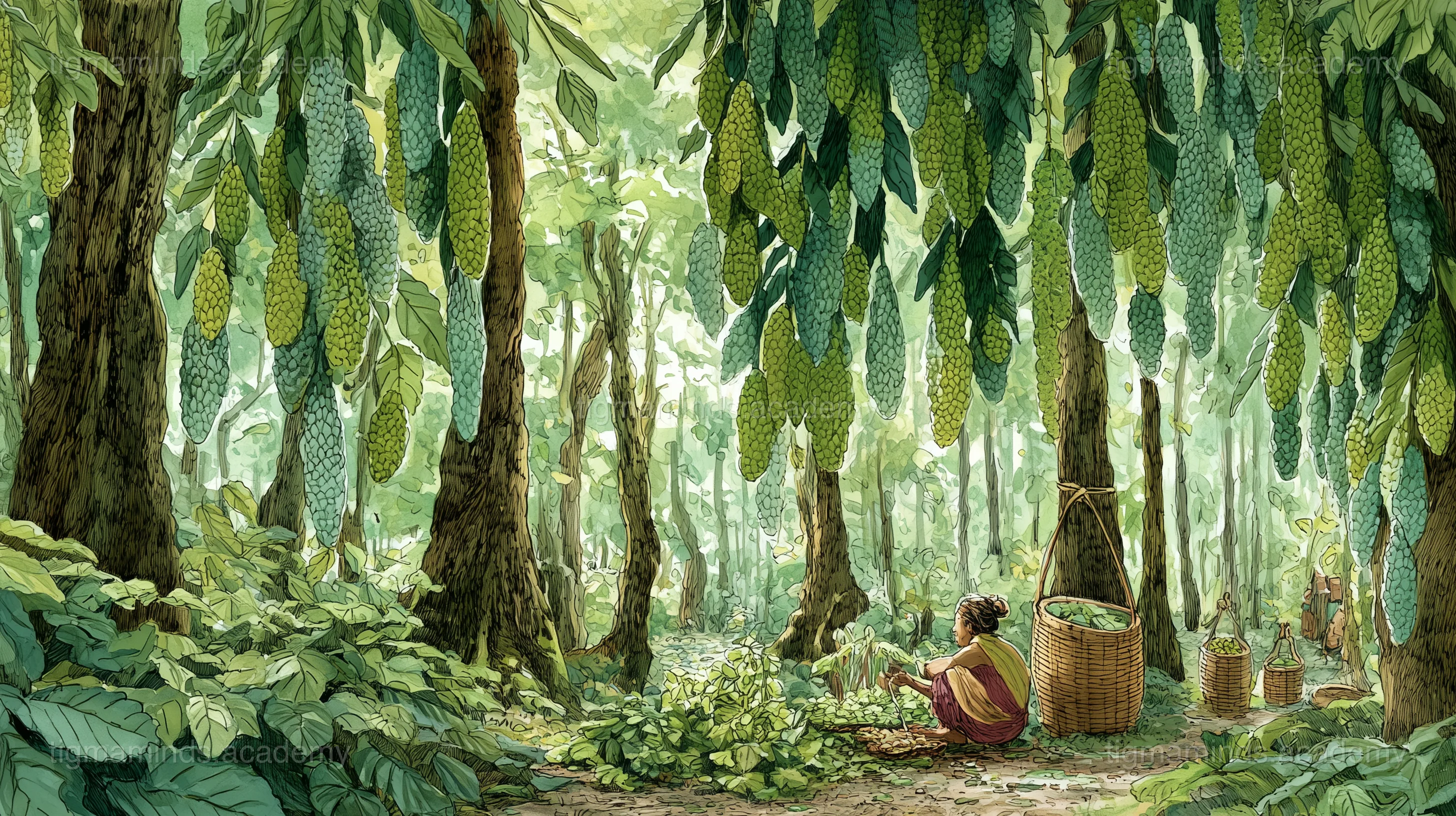
Sikkim is India's largest producer of large cardamom (Amomum subulatum) — not the small green cardamom of South India, but a larger, smoky, intensely aromatic pod that grows in the shaded understory of Sikkim's mid-altitude forests (1,000–2,000 metres).
Pemba Lepcha, a fifteen-year-old from a cardamom-farming family in Dzongu — a protected Lepcha homeland in northern Sikkim — had grown up surrounded by the scent. When the pods were dried over smoky fires of local wood, the air turned into something you could almost taste: warm, camphor-sweet, with a hint of pepper and eucalyptus.
"What IS that smell?" Pemba asked one day, as if asking for the first time.
Her mother laughed. "It's cardamom."
"I know it's cardamom. But what makes it smell? What molecule is doing that?"
Essential Oils
Pemba's chemistry teacher, Sir Tseten, had the answer. "The smell comes from essential oils — a complex mixture of volatile organic compounds produced by the plant and stored in tiny sacs inside the seed coat."
He brought a pod to class and crushed it. The scent exploded.
"When you crush the pod, you rupture those sacs and release the oils into the air. The molecules are small and lightweight, so they evaporate quickly — which is why you smell them instantly."
The primary compounds in large cardamom essential oil are: - 1,8-cineole (eucalyptol) — the fresh, camphor-like note. Same molecule found in eucalyptus leaves. - α-terpinyl acetate — sweet, floral note. - Limonene — citrus note. - Sabinene — warm, peppery note.
"The unique scent of Sikkim cardamom comes from the specific ratio of these molecules," said Sir Tseten. "Different growing conditions (altitude, rainfall, soil, shade) change the ratio, which changes the flavour. This is why Dzongu cardamom tastes different from cardamom grown at a different altitude."
Steam Distillation
Sir Tseten set up a demonstration. He placed crushed cardamom pods in a flask of water and heated it. As the water boiled, steam rose through the plant material, carrying the volatile essential oils with it. The steam-oil mixture passed through a condenser (a glass tube cooled by cold water), where it condensed back into liquid.
"Watch the condensate," said Sir Tseten.
In the collection flask, two layers formed. The bottom layer was water. The top layer was a thin, oily film — the essential oil. It floated because its density (~0.9 g/cm³) was less than water's.
"This is steam distillation — the oldest and most common method for extracting essential oils from plants. The principle is simple: steam is hot enough to vaporise the oils (which have boiling points of 150–300°C) because steam lowers their effective boiling point. When a mixture of water and oil vapour is cooled, they condense separately — water in one layer, oil in another."
Pemba was amazed. "So you can separate smell from a plant?"
"You can separate volatile molecules from anything. Steam distillation is used for perfumes (rose oil, lavender oil), medicines (tea tree oil), and food flavourings (vanilla extract). The same technique your grandmother uses when she boils cardamom in tea — the steam carries the flavour molecules into the liquid."
Why Plants Make Essential Oils
"Why does cardamom bother making these molecules?" asked Pemba. "It costs energy."
"Defence," said Sir Tseten. "1,8-cineole is toxic to many insects. Limonene repels fungi. These oils evolved as chemical weapons — protecting the plant from being eaten or infected. The fact that humans find them pleasant is an accident of biology."
He added: "Some essential oil compounds also attract pollinators (bees and wasps), repel herbivores (deer and monkeys), or inhibit the growth of competing plants (allelopathy). They are a chemical toolkit — offence, defence, and communication in one package."
The Drying Process
Large cardamom in Sikkim is traditionally dried over a bhatti — a slow-burning fire of specific woods (usually Schima or Alnus). The smoke adds its own volatile compounds to the cardamom, creating the distinctive smoky flavour that distinguishes Sikkim large cardamom from all other varieties.
The drying process is a chemical transformation. Fresh pods contain about 80% moisture. Over 24–48 hours on the bhatti, the moisture drops to about 10%. As water leaves, the essential oil becomes more concentrated in the dry pod — this is why dried spices are more pungent than fresh ones.
Some volatile compounds are lost during drying (heat evaporates them). Others are created by the heat — Maillard reactions between sugars and amino acids produce new aromatic molecules, just like the browning of bread or coffee beans. The drying process is itself a form of cooking, transforming the flavour profile of the cardamom.
"Every step changes the chemistry," said Pemba, taking notes furiously. "Growing, harvesting, crushing, drying, distilling — each one alters the mix of molecules that our nose detects as 'cardamom.'"
"Now you're thinking like a chemist," said Sir Tseten.
The end.
Choose your level. Everyone starts with the story — the code gets deeper as you go.
Here is a taste of what Level 1 looks like for this lesson:
# Cardamom Essential Oil Composition
compounds = {
"1,8-Cineole": {"pct": 35, "bp": 176, "note": "camphor/fresh"},
"α-Terpinyl acetate": {"pct": 18, "bp": 220, "note": "sweet/floral"},
"Limonene": {"pct": 8, "bp": 176, "note": "citrus"},
"Sabinene": {"pct": 7, "bp": 163, "note": "warm/pepper"},
"β-Pinene": {"pct": 5, "bp": 166, "note": "pine/fresh"},
}
print("=== Cardamom Essential Oil ===")
for name, info in compounds.items():
bar = "█" * (info["pct"] // 2)
print(f"{name:>22}: {info['pct']:>2}% {bar} ({info['note']})")This is just the first of 6 coding exercises in Level 1. By Level 4, you will build: Build an Essential Oil Composition Analyzer.
Free
Level 0: Listener
Stories, science concepts, diagrams, quizzes. No coding.
You are here
Level 0 is always free. Coding levels (1-4) are part of our 12-Month Curriculum.
Volatile compounds, steam distillation, and the chemistry of scent — how Sikkim's cardamom packs flavour into a tiny pod.
The big idea: "The Cardamom Hills of Sikkim" teaches us about Organic Chemistry & Essential Oils — and you don't need to write a single line of code to understand it.
Essential oils are concentrated mixtures of volatile organic compounds produced by plants. "Essential" doesn't mean necessary for health — it means they capture the plant's "essence" (its characteristic scent). "Volatile" means the molecules evaporate easily at room temperature, which is why you can smell them.
Each essential oil is a mixture of dozens to hundreds of different molecules. Cardamom oil contains at least 30 identified compounds. The scent we perceive as "cardamom" is actually the combined effect of all these molecules reaching our nose in a specific ratio.
The molecules are stored in tiny oil glands in the plant's tissues — in cardamom, these are inside the seed coat. Crushing the seeds ruptures the glands and releases the oils. Heating accelerates evaporation, intensifying the scent — which is why grinding fresh cardamom over warm food releases maximum flavour.
Check yourself: If you open a jar of ground cardamom that has been stored for a year, the scent will be weaker than freshly ground. Why?
Key idea: Essential oils are mixtures of volatile organic compounds that give plants their characteristic scent. They evaporate easily, which is why we can smell them — and why old ground spices lose their flavour.
Steam distillation exploits a physical principle: when water and an insoluble oil are heated together, the mixture boils at a temperature LOWER than either component's individual boiling point. This is because each liquid contributes independently to the total vapour pressure.
Many essential oil compounds have boiling points of 150–300°C — too hot to heat safely without burning the plant material. But in the presence of steam (100°C), the oil evaporates because the combined vapour pressure of water + oil exceeds atmospheric pressure at a lower temperature.
The steam carries oil vapour through a condenser, where both condense back to liquid. Since oil and water are immiscible (they don't mix), the condensate separates into two layers: water below, essential oil above. The oil is collected — pure, concentrated essence of the plant.
Humans have been using steam distillation for at least 1,000 years — the Persian physician Ibn Sina (Avicenna) perfected the technique around 1000 CE for producing rose water and medicinal oils.
Key idea: Steam distillation extracts essential oils by using steam to vaporise oil compounds at temperatures far below their normal boiling points. The vapour condenses into two immiscible layers: water and concentrated oil.
Access all 130+ lessons, quizzes, interactive tools, and offline activities
Plants can't run from predators. They can't hide. Their defence strategy is **chemical warfare** — producing toxic, repellent, or inhibitory molecules...
When you smell cardamom, volatile molecules travel through the air and enter your nose. Inside the nasal cavity, about 10 cm above your nostrils, is t...