The Prayer Flags of Sikkim
Materials Degradation & Textile Science

The Prayer Flags of Sikkim

Why prayer flags fade, fray, and fly — the physics of wind, UV degradation, and textile science.

Materials Degradation & Textile Science12-Month Curriculum 10h

The Story

The Five Colours

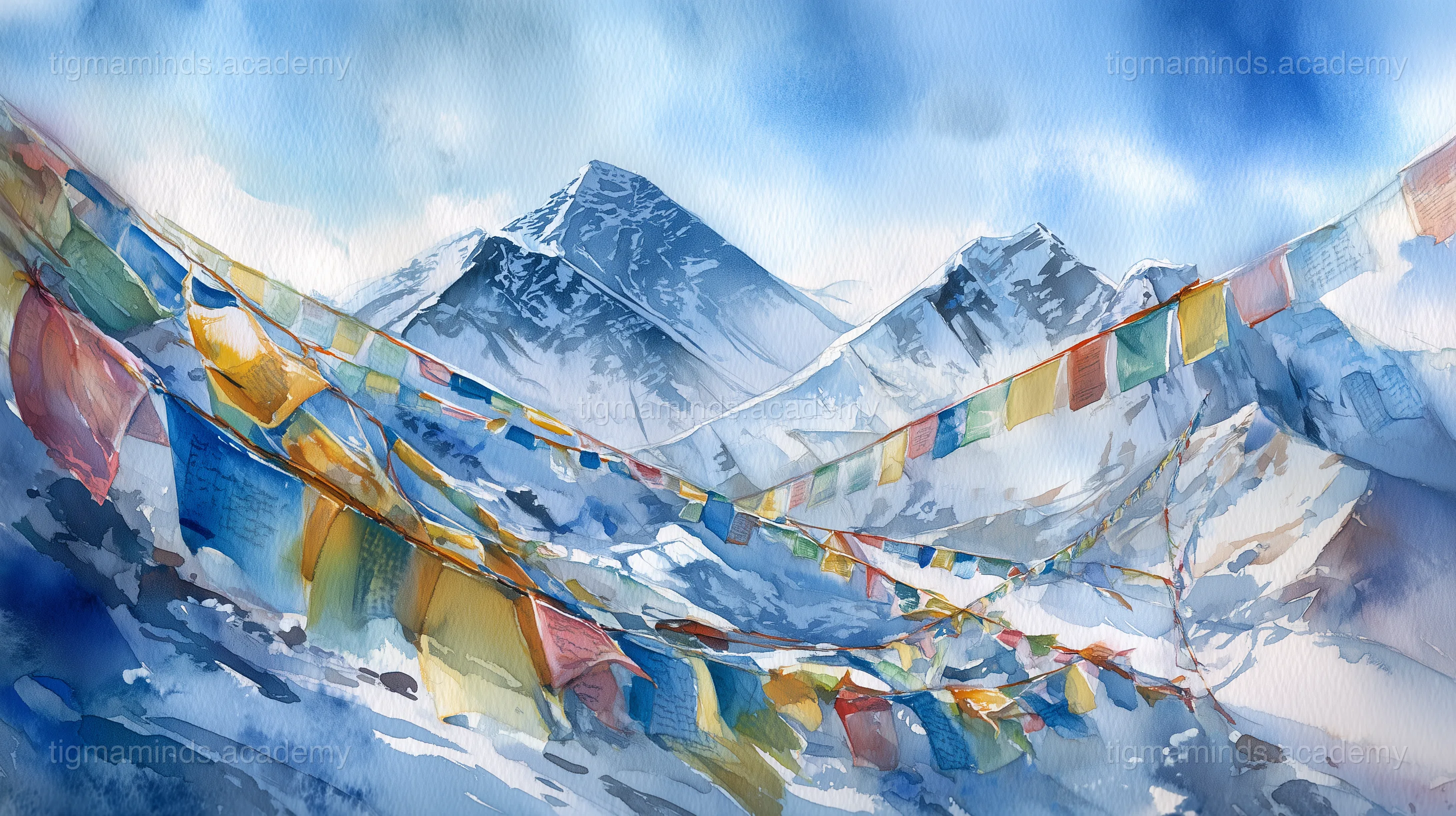
Across every mountain pass, monastery, and bridge in Sikkim, strings of coloured cloth snap and flutter in the wind. Five colours, always in the same order: blue, white, red, green, yellow — representing sky, wind, fire, water, earth.

These are lung-ta — prayer flags — and the Sikkimese believe that the wind carries the prayers printed on them to all living beings. When the flags fray, fade, and finally disintegrate, the prayers have been fully released.

Tenzin Dolkar, a sixteen-year-old girl from Rumtek, where the famous Rumtek Monastery overlooks the Sikkim valley, noticed that prayer flags never lasted. Her grandmother hung fresh flags at New Year, and by monsoon they were already tattered and pale — the reds turned pink, the blues turned grey, the yellow bleached to white.

"Why do they decay so fast?" Tenzin asked her textile science teacher, Miss Ongmu.

"Three enemies," said Miss Ongmu. "Wind, sun, and water. Each one attacks the fabric in a different way."

UV Degradation

The first enemy is ultraviolet radiation from the sun. UV photons have enough energy to break the chemical bonds in both the fabric and the dye molecules.

Prayer flags are traditionally made from thin cotton or polyester, block-printed with prayers in water-based ink. The dye molecules absorb UV photons, and the absorbed energy breaks the molecule into smaller fragments that are no longer coloured. This is photodegradation — the sun literally dismantles the colour, molecule by molecule.

"At Rumtek (2,000 metres), UV is about 20% stronger than at sea level," said Miss Ongmu. "And prayer flags are exposed 24/7, with no shelter. In 6 months, they receive as much UV as a T-shirt would get in 5 years of normal wear."

Red dye fades fastest because red dye molecules absorb blue and UV light most strongly — the same property that makes them look red (reflecting red, absorbing blue) also makes them most vulnerable to UV damage. Blue dyes absorb red and orange light (lower energy photons) and are slightly more resistant.

Wind: The Mechanical Attack

The second enemy is wind. Prayer flags are designed to flutter — they are hung loosely on strings between poles, catching every breeze. Each flutter is a mechanical stress: the fabric bends, straightens, bends again, thousands of times per day.

This is fatigue — the weakening of a material by repeated cyclic stress, even if each individual stress is well below the breaking strength. A paper clip can withstand enormous pulling force, but bend it back and forth 20 times and it snaps. The same happens to cotton fibres in the flag.

Each wind gust also creates localised stress at the flag's attachment points and at any existing weak spots (holes, thin areas). Over time, these stress concentrations cause cracks to propagate, and the flag tears. The edges fray first because the cut edge exposes fibre ends that can unravel.

"Wind speed at mountain passes can exceed 80 km/h," said Miss Ongmu. "At those speeds, a thin cotton flag experiences dynamic pressure of about 300 Pa — modest, but applied millions of times, it destroys the fabric."

Moisture: The Chemical Attack

The third enemy is water — from rain, fog, and the daily cycle of condensation and drying. Water swells cotton fibres (cotton absorbs up to 25% of its weight in water), and repeated swelling-and-drying cycles weaken the fibre structure.

More importantly, water accelerates chemical reactions. When UV breaks dye molecules into reactive fragments, those fragments react with water and oxygen to produce free radicals — highly reactive molecules that attack the fabric's cellulose fibres. This chain reaction (UV + water + oxygen → free radicals → cellulose breakdown) is much faster than UV alone.

"This is why flags in dry mountain air (like Ladakh) last longer than flags in humid Sikkim," said Miss Ongmu. "Same UV, same wind, but less moisture means fewer free radical attacks."

The Science of Impermanence

Tenzin found a beautiful irony: the decay of prayer flags is not a flaw — it is the design. Buddhists view the gradual decomposition as a symbol of impermanence (anicca) — the teaching that all things arise, persist, and pass away. The flag is meant to fade. The colour is meant to drain. The cloth is meant to fray.

"The physics of decay is the physics of impermanence," said Miss Ongmu. "UV degrades dyes. Wind fatigues fibres. Water accelerates both. These are the same processes that weather mountains, rust bridges, and age our bodies. Nothing is permanent — not flags, not rocks, not us."

Tenzin hung fresh prayer flags on the monastery line. Blue, white, red, green, yellow. The wind caught them immediately, snapping them taut, sending prayers — and photons and mechanical stress — across the Himalayan sky.

By monsoon, they would be ghosts. By next New Year, they would be gone.

And that was exactly right.

The end.

Try It Yourself

Choose your level. Everyone starts with the story — the code gets deeper as you go.

Story Progress

0%

Ready to Start Coding?

Here is a taste of what Level 1 looks like for this lesson:

Level 1: Explorer — Python
# Prayer Flag Fading Simulator
import math

colours = {
    "Blue":   {"rate": 0.003, "pct": 100},
    "White":  {"rate": 0.001, "pct": 100},
    "Red":    {"rate": 0.005, "pct": 100},
    "Green":  {"rate": 0.004, "pct": 100},
    "Yellow": {"rate": 0.006, "pct": 100},
}

for month in range(0, 13, 3):
    print(f"Month {month:>2}: ", end="")
    for name, c in colours.items():
        c["pct"] = 100 * math.exp(-c["rate"] * month * 30)
        print(f"{name}={c['pct']:.0f}% ", end="")
    print()

This is just the first of 6 coding exercises in Level 1. By Level 4, you will build: Build a Material Degradation Simulator.

Free

Level 0: Listener

Stories, science concepts, diagrams, quizzes. No coding.

You are here

Enrolled

Levels 1-4

Python, NumPy, Matplotlib, real projects, mentorship.

Sign Up Free

Stay Updated

Join Waitlist

Get notified when enrollment opens for your area.

Notify Me

Level 0 is always free. Coding levels (1-4) are part of our 12-Month Curriculum.