The Ras Lila of Manipur
Circular Motion & Orbital Mechanics

The Ras Lila of Manipur

How Manipur's celestial dance encodes the physics of circular motion and orbital mechanics.
Circular Motion & Orbital Mechanics12-Month Curriculum 10h

The Story

The Circle

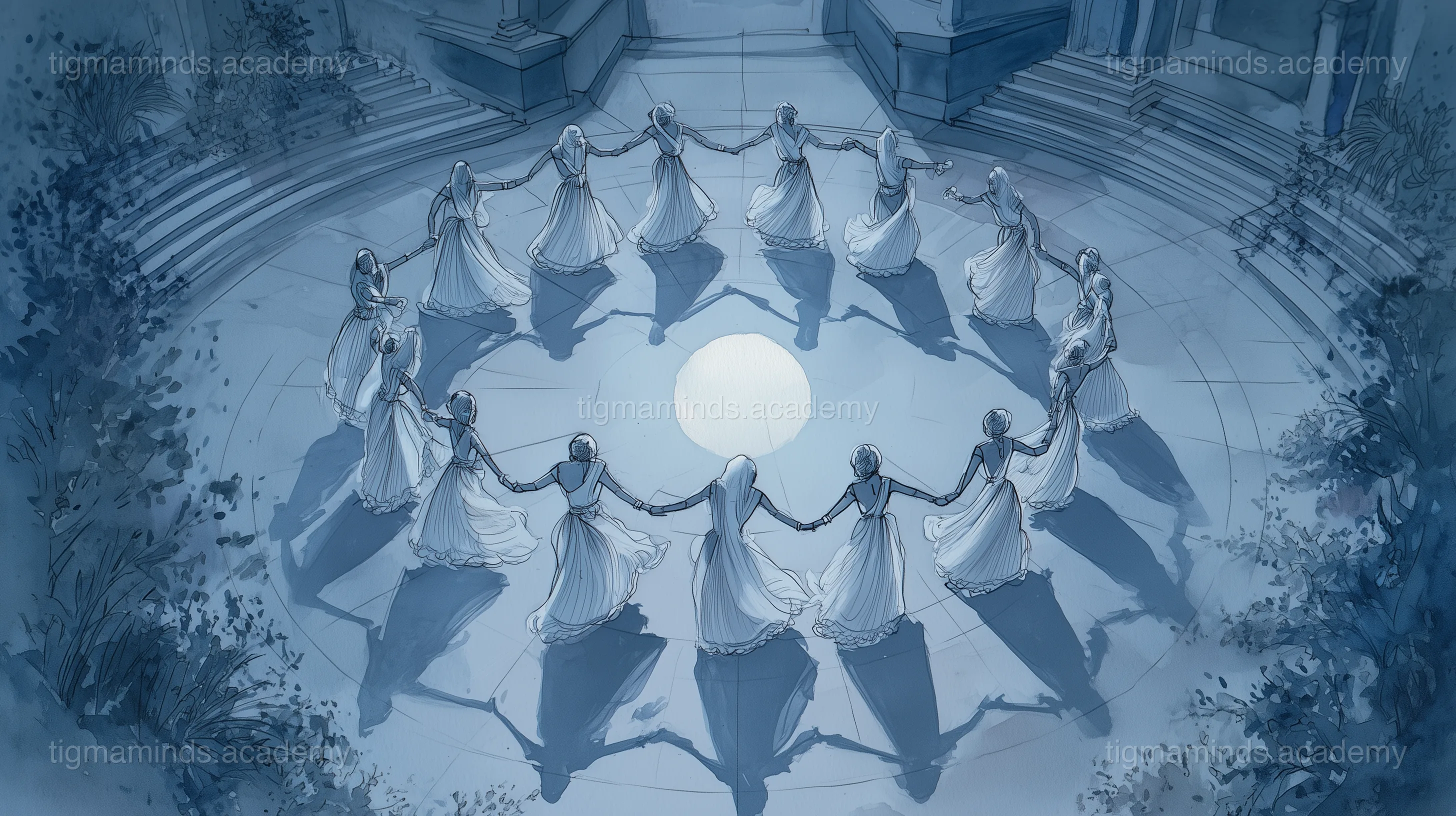
Every autumn, when the full moon of Kartik rises over Imphal, the temple courtyards of Manipur come alive with the Ras Lila — a sacred dance performed by young women dressed as gopis (celestial cowherd maidens), circling a central figure who represents Krishna.

The dancers move in a perfect circle. Their pace is steady, their spacing exact. Each gopi faces the centre, arms extended, hands joined with the gopis on either side. They orbit the central figure the way planets orbit a sun — always moving, never falling in, never flying out.

Lairik Yaipha Chanu — known as Yaima — was fourteen and had trained for the Ras Lila since she was eight. She could hold her position in the circle with her eyes closed, feeling the pull of her neighbours' hands and the centripetal tension in her own body.

One evening, after rehearsal, her physics teacher, Sir Ibomcha (the same Sir Ibomcha who made every lesson interesting), watched a video of the performance on his phone.

"Yaima," he said, "do you know you're demonstrating circular motion?"

"I'm demonstrating devotion," said Yaima, a little offended.

"It can be both," said Sir Ibomcha. "Let me show you."

Why You Don't Fly Off

Sir Ibomcha tied a ball to a string and swung it in a circle.

"The ball wants to fly off in a straight line," he said. "Newton's first law: an object in motion stays in motion in a straight line unless a force acts on it. The string provides that force — it pulls the ball toward the centre. This inward pull is called centripetal force."

He pointed to the video of the Ras Lila. "Your hands, linked with the gopis on either side, provide the same force. Each dancer exerts a slight inward pull through the chain of hands. That's why the circle holds. If one dancer lets go, the circle breaks and dancers fly outward — just like the ball flying off when the string snaps."

Yaima thought about this. She remembered how, during fast portions of the dance, she could feel the tension in her arms — the outward pull as her body wanted to continue in a straight line, and the inward pull from her neighbours' hands keeping her on the curve.

"That tension is centripetal force," said Sir Ibomcha. "And the faster you spin, the stronger it must be. That's why fast sections of the Ras Lila are harder to maintain — the centripetal force increases with the square of the speed."

The Orbital Connection

"Now," said Sir Ibomcha, "imagine a much bigger circle. Earth orbiting the Sun. What provides the centripetal force?"

"Gravity?" said Yaima.

"Exactly. Gravity pulls Earth toward the Sun, just like the string pulls the ball — or like the linked hands pull the dancers. Earth is constantly falling toward the Sun, but it's also moving sideways fast enough that it keeps missing. The result is an orbit — a perpetual circle (well, an ellipse, but close enough)."

He drew a diagram. "If gravity suddenly vanished, Earth would fly off in a straight line — just like a dancer who lets go of the circle. If Earth stopped moving sideways, it would fall straight into the Sun — just like the ball falling when the string goes slack but the ball has no sideways speed."

"So the Ras Lila is a solar system?" said Yaima, now genuinely interested.

"Krishna in the centre is the Sun. The gopis are the planets. The linked hands are gravity. The circular motion is the orbit. The balance between inward pull and forward motion is what keeps everything in place. Your dance literally enacts orbital mechanics."

The Mathematics

Over the next week, Sir Ibomcha taught Yaima the equations. For an object moving in a circle of radius r at speed v, the centripetal acceleration is:

a = v² / r

And the centripetal force is:

F = mv² / r

where m is the mass.

Yaima measured the Ras Lila circle: radius approximately 5 metres. She timed one revolution: about 20 seconds. Speed v = circumference ÷ time = 2π × 5 ÷ 20 ≈ 1.57 m/s.

For a dancer of mass 50 kg: F = 50 × (1.57)² / 5 ≈ 24.6 Newtons — about the force of lifting a 2.5 kg bag of rice.

"That's the tension in your arms during the slow section," said Sir Ibomcha. "Now calculate the fast section — twice the speed."

F = 50 × (3.14)² / 5 ≈ 98.6 Newtons — four times as much, because force scales with the square of speed.

"That's why the fast section feels so much harder," said Yaima. "The force quadruples when the speed doubles."

The Performance

On the night of the full moon, Yaima danced the Ras Lila in the courtyard of the Govindajee Temple. The moonlight silvered the white costumes. The drums kept time. Twelve gopis circled in perfect synchrony, their feet barely whispering on the stone floor, their arms taut with the centripetal tension that held the circle together.

During the fast section, Yaima felt the pull — stronger now, exactly as the equation predicted. She leaned slightly inward, adjusting her centre of gravity, and held the circle firm. The physics was invisible to the audience. All they saw was grace.

But Yaima knew. She was a planet in orbit, held by forces she could now calculate, dancing a pattern as old as gravity itself.

The end.

Try It Yourself

Choose your level. Everyone starts with the story — the code gets deeper as you go.

Story Progress

0%

Ready to Start Coding?

Here is a taste of what Level 1 looks like for this lesson:

Level 1: Explorer — Python
# Ras Lila Centripetal Force Calculator
import math

radius = 5.0       # metres
mass = 50.0        # kg (dancer)
rev_time = 20.0    # seconds per revolution

speed = 2 * math.pi * radius / rev_time
force = mass * speed**2 / radius
accel = speed**2 / radius

print(f"Speed: {speed:.2f} m/s")
print(f"Centripetal acceleration: {accel:.2f} m/s²")
print(f"Centripetal force: {force:.1f} N ({force/9.8:.1f} kg equivalent)")
print()
print("Double speed:")
force2 = mass * (2*speed)**2 / radius
print(f"Force: {force2:.1f} N — {force2/force:.0f}× more!")

This is just the first of 6 coding exercises in Level 1. By Level 4, you will build: Build an Orbital Mechanics Simulator.

Free

Level 0: Listener

Stories, science concepts, diagrams, quizzes. No coding.

You are here

Enrolled

Levels 1-4

Python, NumPy, Matplotlib, real projects, mentorship.

Sign Up Free

Stay Updated

Join Waitlist

Get notified when enrollment opens for your area.

Notify Me

Level 0 is always free. Coding levels (1-4) are part of our 12-Month Curriculum.