The Sword and the Spear of Manipur
Rotational Dynamics & Biomechanics

The Sword and the Spear of Manipur

How Manipur's ancient martial art encodes the physics of torque, angular momentum, and rotational energy.

Rotational Dynamics & Biomechanics12-Month Curriculum 10h

The Story

The Training Ground

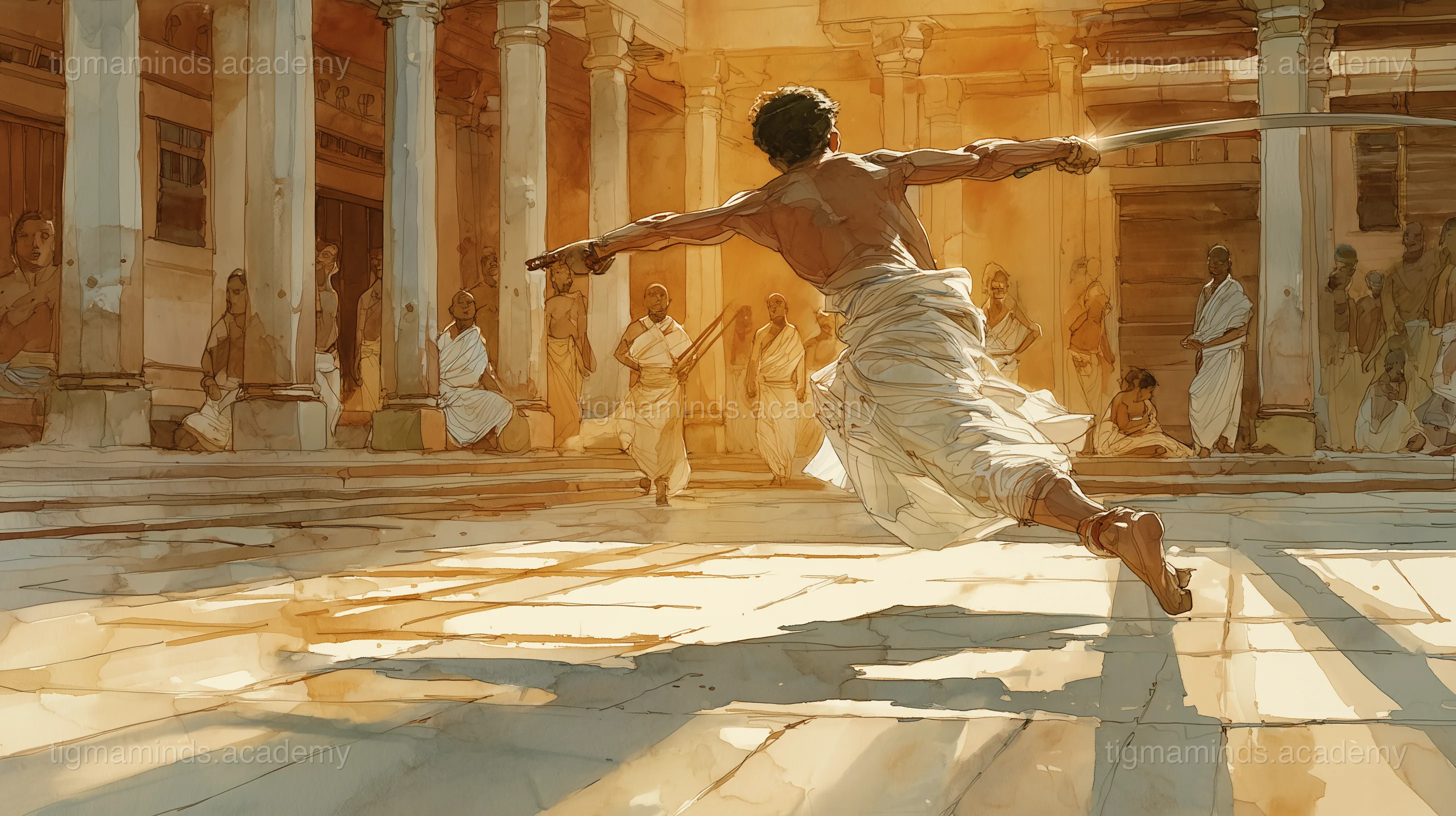
At dawn in the courtyard of a small gymnasium in Imphal, twelve students stood in two rows facing a man who held a sword as if it were part of his arm. He was Guru Ibomcha Singh, one of the last living masters of Thang-Ta — Manipur's ancient martial art.

Thang means sword. Ta means spear. Together, Thang-Ta is the martial art of the Meitei people — a system of armed and unarmed combat developed over centuries for the defence of the Manipur kingdom. It was so effective that in the Anglo-Manipur War of 1891, Thang-Ta warriors with swords held off British troops armed with rifles — for a time.

Khundrakpam Devajit — called Deva — was fifteen and the youngest advanced student in Guru Ibomcha's school. He was fast but small, and he struggled with the spinning cuts — wide, circular swings of the sword that generated devastating power.

"Your arm is too stiff," said Guru Ibomcha. "You are trying to push the sword with muscle. That is wrong. The sword must rotate. Let your body be the axle. Let the blade be the wheel. The circle does the work."

The Physics of the Spin

That evening, Deva sat with his physics textbook and realised that Guru Ibomcha had been teaching him rotational dynamics without ever using the word.

A Thang-Ta spinning cut is a rotational motion — the sword traces a circle with the warrior's spine as the axis. The speed of the blade tip depends on the angular velocity (how fast the body rotates) and the radius (how far the blade tip is from the axis).

The relationship is: v = ωr, where v is the tip speed, ω (omega) is the angular velocity in radians per second, and r is the radius.

A Thang-Ta sword is about 80 cm long. The warrior's arm adds another 60 cm. Total radius from spine to blade tip: about 1.4 metres. If the warrior spins at 2 revolutions per second (ω = 2 × 2π = 12.6 rad/s):

v = 12.6 × 1.4 = 17.6 m/s (63 km/h)

That's the speed of the blade tip — faster than a professional tennis serve — and the warrior barely feels like they're exerting themselves because the rotation does the work.

"Guru was right," Deva muttered. "The circle does the work."

Torque: Why the Twist Matters

The next morning, Guru Ibomcha taught the thiek — a powerful downward cut that begins with a full-body twist.

"Start the twist from your feet," he said. "The ground pushes your feet. Your feet twist your hips. Your hips twist your shoulders. Your shoulders twist your arm. Your arm swings the sword. Each link in the chain adds torque."

Deva knew torque from physics: τ = r × F — the rotational equivalent of force. Torque depends on both the force applied and how far from the axis it is applied. A force applied far from the axis (like pushing the rim of a wheel) creates more torque than the same force applied near the axis (like pushing near the hub).

In the thiek, each body segment adds its own torque: - Feet push against the ground (reaction force creates initial twist) - Hips rotate, adding torque to the shoulders - Shoulders rotate, adding torque to the arm - Arm extends, adding torque to the sword

This kinetic chain — force transferred through a series of body segments, each one amplifying the rotation — is the same principle used in a baseball pitch, a golf swing, and a karate punch. The power doesn't come from the arm. It comes from the sequential uncoiling of the entire body, from feet to fingertips.

Deva tried again. This time, instead of muscling the sword with his arm, he started from the ground. His rear foot pushed. His hips twisted. His shoulders whipped around. The sword came through like a gate slamming shut — fast, heavy, and seemingly effortless.

"Better," said Guru Ibomcha. "Now do it a thousand more times."

Angular Momentum: Why Spinning Fighters Are Hard to Stop

Guru Ibomcha demonstrated the meithi — a spinning defensive move where the warrior rotates 360° with the sword extended, creating a circle of steel that deflects any incoming attack.

"Once you begin the spin," said the Guru, "you are difficult to stop. This is because of angular momentum."

Angular momentum (L) = moment of inertia (I) × angular velocity (ω). It is the rotational equivalent of linear momentum (mass × velocity). Just as a heavy truck moving fast is hard to stop (high linear momentum), a spinning warrior with arms extended is hard to stop (high angular momentum).

The moment of inertia depends on how mass is distributed relative to the axis. Mass far from the axis (extended arms, sword at full reach) has a higher moment of inertia than mass close to the axis (arms pulled in). This is why figure skaters spin faster when they pull their arms in — angular momentum is conserved, so reducing I increases ω.

In Thang-Ta, the warrior exploits this: - Begin the spin with arms extended (high I, moderate ω) — maximum reach, maximum threat radius - Pull arms in mid-spin (I decreases, ω increases) — accelerate the rotation - Extend again to strike (I increases, ω decreases) — maximum reach at the moment of contact

"An ice skater and a sword fighter use the same physics," said Deva's physics teacher when he shared his analysis. "Conservation of angular momentum. The universe doesn't care whether you're wearing sequins or armour."

The Defence of Manipur

Thang-Ta was not sport. It was survival. For centuries, the Meitei kingdom faced invasions from Burma, Assam, and eventually Britain. Thang-Ta warriors trained from childhood, and the art encoded not just combat technique but biomechanical optimisation — how to generate maximum force with minimum energy, how to maintain balance during rapid rotation, and how to exploit the physics of spinning blades.

The British banned Thang-Ta after the Anglo-Manipur War, recognising it as a military threat. The art survived underground, passed secretly from guru to student for decades. It was only after Indian independence that Thang-Ta re-emerged publicly.

Today, Guru Ibomcha's gymnasium is one of about fifty schools in Manipur keeping the art alive. Deva trains every morning, spinning, cutting, thrusting — each move a lesson in rotational physics wrapped in cultural memory.

"When I spin the sword," Deva told his classmates, "I am not just practicing a martial art. I am demonstrating the conservation of angular momentum, the kinetic chain of torque transfer, and the relationship v = ωr. My body is a physics experiment. And it has been for 500 years."

The end.

Try It Yourself

Choose your level. Everyone starts with the story — the code gets deeper as you go.

Story Progress

0%

Ready to Start Coding?

Here is a taste of what Level 1 looks like for this lesson:

Level 1: Explorer — Python
# Thang-Ta Blade Speed Calculator
import math

spin_rate = 2.0    # revolutions per second
omega = spin_rate * 2 * math.pi  # rad/s

# Kinetic chain: spine → shoulder → elbow → wrist → tip
segments = {"Hand": 0.4, "Elbow": 0.7, "Shoulder": 1.0, "Blade tip": 1.4}

print(f"Spin rate: {spin_rate} rev/s ({omega:.1f} rad/s)")
for name, radius in segments.items():
    speed = omega * radius
    print(f"  {name:>12} (r={radius}m): {speed:.1f} m/s ({speed*3.6:.0f} km/h)")

This is just the first of 6 coding exercises in Level 1. By Level 4, you will build: Build a Rotational Strike Analyzer.

Free

Level 0: Listener

Stories, science concepts, diagrams, quizzes. No coding.

You are here

Enrolled

Levels 1-4

Python, NumPy, Matplotlib, real projects, mentorship.

Sign Up Free

Stay Updated

Join Waitlist

Get notified when enrollment opens for your area.

Notify Me

Level 0 is always free. Coding levels (1-4) are part of our 12-Month Curriculum.