The Mothers' Market of Imphal
Economics & Market Dynamics

The Mothers' Market of Imphal

How the world's largest all-women market runs on the invisible hand of supply and demand.
Economics & Market Dynamics12-Month Curriculum 10h

The Story

The Market

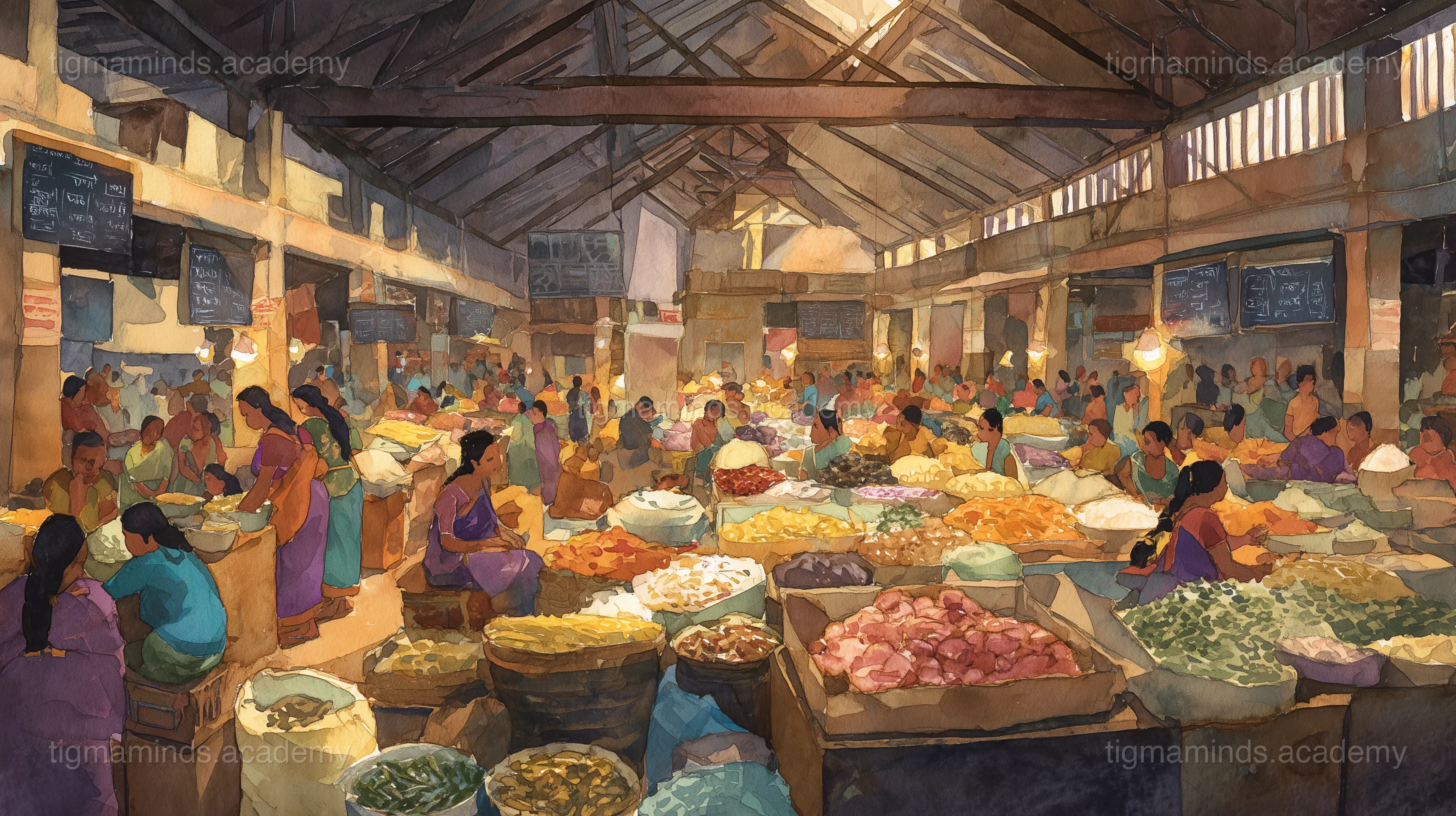
In the heart of Imphal stands a market like no other in the world. Ima Keithel — the Mothers' Market — is the largest all-women marketplace on Earth. Over 5,000 women sit in stalls arranged across three large buildings and the surrounding streets, selling everything from fresh fish and vegetables to handwoven textiles and gold jewellery.

No men are allowed to sell here. It has been this way for over 500 years.

A girl named Ningthoujam Bembem — called Bembem — was thirteen and the daughter of a market woman. Her mother, Ima Memma, had sold vegetables in Ima Keithel for twenty-two years, occupying the same stall that her mother had occupied before her.

Every day after school, Bembem helped at the stall. She weighed tomatoes, counted change, and watched her mother do something that looked simple but was actually extraordinarily complex: set prices.

The Price Problem

"Ima," said Bembem one afternoon, "why are tomatoes ₹40 per kilo today? Yesterday they were ₹30."

"The truck from Churachandpur didn't come today," said Ima Memma. "Less supply. Same customers. So the price goes up."

"But how do you know it should be ₹40 and not ₹50 or ₹35?"

Ima Memma smiled. "Look around you."

Bembem looked. There were seven other women selling tomatoes within her line of sight. She could see their prices written on small chalkboards. ₹38. ₹42. ₹40. ₹39. ₹41.

"If I charge ₹50, my customers walk three stalls down and buy at ₹38," said Ima Memma. "If I charge ₹25, I sell out in an hour but lose money. The price settles where buyers are willing to pay and I can still make a profit. That's where everyone ends up — around ₹40."

"That sounds like what Sir called... supply and demand?"

"I don't know what Sir calls it. I call it common sense."

Supply and Demand in Action

Bembem started keeping a notebook. Every day, she recorded: (1) how much her mother paid for tomatoes at the wholesale market at dawn, (2) how much she sold them for at Ima Keithel, and (3) how many kilos she sold.

After two months, patterns emerged.

When supply was high (good harvest, many trucks arriving), wholesale prices dropped, retail prices dropped, and Ima Memma sold more kilos but at a lower margin. When supply was low (bad weather, road blockages, truck delays), wholesale prices spiked, retail prices rose, and sales volume fell — but the margin per kilo was higher.

On average, her mother's daily profit was remarkably stable: around ₹400-500 per day regardless of price fluctuations. When prices were high, she sold less but earned more per kilo. When prices were low, she sold more at thinner margins.

"Ima," said Bembem, showing her the notebook, "your profit barely changes."

Ima Memma nodded. "If it changed too much in either direction, something would adjust. If I made too much, other women would start selling tomatoes too, increasing supply and pushing the price down. If I made too little, some women would stop selling tomatoes and switch to onions, reducing supply and pushing the price up. The market finds a balance."

The Invisible Hand

Bembem's economics teacher, Sir Sanjit, was delighted when she showed him the notebook.

"You've just demonstrated what Adam Smith called the invisible hand," he said. "No one person decides the price of tomatoes in Ima Keithel. No government official sets it. No committee meets about it. Instead, 5,000 individual women making independent decisions about what to sell, how much to charge, and when to switch products create a system that — without any central coordination — efficiently distributes goods to buyers at prices that roughly match their value."

"But it's not invisible," said Bembem. "I can see my mother watching other stalls, adjusting her price, choosing what to buy at wholesale. It's thousands of visible decisions."

"Exactly right," said Sir Sanjit. "The hand is invisible because no ONE person can see or control the whole system. But every individual hand is very visible. That's the beauty of a market — it aggregates thousands of small, local decisions into a global outcome that no single person could have planned."

The 500-Year Experiment

Sir Sanjit told Bembem that Ima Keithel was one of the longest-running market experiments in history. "Five hundred years of continuous operation, entirely managed by women, without formal regulation or government pricing. The market functions because its participants — the Imas — have developed sophisticated economic intuition through generations of experience."

He pointed out several features that economists would recognise:

Competition keeps prices fair — with hundreds of sellers offering the same goods, no one can overcharge.

Specialisation improves quality — each Ima becomes an expert in her particular goods.

Information flows freely — prices are visible on chalkboards, and every Ima knows what everyone else is charging within minutes.

Trust and reputation substitute for formal contracts — a buyer who is cheated on quality tells every other Ima, and the cheat loses customers permanently.

"Modern economists spend decades building mathematical models of market efficiency," said Sir Sanjit. "Your mother lives inside one."

The end.

Try It Yourself

Choose your level. Everyone starts with the story — the code gets deeper as you go.

Story Progress

0%

Ready to Start Coding?

Here is a taste of what Level 1 looks like for this lesson:

Level 1: Explorer — Python
# Supply-Demand Price Finder
supply_kg = 500    # tomatoes available today
demand_kg = 600    # tomatoes wanted by customers

base_price = 30    # ₹/kg when supply = demand

# Price adjusts based on supply-demand gap
ratio = demand_kg / supply_kg
price = base_price * ratio

print(f"Supply: {supply_kg} kg")
print(f"Demand: {demand_kg} kg")
print(f"Equilibrium price: ₹{price:.0f}/kg")

if supply_kg < demand_kg:
    print("Shortage! Price rises.")
else:
    print("Surplus! Price falls.")

This is just the first of 6 coding exercises in Level 1. By Level 4, you will build: Build a Market Price Simulator.

Free

Level 0: Listener

Stories, science concepts, diagrams, quizzes. No coding.

You are here

Enrolled

Levels 1-4

Python, NumPy, Matplotlib, real projects, mentorship.

Sign Up Free

Stay Updated

Join Waitlist

Get notified when enrollment opens for your area.

Notify Me

Level 0 is always free. Coding levels (1-4) are part of our 12-Month Curriculum.