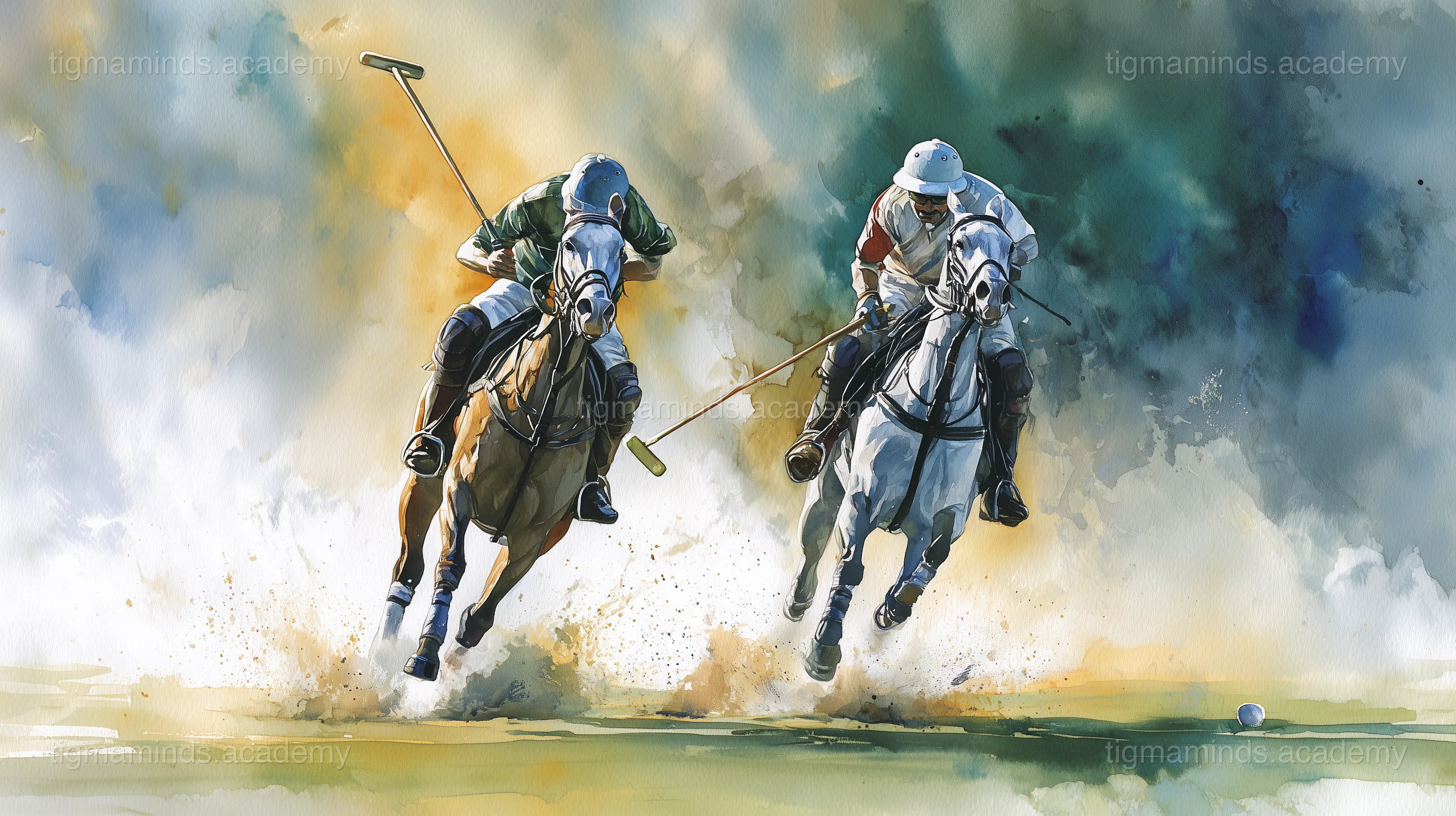
The Birthplace of Polo
Momentum, Collisions & Projectile Motion

The Birthplace of Polo

How Manipur invented the world's oldest team sport — and the physics of horse-stick-ball collisions.

Momentum, Collisions & Projectile Motion12-Month Curriculum 10h

The Story

Sagol Kangjei

Long before British officers brought polo to England, before the game conquered the clubs of Argentina and the fields of Dubai, there was Sagol Kangjei — the original game of mounted polo, born in the valleys of Manipur.

The Manipuri people had been playing Sagol Kangjei for at least 700 years. Some historians trace it back further — perhaps to the time of the Meitei kings in the 1st century CE. The game was not leisure. It was training for cavalry warfare, played with the fierce intensity of a battle rehearsal.

A boy named Yumnam Dorendro — called Doren — was fifteen and the youngest member of his village polo team. He was also the smallest, which meant he rode the smallest pony — a local Manipuri Pony, one of the five recognised horse breeds of India, standing barely 13 hands high.

"Size doesn't matter in Sagol Kangjei," said his coach, Oja Iboyaima. "Speed and timing do. A small pony that turns fast beats a big horse every time."

The Manipuri Pony

The Manipuri Pony is a wonder of selective breeding. For centuries, Meitei kings maintained breeding programs, selecting ponies for agility, stamina, and a low centre of gravity. The result is a horse that can spin on its hindquarters, accelerate explosively, and stop dead from a full gallop in two strides.

Doren's pony, Thoibi (named after the legendary Meitei princess), was 12.2 hands — barely taller than Doren himself. But she could change direction faster than any horse he had ever ridden. When Doren leaned left, Thoibi was already turning. When he shifted his weight forward, she launched into a gallop as if spring-loaded.

"Why can she turn so fast?" Doren asked Oja Iboyaima.

"Low centre of gravity," said the coach. "The shorter the horse, the lower its mass is to the ground. The lower the centre of gravity, the tighter the turn it can make without toppling over. A tall horse at the same speed would roll over trying to turn that sharply."

The Physics of the Hit

The heart of Sagol Kangjei is the shot — swinging a long bamboo mallet at full gallop to strike a ball made of bamboo root. The mallet is about 120 cm long, shorter than the mallets used in international polo (which are 130-137 cm), because the Manipuri Ponies are smaller.

Oja Iboyaima set up a physics lesson on the field.

"When you swing the mallet, your arm and the mallet form a lever. Your shoulder is the fulcrum. The force you apply at the handle is amplified at the mallet head because of the lever arm. But the real power comes from the horse's speed combined with your swing."

He explained: the speed of the mallet head when it strikes the ball is the sum of three velocities: 1. The horse's speed (about 30 km/h = 8.3 m/s) 2. The rider's arm swing (about 5 m/s) 3. The wrist snap at impact (about 3 m/s)

Total mallet head speed at impact: approximately 16 m/s (58 km/h).

"The ball weighs about 120 grams," said the coach. "The collision is what physicists call an elastic collision — not perfectly elastic, because some energy is lost to deformation and sound, but close. The ball leaves the mallet at roughly the same speed the mallet was moving — about 16 m/s."

Using projectile motion equations (assuming a launch angle of 25° for a low, driving shot):

Range = v² × sin(2θ) / g = (16)² × sin(50°) / 9.8 ≈ 20 metres

"A good shot from a galloping Manipuri Pony sends the ball 20 metres," said Oja Iboyaima. "From a full-size polo horse at international speed, the ball can travel 70 metres. But the Manipuri game is played on a smaller field, so 20 metres is plenty."

Conservation of Momentum

Doren noticed something interesting during practice. When he hit the ball squarely, the mallet slowed noticeably. When he missed, the mallet swung through without slowing.

"That's conservation of momentum," said Oja Iboyaima. "Before the hit, the mallet has momentum = mass × velocity. After the hit, the total momentum is shared between the mallet and the ball. The mallet loses momentum; the ball gains it. Momentum is transferred, not created or destroyed."

The equation: m₁v₁ (before) = m₁v₁' + m₂v₂ (after)

If the mallet head weighs 400g and moves at 16 m/s, its momentum is 0.4 × 16 = 6.4 kg⋅m/s. After hitting the 120g ball, the mallet slows to about 10 m/s (momentum = 0.4 × 10 = 4.0 kg⋅m/s), and the ball flies at about 20 m/s (momentum = 0.12 × 20 = 2.4 kg⋅m/s). Total = 6.4 ≈ 6.4. Momentum conserved.

The Game

On match day, Doren's team faced the neighbouring village. The field was 200 metres long (smaller than the 270-metre international polo field) and the goals were just wide enough for the ball to pass through.

The game was fast and brutal. Ponies spun, riders swung, the ball cracked off mallets like gunshots. Doren, on little Thoibi, found himself in open space near the goal. The ball rolled toward him. He leaned down, swung, and connected — the mallet met the ball with a satisfying crack, and the ball flew through the goal posts.

His first goal. The physics worked.

Oja Iboyaima shouted from the sideline: "Low centre of gravity for the win!"

Polo's Journey

British tea planters in Assam saw the Manipuris playing Sagol Kangjei in the 1850s and were captivated. They adopted the game, modified the rules, enlarged the field and the horses, and carried it back to Britain. From there, polo spread to Argentina, the United States, and eventually the world.

But the game began in Manipur. With Manipuri Ponies. On a field no bigger than a school playground. And the physics — momentum, levers, projectile motion, centre of gravity — was the same then as it is now.

The end.

Try It Yourself

Choose your level. Everyone starts with the story — the code gets deeper as you go.

Story Progress

0%

Ready to Start Coding?

Here is a taste of what Level 1 looks like for this lesson:

Level 1: Explorer — Python
# Polo Shot Range Calculator
import math

mallet_speed = 16    # m/s at impact
ball_mass = 0.12     # kg
mallet_mass = 0.4    # kg

# Conservation of momentum (simplified)
ball_speed = (mallet_mass * mallet_speed) / (mallet_mass + ball_mass)

for angle_deg in [15, 25, 35, 45]:
    angle_rad = math.radians(angle_deg)
    range_m = ball_speed**2 * math.sin(2 * angle_rad) / 9.8
    print(f"Angle {angle_deg}°: range = {range_m:.1f}m")

This is just the first of 6 coding exercises in Level 1. By Level 4, you will build: Build a Polo Shot Physics Calculator.

Free

Level 0: Listener

Stories, science concepts, diagrams, quizzes. No coding.

You are here

Enrolled

Levels 1-4

Python, NumPy, Matplotlib, real projects, mentorship.

Sign Up Free

Stay Updated

Join Waitlist

Get notified when enrollment opens for your area.

Notify Me

Level 0 is always free. Coding levels (1-4) are part of our 12-Month Curriculum.