
Cantilever mechanics, corrosion chemistry, and the engineering of India's first sea bridge.
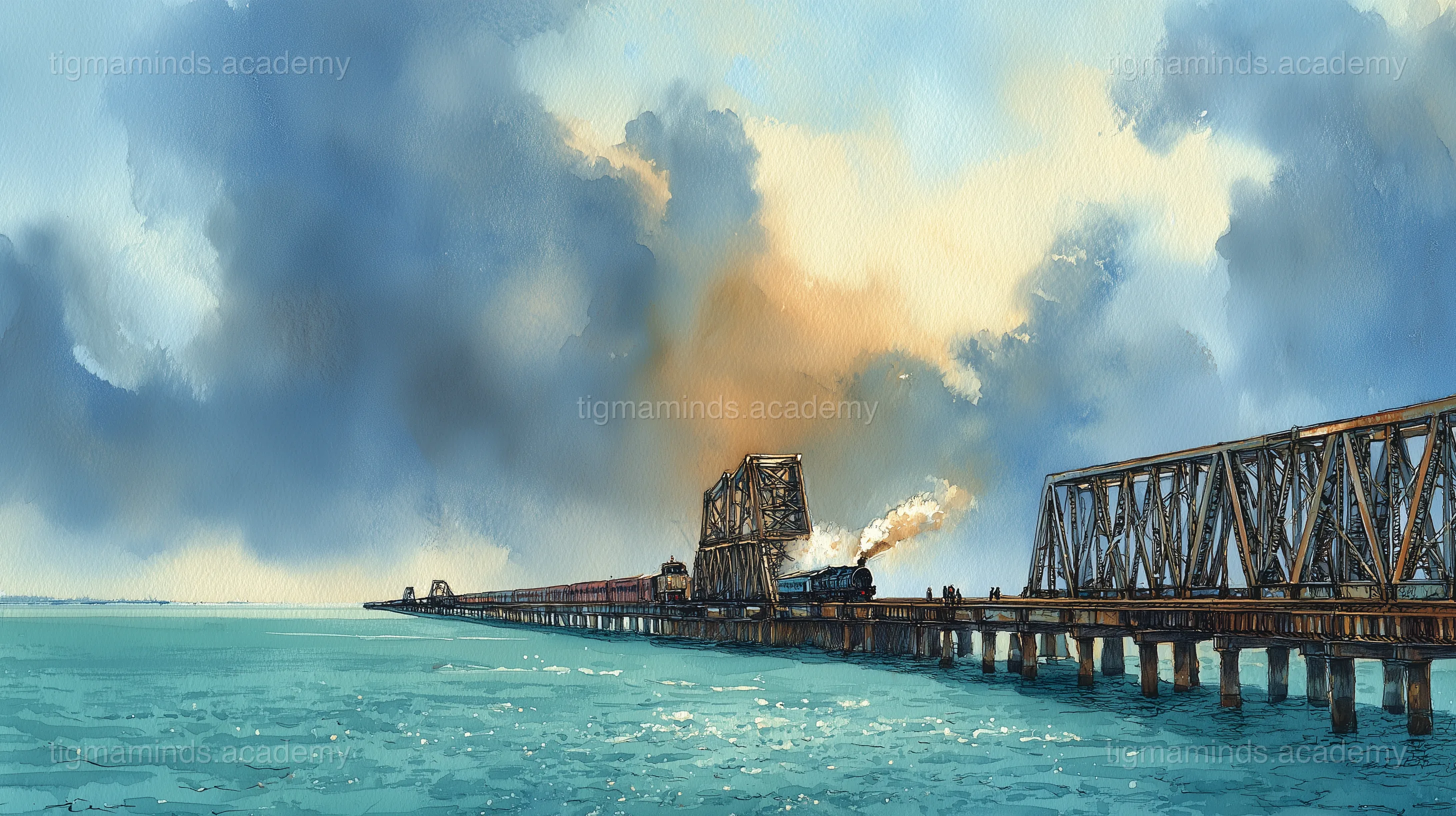
The Inspector
Every Tuesday at 5:30 AM, Thamarai Kannan walked the Pamban Bridge.
She was thirty-six years old, a structural engineer with Southern Railway, and the lead inspector responsible for the maintenance of the 2.06-kilometre railway bridge that connected the island of Rameswaram to the Tamil Nadu mainland across the Palk Strait. The bridge had been built in 1914, rebuilt after a devastating cyclone in 1964, and was now — at over a century old — one of the most aggressively attacked structures in the Indian railway network.
The enemy was not traffic. The Pamban Bridge carried only eight to ten trains per day — light by Indian standards. The enemy was the sea.
The Palk Strait was shallow — only nine metres deep at the bridge site — but the currents were fierce. Twice a day, the tide pushed water through the narrow strait between India and Sri Lanka, creating currents of up to 1.5 metres per second. The water was warm (28 to 30 degrees C year-round), highly saline (35 parts per thousand), and saturated with dissolved oxygen. It was, in other words, the perfect recipe for corrosion — the electrochemical destruction of metal.
Thamarai's Tuesday walk was not a casual stroll. She carried a digital calliper, a ultrasonic thickness gauge, a half-cell potential meter, and a camera. She measured the thickness of steel girder flanges at 47 pre-marked points along the bridge, checked the paint coating for cracking or blistering, and tested the electrical potential of the reinforcing steel in the concrete piers. She was looking for corrosion — and she always found it.
The Cantilever Principle
The Pamban Bridge was built as a series of cantilever spans. A cantilever is a structural element that is supported at one end and extends freely into space at the other — like a diving board fixed at one end and sticking out over the pool. The free end deflects (bends downward) under load, and the fixed end must resist both the downward force and the bending moment (rotational force) created by the load acting at a distance from the support.
In the Pamban Bridge, pairs of cantilever arms extended from each pier toward each other, meeting in the middle where a short suspended span connected them. The advantage of this design was that it could span large distances (the main spans were 56 metres) without requiring temporary support from below during construction — important when building over open sea with strong currents.
Thamarai explained the mechanics to a new assistant engineer, Murugan, during one of her inspections. "Stand on the end of a diving board," she said. "Your weight pushes the board down at the free end. The bolts at the fixed end pull upward — they resist the tendency of the board to rotate downward. The further out you stand, the more leverage your weight has. The bending moment at the fixed end equals your weight multiplied by your distance from the support."
"A bridge span works the same way. When a locomotive is at the centre of a span, the bending moment at the pier is the locomotive's weight times half the span length. This moment tries to rotate the bridge around the pier. The steel girders must resist this rotation by being strong enough in bending — strong enough that their top flange can handle the compression and their bottom flange can handle the tension without yielding."
She pointed to a massive steel girder. "See how the girder is shaped like an I — with wide flanges at the top and bottom and a thin web in between? The flanges carry the bending forces. The web carries the shear forces. An I-beam uses material efficiently: it puts the steel where the stress is highest (the flanges) and uses minimal material where the stress is low (the web centre). A solid rectangular beam of the same weight would be much weaker in bending."
The Scherzer Rolling Bascule
At the centre of the bridge was the feature that made Pamban unique: a Scherzer rolling bascule span — a movable section that could be lifted to allow ships to pass through. The bascule (from the French word for "seesaw") was a counterweighted span that rotated upward around a curved track, like a drawbridge. The counterweight — a massive block of concrete — was built into the landward end of the span. When the span needed to open, an electric motor drove the span upward by pushing the counterweight downward. The weight of the counterweight almost exactly balanced the weight of the span, so the motor only had to overcome friction and wind resistance — not lift the full weight of the bridge.
"The bascule is a lever," Thamarai explained. "The pivot point is the rolling track. The bridge span is on one side, the counterweight is on the other. When the moments on both sides are equal — weight times distance from the pivot — the system is in balance and the motor needs almost no energy to rotate it. This is the same physics as a playground seesaw: if both children weigh the same and sit at the same distance from the pivot, the seesaw balances horizontally."
The original bascule mechanism was hand-operated — a team of workers cranked it open, a process that took nearly thirty minutes. The current electric motor could open the span in two minutes.
Corrosion: The Electrochemical Enemy
But the bascule mechanism was also the most corrosion-vulnerable part of the bridge. The rolling track, the counterweight bearings, and the pivot assemblies were all in the splash zone — the region between low tide and high tide where the steel was alternately wetted by seawater and exposed to air. This was the worst possible environment for steel.
Corrosion of steel in seawater is an electrochemical process. It requires four things: a metal that can lose electrons (iron), an electrolyte that can carry ions (saltwater), oxygen to accept the electrons, and an electrical connection between the corroding area and the area where oxygen is reduced. In the splash zone, all four are abundantly present.
The chemistry is straightforward. At the anode (the corroding spot), iron atoms lose two electrons and enter the water as ferrous ions: Fe goes to Fe2+ plus 2 electrons. At the cathode (a nearby spot on the same steel surface), dissolved oxygen accepts those electrons: O2 plus 2H2O plus 4 electrons gives 4OH-. The ferrous ions react with the hydroxide ions to form ferrous hydroxide, which further oxidises to rust — hydrated iron oxide, Fe2O3 multiplied by nH2O, the familiar red-brown crust.
"Rust is not just ugly," Thamarai told Murugan. "It occupies about six times the volume of the iron it replaces. When rust forms inside a crevice — between two bolted plates, inside a rivet hole — the expanding rust pushes the plates apart, breaking the paint coating, exposing fresh steel, and accelerating the corrosion. This is crevice corrosion, and it is the most destructive form of corrosion on the Pamban Bridge."
Thamarai showed Murugan a section of girder flange where crevice corrosion between the flange and a connection plate had consumed 3 millimetres of steel thickness over ten years — a corrosion rate of 0.3 millimetres per year. At the original flange thickness of 18 millimetres, this section had already lost 17 percent of its structural capacity. At this rate, it would need replacement within another twenty years.
Cathodic Protection
For the submerged piers (the concrete columns standing in the seawater), the bridge used cathodic protection — a technique where sacrificial anodes made of zinc were bolted to the steel reinforcement inside the concrete.
The principle was electrochemical. Zinc is more electrochemically active than iron — it "wants" to corrode more strongly. When zinc and iron are electrically connected and immersed in an electrolyte (seawater seeping through the concrete), the zinc corrodes preferentially, sacrificing itself to protect the iron. The zinc anode produces electrons that flow to the iron, keeping the iron in a reduced (non-corroded) state. The zinc slowly dissolves while the iron stays intact.
"It is like bodyguard duty," Thamarai said. "The zinc takes the hit so the steel does not have to. But the zinc gets consumed in the process, so the anodes must be replaced every seven to ten years."
The Walk
Thamarai completed her Tuesday inspection at 8:15 AM. She had logged twelve locations where paint coating had failed and fresh corrosion was visible, three locations where steel thickness had decreased measurably since the last quarterly ultrasonic survey, and one location where a drainage channel had been blocked by debris, allowing standing saltwater to pool on a horizontal girder flange — the worst possible situation, combining constant wetness with salt concentration.
She filed her report and scheduled the repair crew for Thursday.
The Pamban Bridge was 110 years old. It had survived two cyclones, a tsunami, and a century of the most aggressive marine corrosion environment in the Indian subcontinent. It survived because every week, someone walked its length, measured its steel, and fought the sea one bolt at a time.
The end.
Choose your level. Everyone starts with the story — the code gets deeper as you go.
Here is a taste of what Level 1 looks like for this lesson:
import numpy as np
import matplotlib.pyplot as plt
# Your first data analysis with Python
data = [45, 52, 38, 67, 41, 55, 48] # measurements
mean = np.mean(data)
plt.bar(range(len(data)), data)
plt.axhline(mean, color='red', linestyle='--', label=f'Mean: {mean:.1f}')
plt.xlabel("Sample")
plt.ylabel("Value")
plt.title("Cantilever Mechanics & Corrosion Engineering — Sample Data")
plt.legend()
plt.show()This is just the first of 6 coding exercises in Level 1. By Level 4, you will build: Build a Bridge Corrosion Life Simulator.
Free
Level 0: Listener
Stories, science concepts, diagrams, quizzes. No coding.
You are here
Level 0 is always free. Coding levels (1-4) are part of our 12-Month Curriculum.
The real engineering of a century-old sea bridge — cantilever bending moments, bascule counterweight balance, electrochemical corrosion, and cathodic protection.
The big idea: "The Pamban Bridge" teaches us about Cantilever Mechanics & Corrosion Engineering — and you don't need to write a single line of code to understand it.
Hold a ruler so that half of it sticks out over the edge of a table. Press down on the part on the table to hold it firm. Now press down on the free end with your other finger. The ruler bends downward. The further out you press, the more it bends. If you press near the edge of the table, it barely bends at all. If you press at the very tip, it bends a lot. You have just demonstrated the cantilever principle — and the concept of bending moment.
The bending moment at the fixed end (where the ruler meets the table edge) equals the force you apply times the distance from the table edge to the point where you press. Push with 1 newton at 10 centimetres from the edge: bending moment = 0.1 newton-metres. Push with the same force at 30 centimetres: bending moment = 0.3 newton-metres — three times as much. The same force creates three times the bending stress simply by acting further from the support.
The Pamban Bridge uses this principle in reverse. Two cantilever arms extend from each pier toward each other. A train on one arm creates a bending moment at the pier. But the weight of the OTHER arm (extending the opposite direction) creates a moment in the opposite sense — it partially balances the first. This is why cantilever bridges are built in balanced pairs: each arm counterweights the other, reducing the net moment the pier must resist.
Check yourself: You are standing at the end of a diving board that is 3 metres long. You weigh 500 newtons. What is the bending moment at the fixed end of the board? What happens to this moment if you walk back to the 1.5-metre mark?
Key idea: A cantilever is a beam fixed at one end and free at the other. The bending moment at the fixed end equals force times distance from the support. Greater distance means greater moment. Cantilever bridges use balanced pairs of arms to counterweight each other, reducing the moment each pier must carry.
Take a sheet of paper and try to bridge it across a gap between two books. It sags immediately — paper is weak in bending. Now fold the same sheet into a U-shape (a channel) and bridge the gap again. It holds! The paper is the same material, the same weight, the same thickness. What changed is the shape — and shape determines bending strength.
When a beam bends, the top surface is compressed (squeezed shorter) and the bottom surface is stretched (pulled longer). The further a piece of material is from the centre of the beam, the more compression or tension it experiences. Material at the very centre — the neutral axis — experiences zero stress. It is essentially dead weight, contributing nothing to bending resistance.
This is why structural engineers use I-beams (also called H-beams): wide flanges at the top and bottom, connected by a thin vertical web. The flanges are positioned as far from the centre as possible, where they experience maximum stress and contribute maximum bending resistance. The web in the middle carries shear forces (the sliding force between layers) but does not need to be thick because the shear stress is relatively low.
The Pamban Bridge girders are I-beams with flanges 300 millimetres wide and 18 millimetres thick, connected by a web 1,200 millimetres tall and only 10 millimetres thick. If you melted this I-beam down and recast it as a solid rectangular beam of the same total cross-sectional area, it would be far weaker in bending — because most of the material would be near the neutral axis, where it contributes nothing.
Key idea: In a bending beam, the top and bottom surfaces carry the most stress while the centre carries almost none. I-beams place material (flanges) at the top and bottom where stress is highest, connected by a thin web. This gives maximum bending strength for minimum material — the fundamental principle of efficient structural design.
Access all 130+ lessons, quizzes, interactive tools, and offline activities
Leave a steel nail in a glass of tap water for a week. It develops patches of red-brown rust. Now do the same experiment with a nail in a glass of sal...
Imagine two runners in a race. Runner A (zinc) is faster than Runner B (iron). If both are running (corroding) at the same time, Runner A finishes fir...