Preservation chemistry, volatile oils, and the supply chain logistics that kept spices fresh across oceans.
The Warehouse
The monsoon was six weeks away, and Meenakshi Chettiar had a problem with peppercorns.
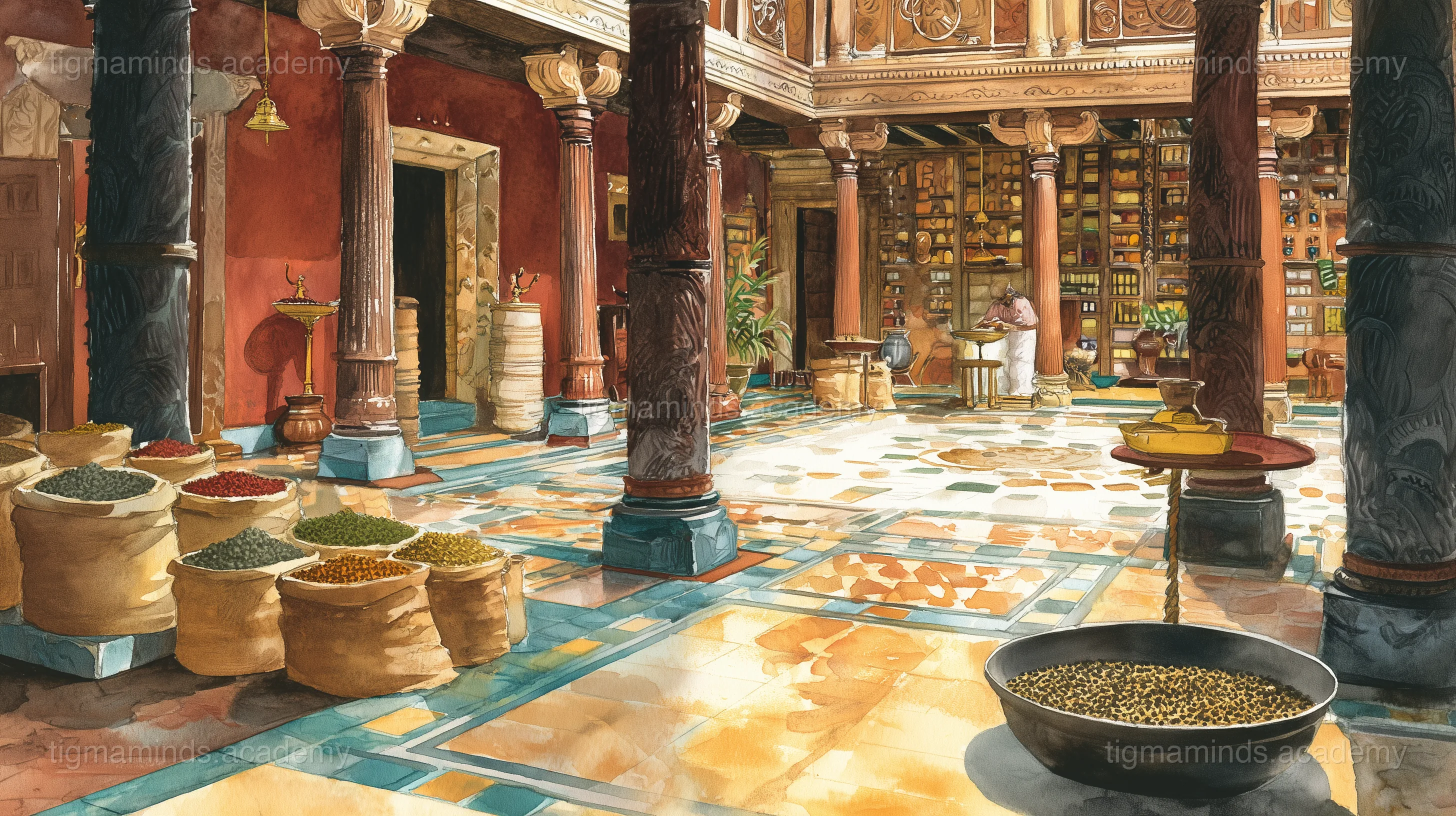
Meenakshi was thirty-one years old and ran the family spice trading business from a sprawling Chettinad mansion in the town of Kanadukathan, in the Sivaganga district of Tamil Nadu. The mansion — a hundred and twenty years old, with a central courtyard tiled in Italian marble and colonnades made of Burmese teak — had been built by her great-great-grandfather Ramanathan Chettiar, who had made his fortune trading spices, textiles, and gemstones across the Indian Ocean, from the Malay Peninsula to East Africa.
The Nattukottai Chettiars — known simply as Nagarathar — were one of the great mercantile communities of South India. For centuries, they had financed and operated a trading network that stretched from Singapore to Colombo to Rangoon to Zanzibar. Their specialty was commodities that were valuable per kilogram: spices, precious metals, gems, and high-grade cotton. And the king of their trade was pepper — specifically, Malabar black pepper (Piper nigrum), sourced from the Western Ghats of Kerala and shipped to buyers in Southeast Asia, the Middle East, and Europe.
Meenakshi's warehouse, adjacent to the mansion, contained forty tonnes of peppercorns, packed in jute sacks, stacked on wooden pallets. The pepper had been purchased from growers in Wayanad, Kerala, three months earlier, at the post-harvest price. She would sell it to exporters in Chennai and Kochi over the next eight months, as the market price rose (it always rose as the year progressed and supply tightened). The profit margin depended entirely on one thing: keeping the pepper in perfect condition for eight months in a climate where the temperature averaged 32 degrees Celsius and the monsoon would bring 95 percent humidity.
If the peppercorns absorbed moisture, they would develop mould — specifically Aspergillus fungi, which could produce aflatoxins, carcinogenic compounds that would make the entire lot unsaleable. If the peppercorns lost too much of their volatile oil content (the chemical compounds that give pepper its aroma and flavour), they would be downgraded at quality inspection, fetching a lower price. Meenakshi needed to keep moisture out and volatile oils in. She needed chemistry.
The Chemistry of Pepper
"Understand what is inside the peppercorn," Meenakshi told her warehouse manager Selvam as they inspected the new shipment, "and you will understand what can go wrong."
A dried black peppercorn is a concentrated chemical factory. The outer skin is wrinkled and black — darkened during the drying process when the fruit's enzymes oxidise the phenolic compounds, similar to how a cut apple browns in air. Inside, the seed is pale, dense, and hard.
The "heat" of pepper — the sharp, burning sensation on the tongue — comes from a single compound: piperine, a crystalline alkaloid that constitutes about 5 to 9 percent of the peppercorn by weight. Piperine is chemically stable. It does not evaporate. It does not break down easily at room temperature. If you stored a peppercorn for ten years, the piperine would still be there, and it would still burn your tongue.
The "aroma" is a different matter entirely. Pepper's complex fragrance — woody, citrusy, slightly floral — comes from a mixture of volatile oils (also called essential oils), making up about 2 to 4 percent of the peppercorn. These oils are a cocktail of dozens of different terpene molecules: beta-caryophyllene (woody, spicy), limonene (citrus), alpha-pinene (pine), linalool (floral), and many others. The word "volatile" means these molecules evaporate easily — they have low boiling points, high vapour pressures, and given any opportunity, they will escape from the peppercorn into the surrounding air.
"When you open a jar of pepper and smell that beautiful aroma," Meenakshi said, "you are smelling molecules escaping. Every sniff is flavour you will not taste later. A peppercorn is a sealed container for volatile oils, and the moment the seal is broken — by grinding, by cracking, or simply by sitting in warm air for too long — the oils begin to leave."
The Moisture Problem
The monsoon was the critical threat. When humid air contacted the peppercorns, the water vapour in the air would be absorbed by the peppercorns — they were hygroscopic, meaning they naturally absorbed moisture from their surroundings until they reached equilibrium with the air. At 95 percent relative humidity, a peppercorn would absorb enough water to reach a moisture content of 14 to 16 percent. At that level, Aspergillus mould could germinate and grow, producing invisible aflatoxin contamination that would show up on laboratory testing and cause the entire lot to be rejected.
The safe moisture content for storage was below 12 percent — ideally below 10 percent. At these levels, there was not enough free water in the peppercorn for mould spores to germinate. The spores were always present (Aspergillus is ubiquitous in tropical environments), but they were dormant without sufficient moisture. The battle was not against the mould itself — it was against the water that activated it.
Meenakshi's defence was a combination of dehumidification and airflow control. The warehouse walls were double-skinned — an outer wall of brick, a 15-centimetre air gap, and an inner wall of plastered lime. The air gap acted as thermal insulation, reducing condensation on the inner wall. (Condensation occurs when warm, humid air contacts a cooler surface — the air cools, its capacity to hold moisture drops, and the excess moisture condenses as liquid water. A well-insulated inner wall stayed close to the air temperature, preventing this.)
At ground level, the jute sacks sat on wooden pallets, never on the concrete floor — because concrete wicked moisture from the ground by capillary action. Selvam checked each sack weekly with a moisture meter, a handheld device that measured electrical conductivity between two probes pushed into the grain. Water is a good conductor; dry pepper is not. Higher conductivity meant higher moisture content. Any sack above 12 percent was moved to the drying yard immediately.
The Volatile Oil Problem
Keeping moisture out was necessary but not sufficient. Meenakshi also needed to keep the volatile oils in.
Volatile oils evaporate faster at higher temperatures — this is basic kinetics. The rate of evaporation approximately doubles for every 10-degree increase in temperature (a rough application of the Arrhenius equation that governs chemical reaction rates). At 32 degrees (Chettinad's average temperature), volatile oils escaped from the peppercorn's surface roughly twice as fast as they would at 22 degrees, and four times as fast as at 12 degrees. Cold storage would preserve the oils perfectly, but refrigerating forty tonnes of peppercorns was prohibitively expensive.
Instead, Meenakshi relied on minimising surface exposure. Whole peppercorns lost volatile oils far more slowly than ground pepper, because the oil had to diffuse from inside the seed through the outer skin before it could evaporate — and the outer skin, with its dense, waxy structure, acted as a natural diffusion barrier. This is why whole pepper stays aromatic for years while ground pepper loses its fragrance in weeks. The grinding exposes thousands of times more surface area, and the oils evaporate rapidly from the exposed surfaces.
She also kept the warehouse dark. Many terpene compounds are photosensitive — ultraviolet light can break the carbon-carbon double bonds in molecules like limonene and pinene, degrading them into odourless fragments. The traditional Chettinad warehouse had small, deep-set windows fitted with wooden shutters, admitting minimal light. Meenakshi maintained this design.
The Supply Chain
"The biggest risk to quality is not storage," Meenakshi told Selvam one evening as they closed the warehouse. "It is transit. A peppercorn can survive eight months in this warehouse. But put it in a steel shipping container on a truck to Chennai, in June, with the sun beating down on the roof — the temperature inside that container can reach 65 degrees Celsius. In four hours at 65 degrees, the peppercorn loses more volatile oil than it would in two months in this warehouse."
The solution was to ship at night or in the early morning, using ventilated containers (shipping containers with passive air vents at the top and bottom, allowing convective airflow) and to insist on reflective covers on the container roof. These were simple, low-technology solutions, but they addressed the physics directly: reduce the temperature, reduce the evaporation rate.
Meenakshi also timed her shipments to avoid the monsoon months entirely. The humidity inside a standard shipping container during monsoon transit could reach 98 percent — enough to push the moisture content of any peppercorn above the critical 12 percent threshold within days. She shipped in October through February, when the northeast monsoon had passed and the air was drier.
The Taste Test
Before any lot was shipped, Meenakshi performed a quality check that no laboratory instrument could replace: she tasted it.
She took a single peppercorn, crushed it between her teeth, and let the flavour develop on her tongue. First the aroma — the burst of terpenes released by crushing, filling her nasal cavity with woody, citrus notes. Then the heat — the slow burn of piperine activating the TRPV1 receptors on her tongue (the same receptors that detect actual heat, which is why capsaicin and piperine feel "hot" even though they are not raising the temperature). Then the aftertaste — a lingering warmth that should last at least thirty seconds in high-quality pepper.
If the aroma was muted, the volatile oils had escaped. If the heat was weak, the piperine had degraded (unlikely at room temperature, but possible if the lot had been exposed to excessive heat during initial drying). If there was any musty or off flavour, mould had started even if the moisture meter showed safe levels.
She spat and nodded. This lot was good. The piperine was strong, the terpenes were intact, and there was no trace of mould.
Forty tonnes of Malabar peppercorns, worth approximately thirty-two lakh rupees, sitting in a Chettinad warehouse, protected by chemistry that had been understood by the Nagarathar trading community long before anyone called it chemistry.
The end.
Choose your level. Everyone starts with the story — the code gets deeper as you go.
Here is a taste of what Level 1 looks like for this lesson:
import numpy as np
import matplotlib.pyplot as plt
# Your first data analysis with Python
data = [45, 52, 38, 67, 41, 55, 48] # measurements
mean = np.mean(data)
plt.bar(range(len(data)), data)
plt.axhline(mean, color='red', linestyle='--', label=f'Mean: {mean:.1f}')
plt.xlabel("Sample")
plt.ylabel("Value")
plt.title("Preservation Chemistry & Supply Chain Science — Sample Data")
plt.legend()
plt.show()This is just the first of 6 coding exercises in Level 1. By Level 4, you will build: Build a Spice Storage Quality Simulator.
Free
Level 0: Listener
Stories, science concepts, diagrams, quizzes. No coding.
You are here
Level 0 is always free. Coding levels (1-4) are part of our 12-Month Curriculum.
The real chemistry of spice preservation — volatile oils, moisture control, mould prevention, and the physics of keeping flavour intact across months and continents.
The big idea: "The Spice Trader of Chettinad" teaches us about Preservation Chemistry & Supply Chain Science — and you don't need to write a single line of code to understand it.
Open a bottle of perfume. You can smell it immediately, even from a distance. That is because perfume contains volatile compounds — molecules with low boiling points and high vapour pressures that readily escape from liquid or solid form into the air. The word "volatile" comes from the Latin volare, meaning "to fly." These molecules literally fly away from the surface.
Spices get their aroma from the same kind of molecules: volatile oils, also called essential oils. In black pepper, these are mostly terpenes — a large family of organic compounds built from repeating units of a 5-carbon molecule called isoprene. Different terpenes produce different scents: beta-caryophyllene smells woody and spicy, limonene smells of citrus, alpha-pinene smells of pine forests. Together, dozens of different terpenes create the complex, layered aroma we recognise as "pepper."
The problem for spice traders is that these molecules are always escaping. Even inside a sealed peppercorn, the terpenes are slowly diffusing outward through the cell walls and evaporating from the surface. The rate of escape depends on temperature: higher temperature gives the molecules more kinetic energy, making them more likely to break free from the surface. As a rough rule, the evaporation rate doubles for every 10 degrees Celsius increase in temperature. This is why a peppercorn stored at 30 degrees C loses its aroma roughly four times faster than one stored at 10 degrees C.
Check yourself: Why does freshly ground pepper smell much more intensely than whole peppercorns? (Hint: think about surface area.)
Key idea: Volatile oils (terpenes) give spices their aroma but continuously evaporate from the surface. The evaporation rate roughly doubles for every 10-degree C temperature increase. Whole spices retain volatile oils longer than ground spices because the intact outer surface acts as a diffusion barrier, limiting the exposed area.
Leave a cracker on the kitchen counter in a humid room for a day. It goes soft and stale. The cracker has absorbed water from the air — it is hygroscopic, meaning it naturally pulls moisture from its surroundings. Most dry foods are hygroscopic: rice, flour, dried herbs, peppercorns. They absorb water vapour from humid air until they reach an equilibrium moisture content that depends on the air's relative humidity.
Relative humidity (RH) measures how much water vapour the air is holding compared to the maximum it could hold at that temperature. At 50% RH, the air has half its maximum water capacity. At 95% RH (common during monsoons in Tamil Nadu), the air is nearly saturated. A peppercorn in 95% RH air will absorb water until its moisture content reaches about 14-16 percent — far above the safe storage level.
Why is 12 percent the critical threshold? Because Aspergillus mould spores — which are always present in tropical air — need a certain minimum amount of free water (called "water activity") to germinate and grow. Below about 12 percent moisture, the water in the peppercorn is tightly bound to the cell walls and starch molecules, and the mould spores cannot access enough free water to activate. Above 12 percent, free water becomes available, spores germinate, and mould colonies grow. Some Aspergillus species produce aflatoxins — potent carcinogens that contaminate the entire batch and make it unsaleable.
The spice trader's job is to keep the peppercorn's moisture below 12 percent in an environment that is trying constantly to push it above 14 percent. This is a battle against thermodynamics — the system naturally tends toward equilibrium with the humid air, and the trader must continuously intervene to prevent it.
Key idea: Peppercorns are hygroscopic — they absorb moisture from humid air until reaching equilibrium. Above 12% moisture content, free water becomes available for Aspergillus mould to germinate, producing dangerous aflatoxins. Storage must keep moisture below this threshold through dehumidification, airflow control, and physical barriers.
Access all 130+ lessons, quizzes, interactive tools, and offline activities
Put a stick of butter on the kitchen counter on a cold winter day. It stays hard. Put the same butter on the counter on a hot summer day. It softens a...
Bite into a peppercorn and you experience two distinct sensations. First, a burst of **aroma** — complex, woody, citrusy notes that fill your nasal ca...