The Stone Screens of Mahabalipuram
Tessellations & Geometric Symmetry

The Stone Screens of Mahabalipuram

Tessellations, geometric symmetry, and the mathematics hidden in seventh-century temple carvings.

Tessellations & Geometric Symmetry12-Month Curriculum 12h

The Story

The Restoration

Kavitha Subramanian was twenty-eight years old and standing on a scaffold, three metres above the floor of the Shore Temple at Mahabalipuram, staring at a problem that was 1,300 years old.

Kavitha was a conservation architect with the Archaeological Survey of India, assigned to the ongoing restoration of the Shore Temple complex — a group of granite structures built by the Pallava Dynasty in the late seventh and early eighth centuries, perched on the coast of Tamil Nadu where the Bay of Bengal met the ancient port town of Mamallapuram. The temples had survived thirteen centuries of salt spray, monsoon storms, and the great tsunami of 2004. But the salt was winning. Sodium chloride from the sea air had been crystallising inside the pore spaces of the granite, and the expanding crystals were slowly pulverising the stone from within — the same salt weathering that destroys coastal buildings worldwide.

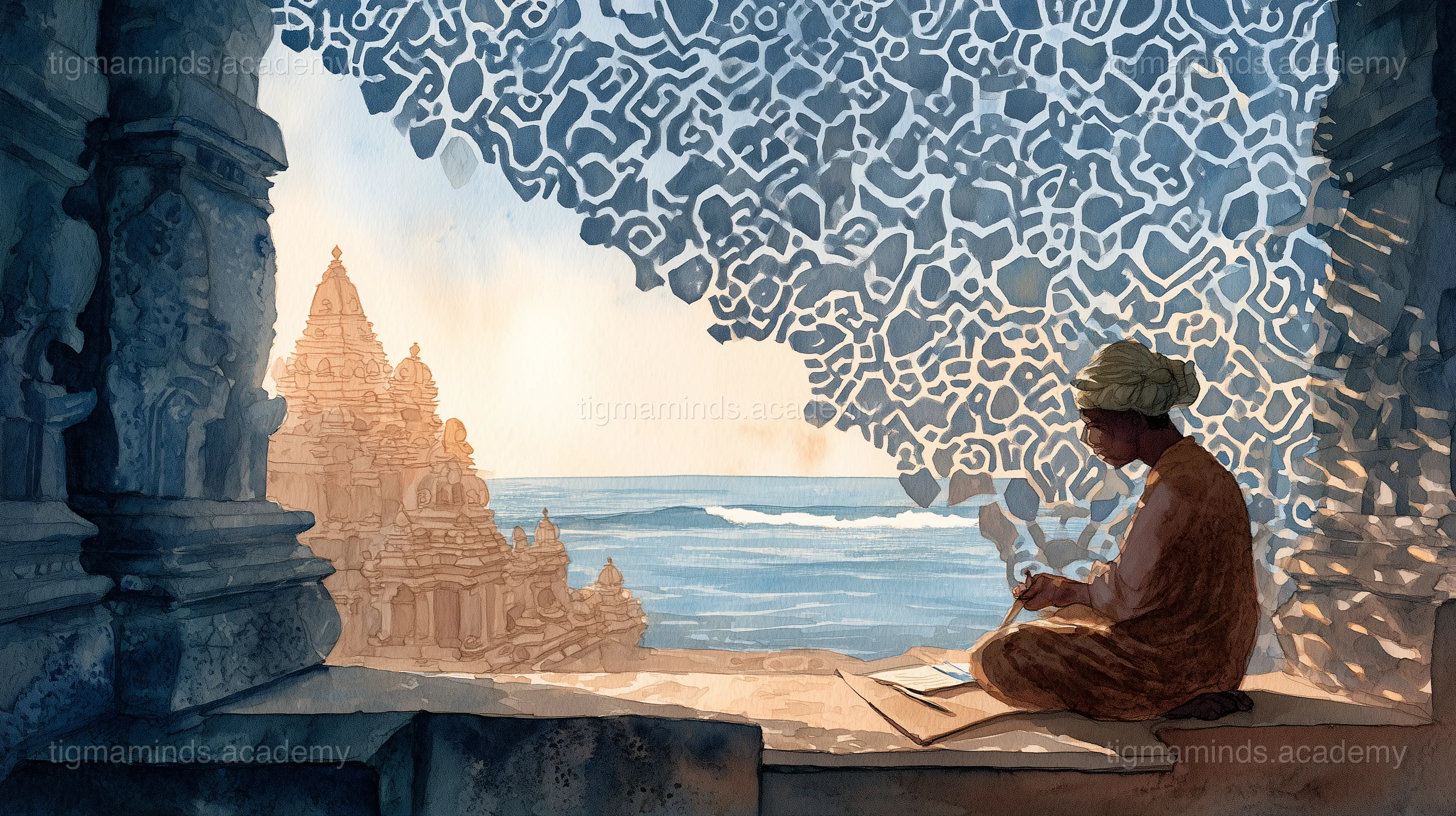
Kavitha's task was to document and stabilise the jali screens — perforated stone panels that served as windows in the temple walls. Each jali was a slab of granite approximately 60 centimetres wide and 90 centimetres tall, carved completely through with a repeating geometric pattern. The patterns allowed light and air to pass through while providing privacy and decoration. They were, in effect, stone lace.

It was the geometry that fascinated Kavitha. She was not just an architect; she had a degree in mathematics from IIT Madras, and she had spent three years studying the mathematical structures embedded in Indian temple architecture. The jali screens of Mahabalipuram were among the most sophisticated examples she had encountered.

The First Pattern: Hexagonal Tessellation

The screen on the south wall of the inner sanctum was a hexagonal tessellation — a pattern of identical regular hexagons filling the entire surface with no gaps and no overlaps. Each hexagon was about 4 centimetres across, and the stone between hexagons formed a web of narrow bridges, each about 8 millimetres wide. Light filtered through the hexagonal openings in a honeycomb pattern, casting a lattice of golden spots on the sanctum floor.

Kavitha measured the pattern and confirmed what she suspected: the hexagons were regular — all six sides were equal in length and all six interior angles were 120 degrees. This was not an accident. Regular hexagons are one of only three regular polygons that can tile a flat surface perfectly — the other two being equilateral triangles and squares. No other regular polygon works. Regular pentagons leave gaps. Regular heptagons overlap. This mathematical constraint, proved rigorously in modern times, was understood intuitively by the Pallava stone carvers 1,300 years ago.

"Why hexagons and not squares?" asked Deepak, Kavitha's assistant, who was photographing each panel.

"Structural efficiency," Kavitha said. "A hexagonal grid distributes force more evenly than a square grid. Look at a honeycomb — bees build hexagons because it is the shape that creates the most enclosed area using the least amount of material. The same principle works here. The stone bridges in this jali are very thin — only 8 millimetres. If the pattern were square, each bridge would carry load from only two directions. In the hexagonal pattern, each bridge shares load with six neighbours. The screen is stronger for the same amount of stone."

The Second Pattern: Star-and-Cross

The screen on the north wall was different. This one used a pattern called star-and-cross — a tessellation of eight-pointed stars alternating with smaller cross-shaped spaces. The eight-pointed star was formed by overlapping two squares rotated 45 degrees relative to each other. The negative space between the stars formed small cross-shaped openings and larger octagonal openings.

Kavitha traced the geometry. Each eight-pointed star could be constructed by starting with a square, drawing the diagonals, and then drawing a second square rotated 45 degrees. The intersections of the two squares defined the eight points of the star. The mathematical relationships were precise: the ratio of the star's outer radius to its inner radius was exactly the square root of 2 — approximately 1.414.

"This pattern has two-fold, four-fold, and eight-fold rotational symmetry," Kavitha explained. "Rotate the pattern 45 degrees and it maps onto itself. Rotate it 90 degrees and it maps onto itself. Rotate it 180 degrees and it maps onto itself. In group theory — the mathematics of symmetry — this pattern belongs to the p4m wallpaper group, one of exactly 17 possible ways to tile a flat surface with a repeating pattern."

Deepak looked sceptical. "You are telling me seventh-century stone carvers understood group theory?"

"They understood the patterns," Kavitha said. "They did not need the formal mathematics. They discovered, through centuries of trial and error, which patterns worked — which ones tessellated perfectly, which ones were structurally stable, which ones admitted light beautifully. Mathematicians later proved why these patterns worked. The carvers had the answer before the question was formally asked."

The Third Pattern: Interlocking Circles

The most complex screen was on the west wall — the wall facing the sea, which had suffered the most salt damage. The pattern was a grid of interlocking circles, each circle overlapping its four neighbours by exactly one radius. The overlap regions formed vesica piscis shapes — pointed ovals that were one of the fundamental motifs of sacred geometry across cultures, from Indian temples to Gothic cathedrals.

The mathematical precision was extraordinary. Kavitha measured the radii with digital callipers: every circle had a radius of 18.2 millimetres, with a variation of less than 0.3 millimetres across the entire panel. The centres of the circles were arranged on a perfect square grid with a spacing of exactly one radius. This meant each circle passed through the centre of its four neighbours — the geometric condition that produces the vesica piscis overlap.

"The carver who made this panel worked with a compass and a straight edge," Kavitha said. "These are the same two tools that Euclid used. With just a compass and straight edge, you can construct every pattern in this temple — hexagons, stars, interlocking circles. You cannot construct a regular heptagon or a regular nonagon, which is why you never see seven-fold or nine-fold symmetry in classical Indian jali screens. The toolset constrains the geometry, and the geometry constrains the art."

The Mathematics of Tiling

That evening, back at the field office, Kavitha laid out her documentation photographs and began the analysis that would form the core of her conservation report.

The key insight was that every pattern in the Mahabalipuram jalis could be described using the language of transformation geometry. Each pattern was generated by a small unit cell — the smallest piece of the pattern that, when repeated by translations, rotations, and reflections, produces the entire design. The hexagonal pattern had a unit cell of a single hexagon plus half of each surrounding bridge. The star-and-cross pattern had a unit cell containing one complete star and portions of the surrounding crosses. The interlocking circle pattern had a unit cell of one circle and the four quarter-circles overlapping it.

The wallpaper group of each pattern described its symmetries — the set of transformations (translations, rotations, reflections, glide reflections) that mapped the pattern onto itself. Mathematicians had proved in the nineteenth century that there are exactly 17 distinct wallpaper groups — 17 and no more. Every repeating two-dimensional pattern in existence belongs to one of these 17 groups. The Pallava carvers, working with compass and straight edge in the seventh century, had discovered and used at least five of the 17 groups.

This was not mystical. It was not coincidental. It was the inevitable result of skilled craftspeople exploring the space of possible patterns with rigorous geometric tools. They did not need abstract algebra to find patterns that tessellated — they needed patience, precision, and a compass. The mathematics was embedded in the craft.

The Conservation Plan

Kavitha's final task was to design the conservation treatment for the salt-damaged screens. The interlocking circle pattern on the west wall had lost 30 percent of its bridge connections to salt crystallisation. She would consolidate the remaining stone with a breathable silicone resin, replace missing bridges with inserts of matching granite shaped using CNC milling (guided by her mathematical models of the pattern), and install a micro-drainage system behind the wall to reduce future salt intrusion.

The patterns themselves were the best guide for the restoration. Because every unit cell was identical, a damaged section could be reconstructed from an undamaged section — the mathematics guaranteed that the missing geometry was fully defined by the surviving geometry. In a sense, the patterns contained their own repair manual.

Kavitha packed her instruments and looked out at the Shore Temple silhouetted against the sunset over the Bay of Bengal. The temple had stood here since 700 CE. The geometry carved into its walls was timeless — not because it was sacred, but because it was mathematically precise. Hexagons would tessellate in the eighth century, and they would tessellate in the twenty-eighth. The mathematics would not erode, even if the stone did.

The end.

Try It Yourself

Choose your level. Everyone starts with the story — the code gets deeper as you go.

Story Progress

0%

Ready to Start Coding?

Here is a taste of what Level 1 looks like for this lesson:

Level 1: Explorer — Python
import numpy as np
import matplotlib.pyplot as plt

# Your first data analysis with Python
data = [45, 52, 38, 67, 41, 55, 48]  # measurements
mean = np.mean(data)

plt.bar(range(len(data)), data)
plt.axhline(mean, color='red', linestyle='--', label=f'Mean: {mean:.1f}')
plt.xlabel("Sample")
plt.ylabel("Value")
plt.title("Tessellations & Geometric Symmetry — Sample Data")
plt.legend()
plt.show()

This is just the first of 6 coding exercises in Level 1. By Level 4, you will build: Build a Tessellation Pattern Generator.

Free

Level 0: Listener

Stories, science concepts, diagrams, quizzes. No coding.

You are here

Enrolled

Levels 1-4

Python, NumPy, Matplotlib, real projects, mentorship.

Sign Up Free

Stay Updated

Join Waitlist

Get notified when enrollment opens for your area.

Notify Me

Level 0 is always free. Coding levels (1-4) are part of our 12-Month Curriculum.