The Bronze Casters of Swamimalai
Lost-Wax Casting & Metallurgy

The Bronze Casters of Swamimalai

Lost-wax casting, metallurgy, and the 4,000-year-old art of turning liquid metal into divine form.

Lost-Wax Casting & Metallurgy12-Month Curriculum 12h

The Story

The Apprentice

Raghunath Sthapathi was twenty years old, and his hands were covered in beeswax. He sat cross-legged on the stone floor of the family workshop in Swamimalai, a small town on the banks of the Kaveri River in Tamil Nadu's Thanjavur district. Around him, fifteen members of his extended family — uncles, cousins, his father, his grandfather — worked at various stages of the process that had defined this family for twenty-three generations: the making of bronze icons using the lost-wax method, known in Tamil as madhu-uchishta-vidhana and in Sanskrit as cire perdue.

The Sthapathis were Vishwakarma Brahmins — a community whose sacred duty, as described in the ancient text Shilpa Shastra, was to give physical form to the divine. Every Nataraja, every Parvati, every Ganesha that emerged from this workshop was not merely a sculpture. It was a vigraha — a consecrated form through which devotees could commune with the deity. The standards for proportion, posture, and expression were codified in the Agama texts written over two thousand years ago: the ratio of head to body, the angle of the hip in tribhanga (triple-bend) pose, the exact curve of the fingers in abhaya mudra (the gesture of fearlessness). A deviation of a few millimetres could render the icon ritually unacceptable.

Raghunath's task this month was ambitious. His grandfather, Thirumalai Sthapathi, who had received the Padma Shri from the President of India for his lifetime contribution to the craft, had assigned him his first solo commission: a 60-centimetre Nataraja — Shiva as the Lord of Dance, the most complex and technically demanding icon in the entire Hindu canon. Four arms, a ring of fire, one leg raised in the bhujangatrasita pose, the other planted on a dwarf figure representing ignorance, flying locks of hair adorned with a crescent moon, a cobra, and the goddess Ganga, all balanced on a lotus pedestal.

"If you can cast this," his grandfather said, "you can cast anything."

The Wax Original

The process began with wax. Not just any wax, but a specific mixture of beeswax, dammar resin, and a small amount of groundnut oil. The beeswax provided plasticity — the ability to be moulded smoothly. The dammar resin (harvested from Shorea trees in the forests of Tamil Nadu) added hardness, so the finished model would hold fine details without sagging in the tropical heat. The groundnut oil adjusted the melting point and made the mixture flow cleanly when it was eventually melted out of the mould.

Raghunath heated the mixture in a brass vessel over a charcoal fire until it was liquid — about 62 degrees Celsius. He poured it into a shallow tray to cool into sheets about 3 millimetres thick. From these sheets, he cut and shaped the components of the Nataraja, working with small metal tools heated in the charcoal to soften the wax locally.

The body was built first: a hollow torso shaped over a clay core. The limbs were solid wax rods bent to the correct posture and joined to the torso with heated tools that fused the wax seams. The face was the most critical element — Raghunath spent two full days on the face alone, sculpting the half-closed eyes (representing meditative awareness), the faint smile, and the elongated earlobes that indicated the weight of the heavy earrings worn by Shiva.

Every surface was finished with tiny tools: the individual strands of hair in the flying locks, the scales of the cobra wrapped around the arm, the muscles of the raised leg, the fingers positioned precisely in the mudras prescribed by the Agamas. The wax model, when complete, was a fully detailed sculpture — the bronze would be an exact replica of this wax, capturing every mark, every fingerprint, every texture.

The Spruing System

But a wax model alone cannot become a bronze. The molten metal must flow into the mould somehow, and the air inside the mould must escape somehow. Raghunath attached a system of wax channels to the model: a main pouring cup at the top (where the metal would be poured in), runners (channels leading from the cup to the model), gates (points where the runners entered the model cavity), and vents (thin wax rods leading from the highest points of the model to the outside, allowing trapped air to escape as metal filled the mould).

The spruing system was not arbitrary. Raghunath had to ensure that molten bronze would reach every part of the mould before it solidified. Bronze begins to solidify the moment it touches the cooler mould walls. If the metal has to travel too far through a thin section, it will freeze before reaching the extremity — and the finger, or the strand of hair, or the tip of the flame will be missing from the final casting. The gates had to be placed so that metal entered at the thickest sections (the torso, the thighs) and flowed outward to the thin extremities (fingers, flames, cobra hood).

"Think of it like a river," his grandfather said. "The metal is the water. The channels are the tributaries. Every part of the field must be irrigated before the water runs out."

The Mould

With the spruing complete, Raghunath began the moulding process. The first layer was a face coat — a thin slurry of fine river sand, cow dung ash, and a binding agent made from the juice of the kadukkai fruit (Terminalia chebula). This slurry was painted directly onto the wax surface with a soft brush, filling every crevice and capturing every detail. It dried to form a hard, smooth inner surface that would become the casting surface of the mould — the surface the bronze would touch.

Over the face coat, Raghunath built up successive layers of progressively coarser clay, each layer dried before the next was applied. The first layers used fine clay mixed with rice husk. The outer layers used coarser clay mixed with chopped straw for strength. The total mould wall was about 25 millimetres thick — strong enough to contain the pressure of molten bronze without cracking, but porous enough to allow the gases generated during casting to escape.

After two weeks of layering and drying, the mould was a rough clay sphere encasing the wax model and its spruing system. Only the pouring cup and the vent tips were visible on the outside.

The Burnout

This was the step that gave the process its name: lost-wax casting. The mould was placed upside down in a kiln and heated slowly to 700 degrees Celsius. At 62 degrees, the wax melted and began to drain out through the pouring cup (now at the bottom). At higher temperatures, any remaining wax residue burned away completely, leaving behind a negative cavity — a hollow space inside the mould that was an exact replica of the original wax model, but in reverse. Every detail Raghunath had carved into the wax was now imprinted into the inner wall of the mould as a negative impression.

The mould was held at 700 degrees for several hours to ensure every trace of wax and organic material had been burned away. Any residual carbon from incomplete burnout would react with the molten bronze and create gas bubbles — porosity — in the finished casting, weakening the metal and marring the surface.

The Pour

The bronze alloy was prepared in a crucible — a vessel of fired clay and graphite that could withstand temperatures above 1,100 degrees Celsius. The alloy was a specific mixture: 88 percent copper, 10 percent tin, and 2 percent lead. This is Panchaloha in the Swamimalai tradition — though the name literally means "five metals," the traditional proportions vary by workshop and commission.

Copper provides the base structure. Tin increases hardness and lowers the melting point — pure copper melts at 1,084 degrees, but the addition of 10 percent tin drops the melting point to about 1,000 degrees and makes the liquid metal flow more freely into thin sections. Lead further improves fluidity and gives the finished surface a warm lustre, but too much lead makes the alloy brittle. The proportions were calibrated over centuries for a specific result: a metal that pours easily, fills fine details, and can be chiselled, filed, and polished to a mirror finish without cracking.

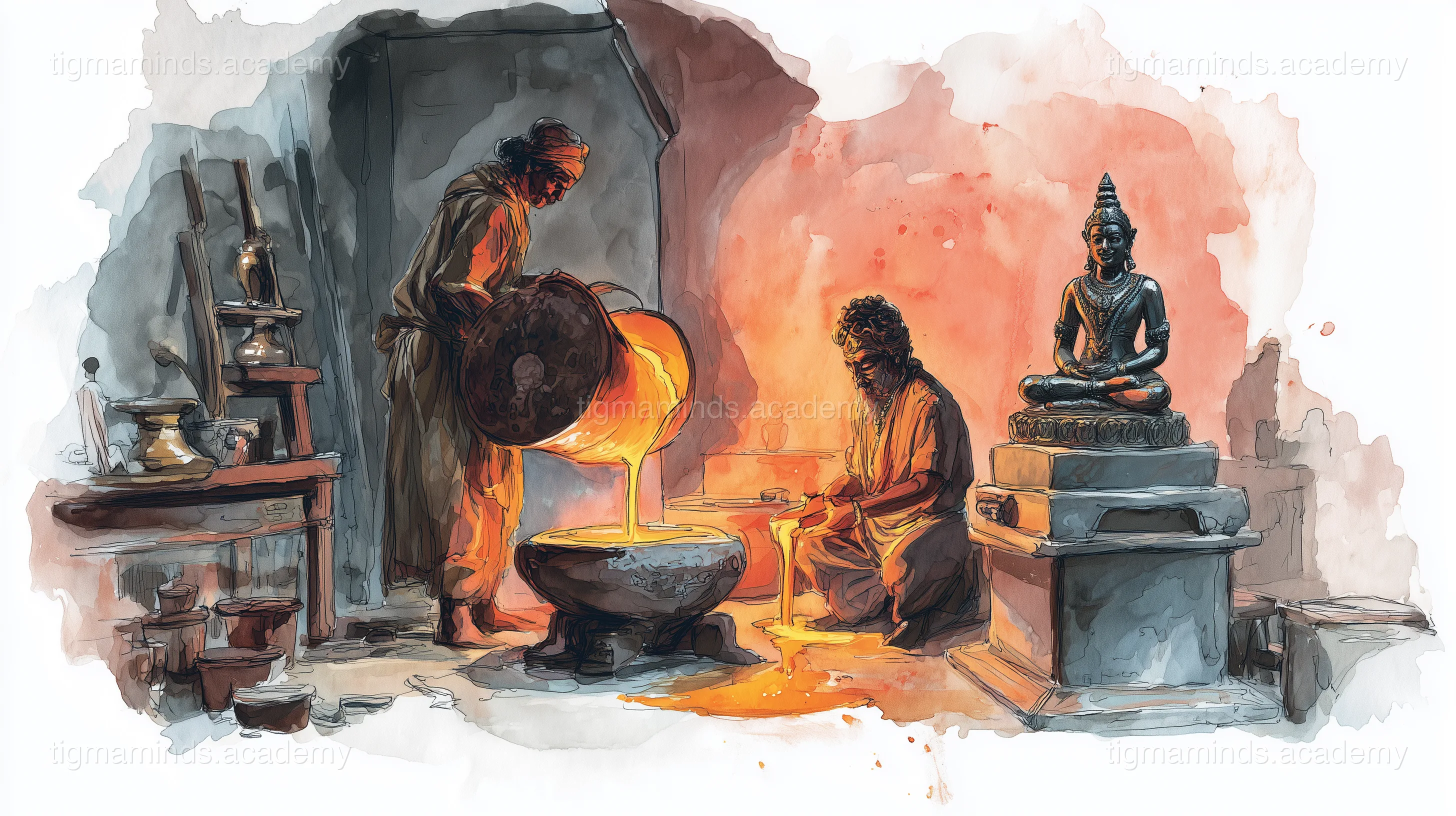
Raghunath heated the alloy in the crucible over a coke-fired furnace. At 1,050 degrees, the metal was fully liquid — a blinding orange-white fluid that threw off sparks and radiated heat intense enough to scorch skin at a metre's distance. He wore no protective suit — just a cotton lungi and a wet cloth over his face. The Sthapathis had been pouring bronze like this for centuries, and they relied on skill and experience rather than equipment.

The hot mould, still at about 400 degrees from the burnout kiln (maintaining it hot reduced the thermal shock when the metal entered), was set upright in a sand pit. Raghunath lifted the crucible with iron tongs and poured.

The metal entered the pouring cup in a smooth, continuous stream — not too fast (which would create turbulence and trap air) and not too slow (which would allow the metal to begin solidifying before it filled the extremities). He watched the vents: when bronze appeared at the tip of each vent, it meant the mould was full. The pour took twelve seconds.

The Reveal

The mould cooled for twenty-four hours. Then Raghunath broke it open with a hammer.

Inside, embedded in the clay, was the Nataraja — dark, rough, encrusted with mould material, but unmistakably complete. All four arms were intact. Every finger was present. The ring of fire was continuous. The cobra's hood was fully formed. The flying locks of hair, each strand no thicker than a matchstick, had filled completely.

Over the next three weeks, Raghunath would cut away the sprues, fill any surface defects with bronze plugs, file and chase every detail to crisp precision, and polish the surface to a warm, glowing finish. The eyes would be inlaid with silver. The lips would be finished with a thin layer of copper to give them a reddish tint. The surface would be treated with a chemical patina — a controlled oxidation that gave the bronze its characteristic deep brown-green colour.

When he presented the finished Nataraja to his grandfather, the old man examined it for twenty minutes in silence. He checked the proportions against the canonical ratios. He ran his thumb over the face. He held the icon at arm's length and squinted at the overall silhouette.

"The right hand in abhaya is two millimetres too high," he said. "Otherwise, it is correct."

He placed it on the workshop altar.

"Your first Nataraja. Not your last."

The end.

Try It Yourself

Choose your level. Everyone starts with the story — the code gets deeper as you go.

Story Progress

0%

Ready to Start Coding?

Here is a taste of what Level 1 looks like for this lesson:

Level 1: Explorer — Python
import numpy as np
import matplotlib.pyplot as plt

# Your first data analysis with Python
data = [45, 52, 38, 67, 41, 55, 48]  # measurements
mean = np.mean(data)

plt.bar(range(len(data)), data)
plt.axhline(mean, color='red', linestyle='--', label=f'Mean: {mean:.1f}')
plt.xlabel("Sample")
plt.ylabel("Value")
plt.title("Lost-Wax Casting & Metallurgy — Sample Data")
plt.legend()
plt.show()

This is just the first of 6 coding exercises in Level 1. By Level 4, you will build: Build a Bronze Casting Solidification Simulator.

Free

Level 0: Listener

Stories, science concepts, diagrams, quizzes. No coding.

You are here

Enrolled

Levels 1-4

Python, NumPy, Matplotlib, real projects, mentorship.

Sign Up Free

Stay Updated

Join Waitlist

Get notified when enrollment opens for your area.

Notify Me

Level 0 is always free. Coding levels (1-4) are part of our 12-Month Curriculum.