The Solar Kitchen of Auroville
Parabolic Reflectors & Solar Thermodynamics

The Solar Kitchen of Auroville

Parabolic reflectors, thermodynamics, and the engineering of cooking for a thousand people using nothing but sunlight.

Parabolic Reflectors & Solar Thermodynamics12-Month Curriculum 12h

The Story

The Morning Shift

At 6:30 AM on a cloudless February morning, Priya Venkataraman climbed the steel ladder to the roof of the Solar Kitchen in Auroville, the international township near Puducherry on the Coromandel Coast of Tamil Nadu.

Priya was twenty-nine years old, a solar thermal engineer who had joined the Auroville community three years earlier after completing her master's degree in renewable energy at IIT Madras. Her job — a job that existed nowhere else in India — was to operate and maintain a solar cooking system that fed a thousand people every day using nothing but concentrated sunlight.

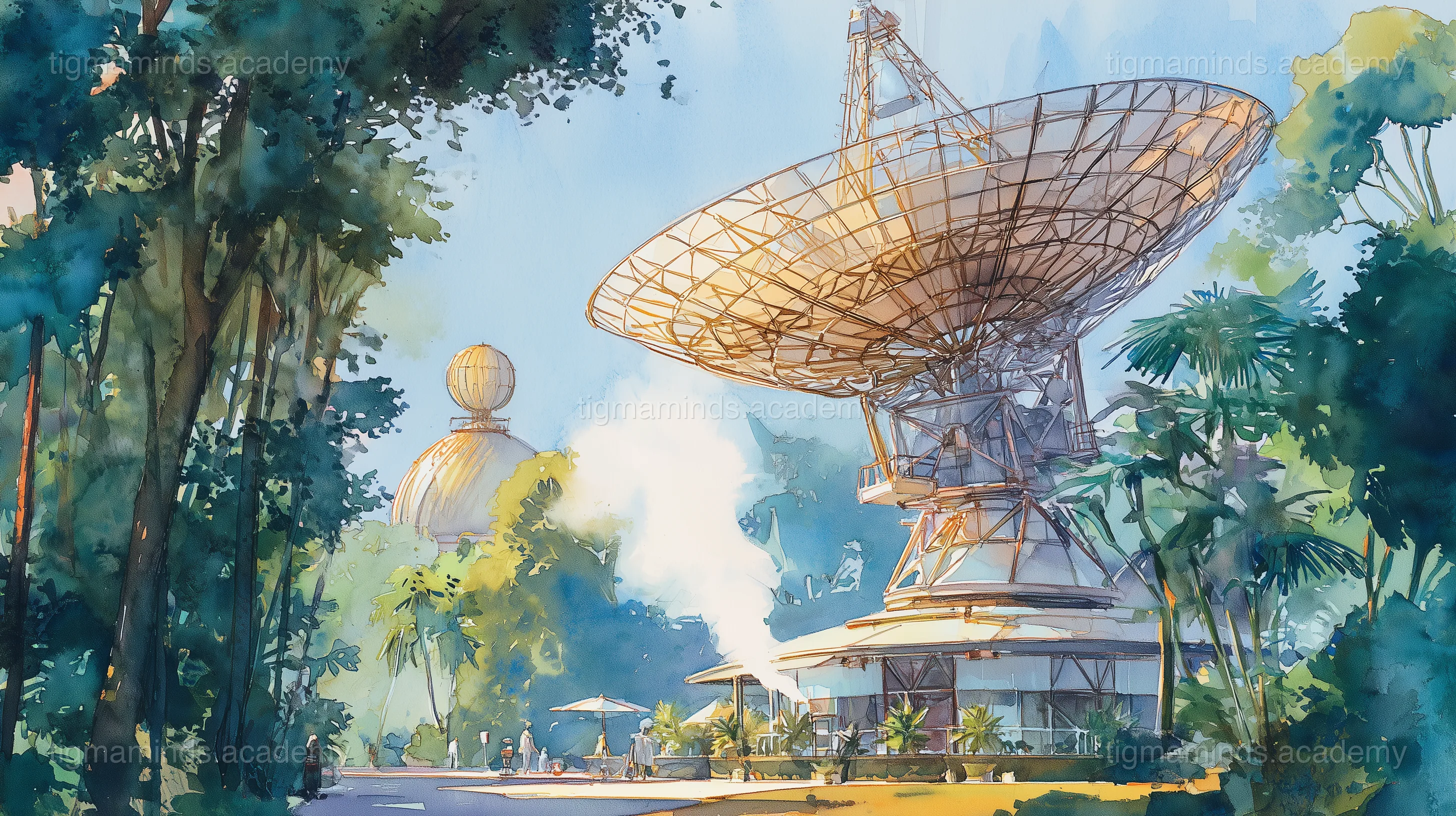
From the roof, she could see the entire apparatus. Spread across the roof and the adjoining ground were fifteen parabolic dish reflectors, each one a gleaming bowl of polished aluminium, 15 metres in diameter, mounted on a motorised frame that tracked the sun across the sky. The dishes were not flat mirrors — they were precisely curved in a paraboloid shape, which meant that every ray of sunlight hitting the dish surface was reflected to a single point: the focus, located 7.5 metres above the centre of the dish.

At the focus of each dish, a receiver — a blackened steel vessel containing a heat-transfer fluid (a food-grade thermal oil rated to 350 degrees Celsius) — absorbed the concentrated sunlight and heated the oil to temperatures between 200 and 280 degrees Celsius. The hot oil was pumped through insulated pipes to the kitchen below, where it passed through heat exchangers that transferred its thermal energy to steam. The steam cooked rice, sambar, vegetables, and chutneys in industrial-scale pressure vessels.

On a clear day, the system could deliver 600 kilowatts of thermal power — enough to cook lunch for a thousand people without burning a single gram of fossil fuel.

The Parabola

"Why a parabola?" asked Dinesh, Priya's trainee, who was helping calibrate the tracking motors.

"Because of a mathematical property that no other curve has," Priya said. She picked up a piece of chalk and drew on the concrete floor. "A parabola is defined as the set of all points equidistant from a fixed point (the focus) and a fixed line (the directrix). Any curve that satisfies this definition has one crucial optical property: all rays arriving parallel to the axis of symmetry are reflected to the focus."

"Sunlight arrives at the Earth's surface as essentially parallel rays — the Sun is so far away (150 million kilometres) that the rays from different parts of the Sun diverge by less than 0.5 degrees. A parabolic reflector captures all these parallel rays and redirects them to a single small point. The energy that was spread over 15 metres of dish surface — an area of about 177 square metres — is now concentrated onto a receiver that is only 0.5 metres across. The energy density at the focus is roughly 700 times greater than the energy density of the original sunlight."

"Could you use a spherical mirror instead?" Dinesh asked.

"No. A spherical mirror suffers from spherical aberration — rays hitting the edge of the mirror are reflected to a different point than rays hitting the centre. The focus is blurred. A sphere approximates a parabola near the centre, but diverges at the edges. For a 15-metre dish, the aberration would be severe. Only a true parabola brings all parallel rays to a single point."

The Concentration Ratio

On the roof, Priya showed Dinesh the pyrheliometer — a sensor that measured the Direct Normal Irradiance (DNI), the intensity of sunlight arriving directly from the Sun, perpendicular to the beam. On this February morning, the DNI read 920 watts per square metre — close to the theoretical maximum at Auroville's latitude.

"The dish has an aperture area of 177 square metres," Priya calculated. "At 920 W/sq m, the total solar power intercepted is 177 times 920, which is approximately 163 kilowatts. But not all of that reaches the receiver. The mirror reflectivity is about 92 percent — some light is absorbed by the aluminium rather than reflected. The receiver absorptivity is about 95 percent — some concentrated light bounces off. And the tracking accuracy means that at any moment, about 97 percent of the reflected light actually hits the receiver. So the net thermal power delivered is 163 times 0.92 times 0.95 times 0.97, which equals approximately 138 kilowatts per dish."

"Fifteen dishes gives us about 600 kilowatts on a clear morning. By noon, the DNI will drop slightly as the Sun approaches the zenith and atmospheric thickness changes, but we will still have over 500 kilowatts."

"What about clouds?" Dinesh asked.

"Clouds are the enemy," Priya said flatly. "A thin cirrus cloud reduces DNI by 20 percent. A cumulus cloud blocks it entirely. When a cloud passes over, the thermal power drops to near zero in seconds. The thermal oil in the receiver starts cooling immediately. If the cloud lasts more than a few minutes, the kitchen must switch to the backup system — a conventional LPG boiler that can bring the steam line up to full temperature in eight minutes."

Heat Transfer: From Sunlight to Steam

In the kitchen below, Priya showed Dinesh the heat exchanger — a stainless steel vessel where the hot thermal oil (at 250 degrees C) flowed through a coil of tubes immersed in water. The oil transferred its heat to the water, converting it to steam at 150 degrees C and 5 bar pressure. The cooled oil (now at about 180 degrees C) was pumped back to the rooftop receivers to be reheated.

"There are three modes of heat transfer happening simultaneously in the system," Priya said. "On the roof, radiation — electromagnetic waves from the Sun hit the dish and are concentrated on the receiver. The receiver surface absorbs the radiation and converts it to thermal energy. Inside the receiver, conduction — heat flows through the steel wall of the receiver into the thermal oil in contact with it. In the heat exchanger, convection — the hot oil circulates past the water, carrying thermal energy from one fluid to another."

"At each transfer stage, some energy is lost. The receiver radiates some heat back into the sky — this is called re-radiation, and it increases with the fourth power of temperature (Stefan-Boltzmann law). The insulated pipes lose a small amount of heat to the ambient air. The heat exchanger is not 100 percent efficient because the oil and water can never reach exactly the same temperature — there is always a temperature difference (called the approach temperature) between them."

"The overall system efficiency — solar energy in, useful steam energy out — is about 65 to 70 percent on a clear day. That may not sound impressive until you compare it to solar electricity: a photovoltaic panel converts about 20 percent of sunlight to electricity. Our parabolic system is three times more efficient because we do not need to convert heat to electricity — we use the heat directly."

The Tracking System

Each 15-metre dish had to track the Sun's position in the sky with an accuracy of better than 0.5 degrees. At the focus distance of 7.5 metres, a 0.5-degree pointing error translated to a 6.5-centimetre displacement of the focus — enough to move the concentrated beam partly off the receiver, wasting energy and potentially damaging the support structure.

The tracking system used two motors — one for the elevation axis (tilting up and down) and one for the azimuth axis (rotating left and right). A small computer calculated the Sun's position from astronomical equations (the Sun's declination changes daily due to the Earth's axial tilt, and its hour angle changes continuously as the Earth rotates) and sent motor commands every 15 seconds.

A feedback sensor — a four-quadrant photodiode mounted next to the receiver — detected whether the concentrated light spot was centred on the receiver. If the spot drifted, the sensor reported the direction and magnitude of the error, and the computer applied a correction. This combination of feedforward (astronomical calculation) and feedback (sensor correction) achieved pointing accuracy better than 0.2 degrees in practice.

Lunch

At 12:30 PM, the kitchen served lunch: rice (cooked in solar-heated steam pressure cookers, 200 kilograms per batch), sambar, mixed vegetable kootu, cabbage poriyal, pappadam, and curd rice. A thousand residents and guests lined up along the serving counter, collecting their meals in stainless steel thali plates.

Priya ate with them. The rice was perfectly cooked — steam is steam, whether it comes from burning gas or concentrated sunlight. The sambar was rich with tamarind and drumstick, simmered for ninety minutes in a solar-heated vessel.

She looked up at the dishes on the roof, still tracking the afternoon sun, still concentrating 920 watts per square metre into receivers no bigger than a washbasin.

Six hundred kilowatts. From a star 150 million kilometres away. Reflected by aluminium, concentrated by geometry, transferred by oil, delivered as steam.

No fuel. No flame. No emissions. Just a curve — a parabola — and the physics of light.

The end.

Try It Yourself

Choose your level. Everyone starts with the story — the code gets deeper as you go.

Story Progress

0%

Ready to Start Coding?

Here is a taste of what Level 1 looks like for this lesson:

Level 1: Explorer — Python
import numpy as np
import matplotlib.pyplot as plt

# Your first data analysis with Python
data = [45, 52, 38, 67, 41, 55, 48]  # measurements
mean = np.mean(data)

plt.bar(range(len(data)), data)
plt.axhline(mean, color='red', linestyle='--', label=f'Mean: {mean:.1f}')
plt.xlabel("Sample")
plt.ylabel("Value")
plt.title("Parabolic Reflectors & Solar Thermodynamics — Sample Data")
plt.legend()
plt.show()

This is just the first of 6 coding exercises in Level 1. By Level 4, you will build: Build a Solar Cooker Power Calculator.

Free

Level 0: Listener

Stories, science concepts, diagrams, quizzes. No coding.

You are here

Enrolled

Levels 1-4

Python, NumPy, Matplotlib, real projects, mentorship.

Sign Up Free

Stay Updated

Join Waitlist

Get notified when enrollment opens for your area.

Notify Me

Level 0 is always free. Coding levels (1-4) are part of our 12-Month Curriculum.