The Bamboo Dance of Mizoram
Periodic Motion & Rhythm Physics

The Bamboo Dance of Mizoram

Rhythm, timing, and the geometry hidden in a thousand-year-old dance.
Periodic Motion & Rhythm Physics12-Month Curriculum 10h

The Story

The Challenge

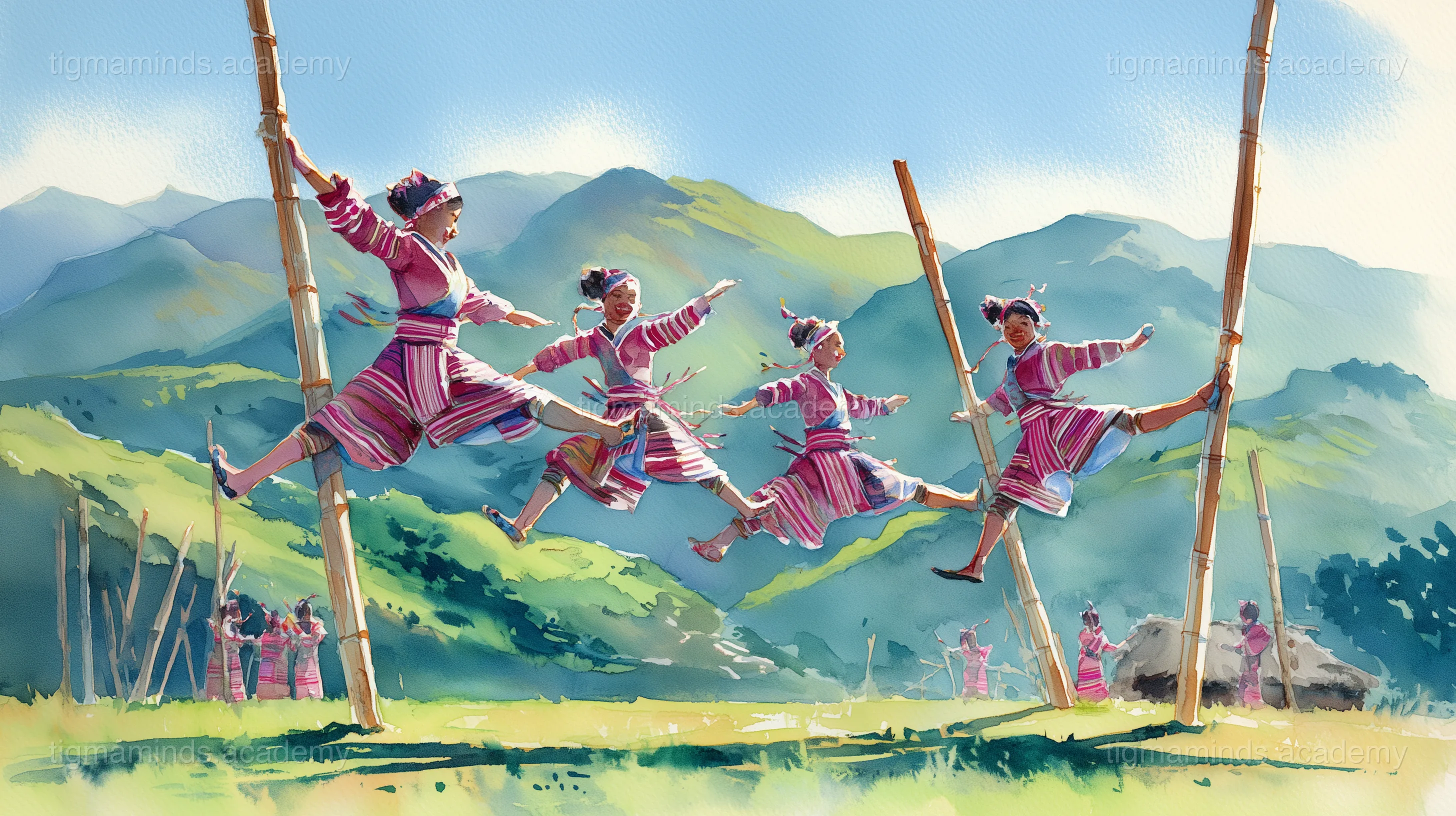
In a village high in the Lushai Hills of Mizoram, a girl named Lalruati watched the elders prepare for the Cheraw — the bamboo dance. Four men sat on the ground facing each other in pairs, each pair holding two long bamboo poles. They slid the poles together and apart in a steady rhythm — clap-open-clap-open — while dancers leaped between them.

The timing had to be perfect. Step in when the poles are open. Step out before they close. One mistake, and the bamboo catches your ankle.

Lalruati was twelve, and this was the year she was finally old enough to dance.

"Watch the rhythm first," said her grandmother, Pi Thangi, who had danced the Cheraw for fifty years and never once been caught. "The bamboo tells you when to move. You do not decide — you listen."

Learning to Listen

Pi Thangi sat Lalruati beside the bamboo holders and told her to close her eyes.

Clap. The poles struck together. Shhhh. They slid apart. Clap. Together again. Shhhh. Apart.

"Count the beats," said Pi Thangi. "The cycle is four beats. On beats one and three, the poles are closed. On beats two and four, the poles are open. You step in on two. You step out on four."

Lalruati counted. One-two-three-four. One-two-three-four. The rhythm was steady, like a heartbeat. But when she opened her eyes and watched the dancers, it looked impossibly fast. Their feet flickered between the poles like sparks — in, out, in, out — while the bamboo slammed shut behind them with a crack that made Lalruati flinch.

"How do they do it so fast?" she asked.

"They do not think about speed," said Pi Thangi. "They think about pattern. Once you feel the pattern in your body, speed takes care of itself."

The Pattern

Pi Thangi drew a diagram in the dust with a stick. She sketched two parallel lines for the bamboo poles and marked positions.

"The basic step has three foot positions," she explained. "In, across, and out. Your right foot goes in between the poles. Your left foot crosses over. Your right foot comes out. That is three movements in two beats."

She drew arrows showing the path: a zigzag pattern that looked like the letter Z.

"When you add a second set of poles," Pi Thangi continued, drawing another pair of parallel lines, "the pattern becomes a grid. Now you must navigate two sets of rhythms simultaneously — and the two pairs might not be in sync."

Lalruati stared at the diagram. "That's like a… a coordinate grid," she said. She had learned about x-y coordinates in school last month.

Pi Thangi smiled. "I don't know what coordinates are. But I know that every dance step has a position, every position has a timing, and if you map them correctly, you can dance through anything."

The First Attempt

The next morning, Lalruati stood before a single pair of bamboo poles. Two boys her age operated them at a slow tempo — about 60 beats per minute, half the speed of the real dance.

Clap-open-clap-open.

Lalruati watched three cycles. On the fourth open beat, she stepped in with her right foot. The poles were wide apart, and she felt the bamboo vibrate through the ground beneath her feet. She shifted her left foot across, then pulled her right foot out just as the poles closed behind her.

She had done it. One cycle. One step.

"Again," said Pi Thangi.

Lalruati danced the single step fifty times that morning. By the fiftieth, she didn't need to count. Her body had learned the interval — the period of the rhythm — and her feet moved on their own.

"Good," said Pi Thangi. "Tomorrow, we add the second pair."

Two Grids

The second pair of poles was offset by one beat. When the first pair was open, the second was closed, and vice versa. This meant Lalruati had to alternate: step through the first pair on beat two, then immediately step through the second pair on beat four, then back to the first pair on beat two, and so on.

It was like jumping rope with two ropes turning in opposite directions — a double Dutch pattern, but on the ground with bamboo.

The first time she tried, the second pair caught her left ankle. The bamboo wasn't sharp — it was smooth and polished from years of use — but the clap stung.

"Your timing was right for the first pair but wrong for the second," said Pi Thangi. "You cannot carry the rhythm of one grid into another. Each grid has its own phase."

Phase. Lalruati's science teacher had used that word when talking about waves. Two waves could have the same frequency but be out of phase — their peaks and troughs offset from each other.

That was exactly what the two sets of poles were doing. Same rhythm, offset timing.

The Festival

By the night of the festival, Lalruati could dance through four pairs of poles at full tempo — 120 beats per minute. Her feet moved in a pattern so complex that it looked like pure improvisation, but it was actually mathematics: a precise sequence of positions and timings mapped across a moving grid.

The bamboo holders wore traditional Mizo cloth, their arms moving in perfect synchrony. The dancers — Lalruati among them — leaped and spun through the gauntlet of snapping bamboo, their movements fluid and joyful. The audience clapped and cheered.

When the dance ended, Lalruati was breathing hard, her face flushed, her feet tingling. Pi Thangi was waiting at the edge of the dance ground.

"How did it feel?" asked her grandmother.

"Like flying," said Lalruati. "Like the bamboo was holding me up instead of trying to catch me."

Pi Thangi nodded. "That is what happens when you stop fighting the pattern and become part of it. The bamboo does not want to hurt you. It wants to dance with you. You just have to match its rhythm."

What the Dance Teaches

The Cheraw is one of the oldest dances in Mizoram, performed at festivals, weddings, and community gatherings for centuries. It requires no music — the bamboo poles provide both the rhythm and the obstacle. The dancers provide the grace.

But underneath the grace is precision. The dance encodes principles of periodic motion (the regular, repeating rhythm of the poles), phase relationships (multiple sets of poles offset in time), and spatial-temporal coordination (mapping movement through space against a time grid).

In science class, these concepts appear in the study of waves, oscillations, and synchronisation. In the Cheraw, they appear as a dance that is also a mathematical puzzle — solved not with equations but with feet, timing, and a grandmother's patient instruction.

The end.

Try It Yourself

Choose your level. Everyone starts with the story — the code gets deeper as you go.

Story Progress

0%

Ready to Start Coding?

Here is a taste of what Level 1 looks like for this lesson:

Level 1: Explorer — Python
# Cheraw Bamboo Dance Simulator
import math

bpm = 120
period = 60 / bpm  # seconds per beat

# Two pole pairs, 180° out of phase
for beat in range(1, 17):
    time = beat * period
    pair1 = "OPEN" if beat % 2 == 0 else "SHUT"
    pair2 = "SHUT" if beat % 2 == 0 else "OPEN"
    safe = "STEP!" if pair1 == "OPEN" else "WAIT"
    print(f"Beat {beat:>2} ({time:.1f}s): Pair1={pair1} Pair2={pair2}  → {safe}")

This is just the first of 6 coding exercises in Level 1. By Level 4, you will build: Build a Rhythm Pattern Simulator.

Free

Level 0: Listener

Stories, science concepts, diagrams, quizzes. No coding.

You are here

Enrolled

Levels 1-4

Python, NumPy, Matplotlib, real projects, mentorship.

Sign Up Free

Stay Updated

Join Waitlist

Get notified when enrollment opens for your area.

Notify Me

Level 0 is always free. Coding levels (1-4) are part of our 12-Month Curriculum.