Mesopotamian Irrigation
Soil Chemistry & Hydrology

Mesopotamian Irrigation

The invention of agriculture at scale — canals, salination, and the collapse that followed.
Soil Chemistry & Hydrology12-Month Curriculum 12h

The Story

Between Two Rivers

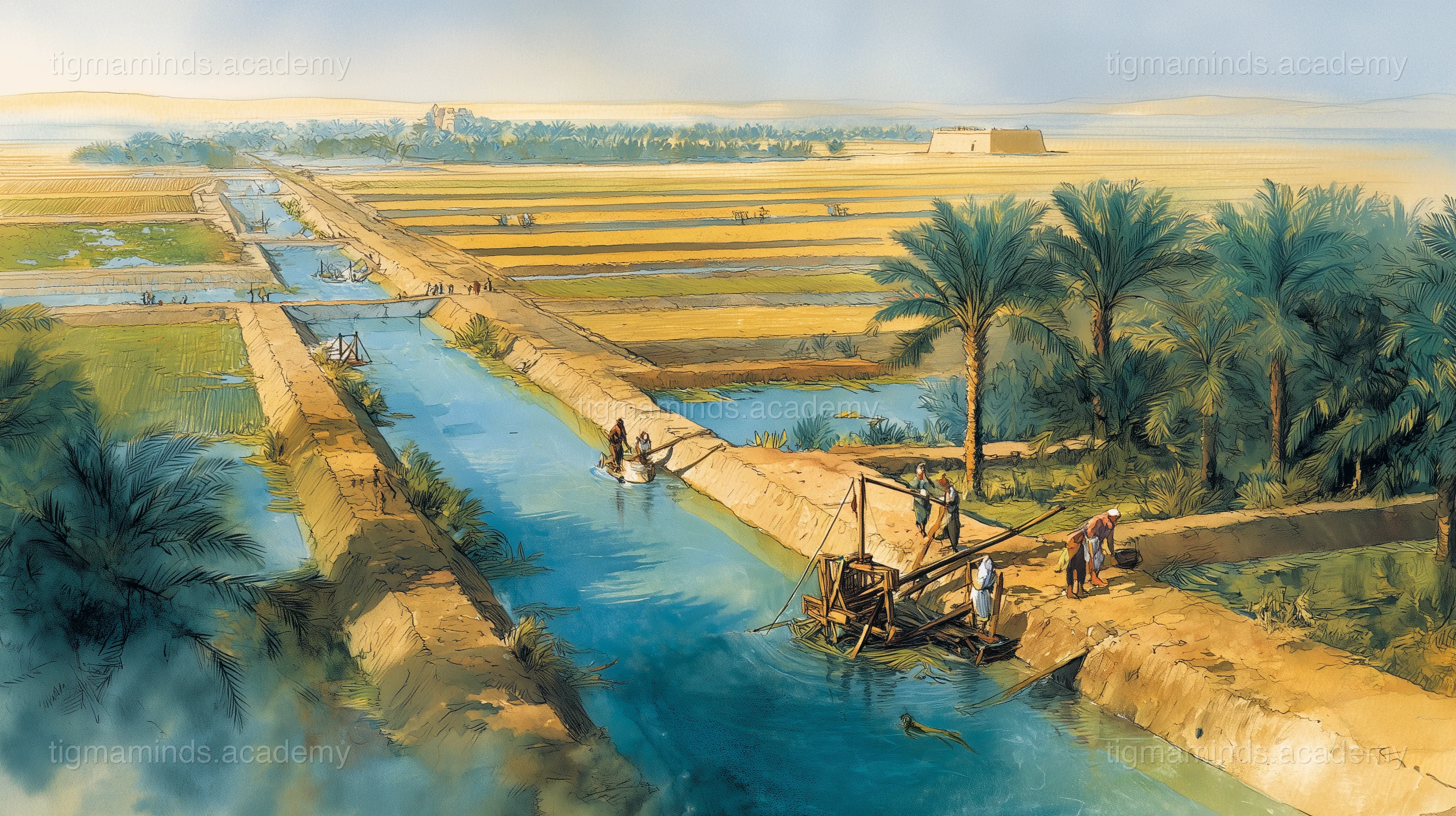
The name says it all. Mesopotamia — from the Greek mesos (middle) and potamos (river) — was the land between the Tigris and Euphrates rivers, in what is now Iraq. Around 6,000 BCE, the people living there faced a paradox: they lived beside two enormous rivers, but the land between them was desert.

The rivers flooded in spring, fed by snowmelt from the mountains of Turkey. But the floods came at the wrong time — too early for planting, too violent for crops. And the rest of the year, the land baked under temperatures exceeding 45°C, with almost no rainfall.

The solution was irrigation — diverting river water through artificial channels to water fields when and where it was needed. This was not a small project. It required canals dug by hand (some stretching 80 kilometres), levees to prevent uncontrolled flooding, distribution gates to regulate flow, and a social organization capable of mobilizing thousands of workers for construction and maintenance.

The result was the most productive agricultural region on Earth. Irrigated fields in southern Mesopotamia produced wheat yields of 2,500 litres per hectare — a figure not matched by European agriculture until the 18th century, five thousand years later. This surplus fed the world's first cities: Ur, Uruk, Eridu, Babylon.

But irrigation carried a hidden poison.

The Salt Problem

Every river carries dissolved minerals — tiny amounts of sodium, calcium, magnesium, and other salts picked up as the water flows over and through rock. In a natural river system, these minerals wash out to sea. But in an irrigation system, the water is spread across fields and evaporates, leaving the dissolved salts behind in the soil.

This process is called salinisation. Each irrigation cycle deposits a thin film of salt on the soil surface. Over years, decades, and centuries, the salt accumulates. Eventually, the soil becomes so salty that plant roots cannot absorb water — the osmotic pressure of the salt solution in the soil exceeds the plant's ability to draw water inward.

The Sumerians noticed the problem as early as 2400 BCE. Their agricultural records — inscribed on clay tablets in cuneiform script — show a gradual shift from wheat (which is salt-sensitive) to barley (which tolerates higher salinity). By 1700 BCE, wheat had disappeared entirely from southern Mesopotamian agriculture. By 1200 BCE, even barley yields had declined catastrophically.

The great cities of southern Mesopotamia — the cradle of civilization — were slowly poisoned by their own success. The irrigation that made civilization possible was destroying the soil that fed it.

The Science of Salinisation

Soil salinisation is an osmotic process. Healthy soil has a low salt concentration — the water between soil particles is relatively pure. Plant roots absorb this water through osmosis: water moves from the low-concentration soil solution, through the semi-permeable root membrane, into the higher-concentration cell interior.

When soil salt concentration rises, the osmotic gradient reverses. The soil solution becomes more concentrated than the cell interior. Water is pulled out of the roots instead of in. The plant wilts, even though the soil is wet. This is called physiological drought — the plant dies of thirst while surrounded by water, because the water is too salty to absorb.

The critical threshold is measured as electrical conductivity (EC) of the soil solution. Most crops begin to suffer when EC exceeds 4 deciSiemens per metre (dS/m). At 8 dS/m, only salt-tolerant crops (barley, date palms) can survive. Above 16 dS/m, virtually nothing grows.

Modern satellite imagery shows that salinisation affects 20% of all irrigated land worldwide — roughly 60 million hectares. It is happening today in the Indus Valley (Pakistan), the Murray-Darling Basin (Australia), the San Joaquin Valley (California), and across the Middle East. We are repeating the Mesopotamian mistake on a global scale.

The Solution (That the Sumerians Didn't Have)

Modern agriculture manages salinisation through leaching — applying extra water to flush salts below the root zone — and drainage — installing underground pipes to carry the salty water away. Both require energy, infrastructure, and fresh water, all of which are increasingly scarce.

A more sustainable approach is drip irrigation, which delivers water directly to plant roots in small, precise amounts, minimising evaporation and salt accumulation. Israel — a country that is mostly desert — produces enormous agricultural output using drip irrigation technology developed in the 1960s.

The lesson of Mesopotamia is the lesson of unintended consequences: the technology that creates abundance can, if misunderstood, destroy the very foundation it depends on. Understanding the chemistry of your soil is as important as understanding the engineering of your canals.

The end.

Try It Yourself

Choose your level. Everyone starts with the story — the code gets deeper as you go.

Story Progress

0%

Ready to Start Coding?

Here is a taste of what Level 1 looks like for this lesson:

Level 1: Explorer — Python
import numpy as np
import matplotlib.pyplot as plt

# Your first data analysis with Python
data = [45, 52, 38, 67, 41, 55, 48]  # measurements
mean = np.mean(data)

plt.bar(range(len(data)), data)
plt.axhline(mean, color='red', linestyle='--', label=f'Mean: {mean:.1f}')
plt.xlabel("Sample")
plt.ylabel("Value")
plt.title("Soil Chemistry & Hydrology — Sample Data")
plt.legend()
plt.show()

This is just the first of 6 coding exercises in Level 1. By Level 4, you will build: Build a Soil Salinisation Model.

Free

Level 0: Listener

Stories, science concepts, diagrams, quizzes. No coding.

You are here

Enrolled

Levels 1-4

Python, NumPy, Matplotlib, real projects, mentorship.

Sign Up Free

Stay Updated

Join Waitlist

Get notified when enrollment opens for your area.

Notify Me

Level 0 is always free. Coding levels (1-4) are part of our 12-Month Curriculum.