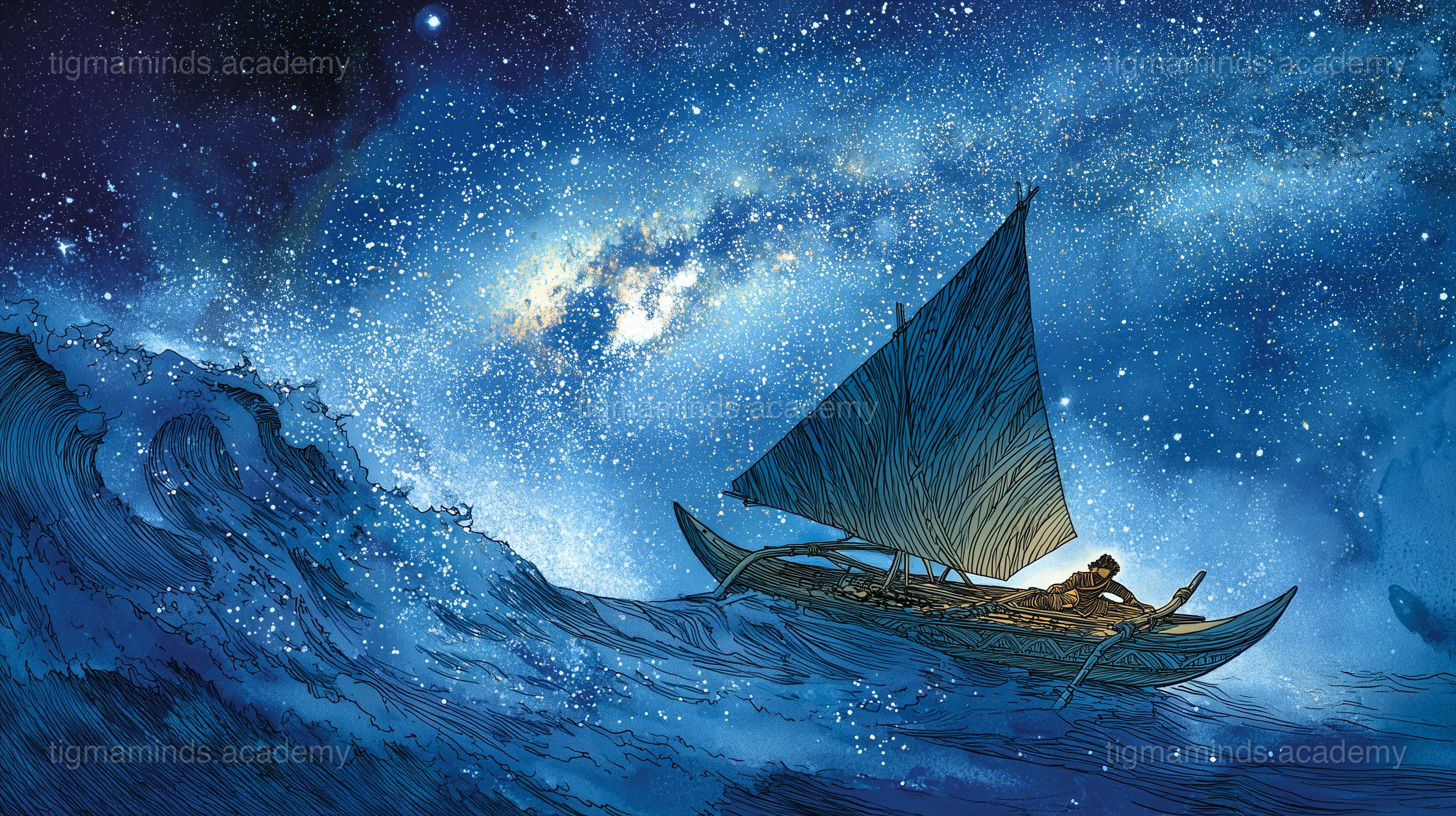
Polynesian Wayfinding
Wave Physics, Celestial Navigation & Signal Detection

Polynesian Wayfinding

The greatest navigators in human history — star compasses, wave patterns, and crossing the Pacific without instruments.

Wave Physics, Celestial Navigation & Signal Detection12-Month Curriculum 14h

The Story

The Largest Migration

The Polynesians settled the largest ocean on Earth. Starting from Southeast Asia around 3,000 years ago, they spread across the Pacific — an area covering one-third of the planet's surface — reaching every habitable island from Hawaii to New Zealand to Easter Island.

They did this in double-hulled sailing canoes — vessels 15 to 25 metres long, with no deck, no shelter from the weather, and carrying up to 80 people along with pigs, chickens, dogs, seedlings, and enough food and water for weeks at sea.

And they did it without any navigation instruments. No compass, no sextant, no charts, no clock. They navigated using a system so sophisticated that Western scientists didn't fully understand it until the 1970s — and some aspects remain poorly understood today.

The Star Compass

Polynesian navigators used a mental model called the star compass — a circle of horizon points defined by the rising and setting positions of specific stars.

Unlike Western celestial navigation, which measures a star's angle above the horizon, Polynesian navigation focuses on where stars touch the horizon — the points where they rise in the east and set in the west. Each star rises at a specific compass bearing that changes slightly with latitude but remains constant enough for navigation.

A skilled navigator memorized the rising and setting points of approximately 220 stars, creating a mental compass with dozens of directional points around the horizon. As one star rose too high to be useful, the next one was already appearing at the same horizon point, creating a continuous chain of directional references throughout the night.

During the day, the navigator used the sun's arc and, when the sky was overcast, the direction of ocean swells — which maintain a consistent bearing over hundreds of kilometres, driven by distant trade winds.

Reading the Waves

The most remarkable aspect of Polynesian navigation was the ability to read wave patterns to detect land that was far beyond the horizon.

The Pacific has multiple swell systems running simultaneously — long-period swells generated by different wind systems in different parts of the ocean. These swells interact with each other, creating complex patterns on the surface. When a swell encounters a submerged reef, an atoll, or an island, it refracts, reflects, and diffracts around the obstacle, creating distortion patterns that radiate outward for 50 to 100 kilometres beyond the island.

A navigator lying in the hull of the canoe — feeling the motion of the boat rather than looking at the water — could detect these distortion patterns. The boat's rocking changes subtly as the regular swell pattern is disrupted by reflections from distant land. Mau Piailug, one of the last traditional navigators from Satawal in Micronesia, described it as "feeling the island" through the motion of the hull.

Modern oceanography has confirmed this phenomenon. When ocean swells encounter an island, they refract around it and create interference patterns on the far side — zones where waves cancel each other (creating unusual calm) and zones where they reinforce each other (creating unusual chop). These patterns are detectable instrumentally at distances of 30-50 kilometres from the island. Polynesian navigators detected them by feel.

The Evidence

The settlement of Polynesia was not accidental — not a series of lucky fishermen blown off course. The evidence for intentional, planned voyaging is overwhelming:

The plants and animals: Every Polynesian settlement has the same suite of domesticated species — taro, breadfruit, sweet potato, coconut, banana, pigs, chickens, dogs. These were brought deliberately, in canoes, with their seeds and breeding populations. You don't accidentally bring 20 plant species and 3 animal species to an island 3,000 kilometres from the nearest land.

The genetics: DNA analysis of Polynesian populations shows clear patterns of genetic relatedness that match a settlement sequence from west to east — Samoa, Tonga, the Cook Islands, the Society Islands (Tahiti), the Marquesas, Hawaii, Easter Island, and finally New Zealand.

The linguistics: Polynesian languages form a family tree that mirrors the genetic evidence. Hawaiian, Tahitian, Maori, and Rapa Nui (Easter Island) are all related, with mutual intelligibility decreasing with geographic and temporal distance from the homeland.

The canoes: In 1976, the replica double-hulled canoe Hōkūleʻa sailed from Hawaii to Tahiti — 4,000 kilometres — using only traditional Polynesian navigation methods, guided by Mau Piailug. The voyage proved that traditional wayfinding could accurately guide a canoe across open ocean. The Hōkūleʻa has since sailed over 240,000 kilometres across the Pacific, Indian, and Atlantic Oceans, all navigated by star compass, swell reading, and observation of birds, clouds, and sea colour.

The Mathematics of Finding an Island

Finding an island in the Pacific is a probability problem. A typical Polynesian target island might be 10 kilometres wide. The surrounding ocean is thousands of kilometres across. How do you find a 10-kilometre target in a 3,000-kilometre ocean?

The navigators expanded their target. An island isn't just the land — it's surrounded by a zone of signs: reflected swells (detectable at 50 km), altered cloud patterns (clouds pile up over land, visible at 100+ km), seabirds (certain species fly 50-100 km from shore to feed), changes in water colour and temperature, floating vegetation and debris, and the smell of vegetation carried on the wind.

All of these signs expand the effective "target" from a 10-kilometre island to a zone of detection roughly 200 kilometres in diameter. This changes the mathematics dramatically: the probability of sailing past a 200-km detection zone is much lower than the probability of missing a 10-km island.

This is signal detection theory applied to navigation — the same mathematics used in radar, sonar, and modern search algorithms. The Polynesian navigators were, unknowingly, optimizing their search strategy by maximizing the number of detectable signals from their target.

The end.

Try It Yourself

Choose your level. Everyone starts with the story — the code gets deeper as you go.

Story Progress

0%

Ready to Start Coding?

Here is a taste of what Level 1 looks like for this lesson:

Level 1: Explorer — Python
import numpy as np
import matplotlib.pyplot as plt

# Your first data analysis with Python
data = [45, 52, 38, 67, 41, 55, 48]  # measurements
mean = np.mean(data)

plt.bar(range(len(data)), data)
plt.axhline(mean, color='red', linestyle='--', label=f'Mean: {mean:.1f}')
plt.xlabel("Sample")
plt.ylabel("Value")
plt.title("Wave Physics, Celestial Navigation & Signal Detection — Sample Data")
plt.legend()
plt.show()

This is just the first of 6 coding exercises in Level 1. By Level 4, you will build: Build a Wayfinding Simulator.

Free

Level 0: Listener

Stories, science concepts, diagrams, quizzes. No coding.

You are here

Enrolled

Levels 1-4

Python, NumPy, Matplotlib, real projects, mentorship.

Sign Up Free

Stay Updated

Join Waitlist

Get notified when enrollment opens for your area.

Notify Me

Level 0 is always free. Coding levels (1-4) are part of our 12-Month Curriculum.