The Lily of Dzükou Valley
Alpine Botany & Plant Adaptation

The Lily of Dzükou Valley

How a flower survives above the clouds — alpine botany and plant adaptation.
Alpine Botany & Plant Adaptation12-Month Curriculum 10h

The Story

The Hidden Valley

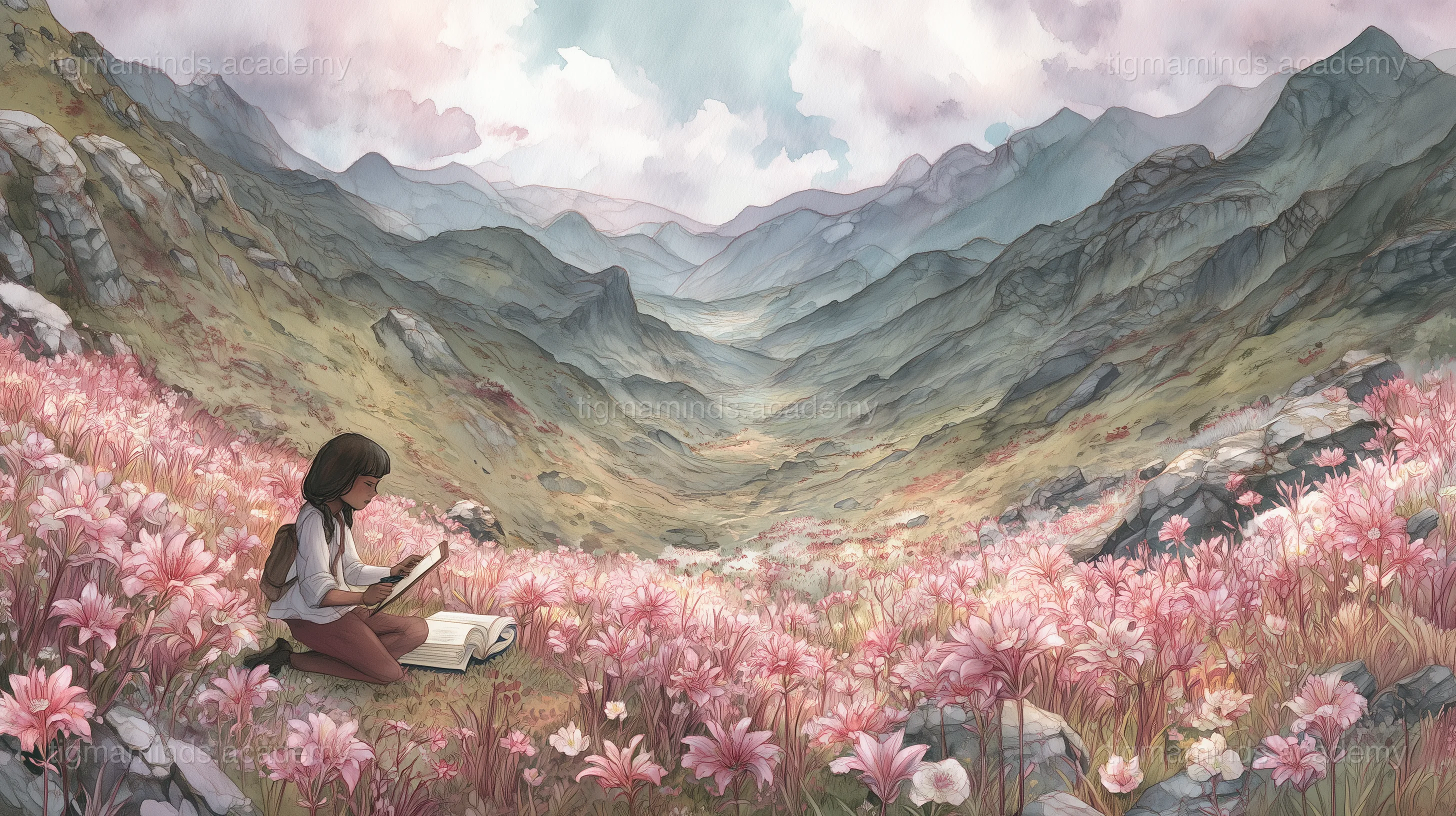
At 2,452 metres, on the border between Nagaland and Manipur, lies Dzükou Valley — a broad, treeless meadow cradled between mountains, invisible from below. You can only reach it by climbing a steep, forested path from Viswema village, and when you emerge from the tree line onto the valley floor, the sight stops you.

In October, the valley turns pink. Millions of Dzükou lilies — found nowhere else on Earth — bloom simultaneously, carpeting the meadow in a colour somewhere between blush and salmon. The lilies last two weeks. Then they're gone, and the valley returns to a palette of green and gold until the next October.

Vizokienuo Mero — everyone called her Keno — was sixteen and had been trekking to Dzükou since she was ten. Her father, a forest guard with the Nagaland Forest Department, took her every October to count the lilies as part of the annual census.

This year, Keno had a question. "The valley is 2,400 metres up. It freezes in winter. The soil is thin. There's no shelter from wind. How does a delicate lily survive here when tougher plants can't?"

Her father smiled. "Ask the lily."

Alpine Adaptation

Keno's biology teacher, Miss Dielienom, had answers. "The Dzükou lily (Lilium mackliniae) is a specialist," she said. "It has evolved specific adaptations for life in the alpine zone."

Adaptation 1: The Bulb. The Dzükou lily doesn't survive winter as a plant — it survives as a bulb underground. In October, the above-ground parts die. The bulb, buried 10–20 cm deep, is insulated from freezing temperatures by soil and snow cover. The bulb stores starch (energy) accumulated during the summer growing season, enough to power rapid growth when spring returns.

Adaptation 2: Rapid Growth. The alpine growing season in Dzükou is short — roughly May to October (5 months). In that time, the lily must sprout, grow a stem, produce leaves, flower, set seed, and store enough energy in its bulb for next year. This is why the flowering is so sudden — the lily has no time to waste. It grows at maximum speed, flowers for two weeks, and shuts down.

Adaptation 3: UV Protection. At 2,400 metres, ultraviolet (UV) radiation is much stronger than at sea level because there is less atmosphere above to absorb it. The Dzükou lily produces anthocyanins — pigment molecules that absorb UV light and protect the plant's DNA from damage. These anthocyanins are the same molecules that give the flowers their distinctive pink colour.

Adaptation 4: Wind Resistance. The valley is exposed to strong winds with no tree shelter. The lily's stem is short (30–50 cm) and flexible, bending with the wind rather than breaking. Its bell-shaped flowers hang downward, reducing wind drag and protecting the pollen from being blown away before pollinators arrive.

Altitude and Air

Keno wanted to understand the altitude connection. "Why is UV stronger at higher altitude?"

Miss Dielienom drew a diagram. "The atmosphere is like a blanket of air around the Earth. Sea level has the full blanket — about 10 km of atmosphere above you. At 2,400 metres, you have 2.4 km less atmosphere above you. Less atmosphere means less UV absorption — roughly 25% more UV reaches you at 2,400 metres compared to sea level."

"Air pressure also drops with altitude," she continued. "At sea level, atmospheric pressure is about 101,325 Pa (1 atmosphere). At 2,400 metres, it's about 75,000 Pa — 26% less. This means less oxygen per breath, which is why people feel breathless when trekking to Dzükou."

"The boiling point of water also drops. At sea level, water boils at 100°C. At 2,400 metres, it boils at about 92°C. This is why rice takes longer to cook in mountain villages — the water is hot but not as hot as at sea level."

The Census

On census day, Keno and her father walked systematic transects across the valley floor, counting flowering plants in 1-metre-square quadrats at 50-metre intervals. This is a standard ecological technique called quadrat sampling — you can't count every plant, but by sampling systematically, you can estimate the total population.

In their 40 quadrats, they counted an average of 12 flowering lilies per square metre. The valley floor covers approximately 1.5 km² (1,500,000 m²) of which about 30% is suitable lily habitat. Estimated population:

12 × 1,500,000 × 0.30 = 5,400,000 flowering plants

Five million lilies, found nowhere else on Earth, blooming for two weeks in a valley above the clouds. Each one a masterpiece of alpine adaptation — bulb storage, rapid growth, UV-shielding pigments, and wind-resistant design.

"The lily is fragile in appearance," said Miss Dielienom. "But its adaptations make it one of the toughest plants alive. Surviving where nothing else can is not weakness — it is extreme specialisation."

The end.

Try It Yourself

Choose your level. Everyone starts with the story — the code gets deeper as you go.

Story Progress

0%

Ready to Start Coding?

Here is a taste of what Level 1 looks like for this lesson:

Level 1: Explorer — Python
# Altitude Effects Calculator
import math

altitude = 2400  # metres (Dzükou Valley)
P0 = 101325      # sea-level pressure (Pa)
H = 8500         # scale height (m)

pressure = P0 * math.exp(-altitude / H)
oxygen_pct = (pressure / P0) * 100
uv_increase = (altitude / 1000) * 11  # ~11% per 1000m
boiling_pt = 100 - (altitude / 300)   # rough approximation

print(f"Altitude: {altitude}m")
print(f"Pressure: {pressure:.0f} Pa ({pressure/P0*100:.0f}% of sea level)")
print(f"Oxygen: {oxygen_pct:.0f}% of sea level")
print(f"UV increase: +{uv_increase:.0f}%")
print(f"Water boils at: {boiling_pt:.0f}°C")

This is just the first of 6 coding exercises in Level 1. By Level 4, you will build: Build an Altitude Effects Calculator.

Free

Level 0: Listener

Stories, science concepts, diagrams, quizzes. No coding.

You are here

Enrolled

Levels 1-4

Python, NumPy, Matplotlib, real projects, mentorship.

Sign Up Free

Stay Updated

Join Waitlist

Get notified when enrollment opens for your area.

Notify Me

Level 0 is always free. Coding levels (1-4) are part of our 12-Month Curriculum.