The Temple on the Turtle's Back
Geology & Plate Tectonics

The Temple on the Turtle's Back

How Tripura's sacred temple sits on a hillock shaped by geology — plate tectonics and erosion.
Geology & Plate Tectonics12-Month Curriculum 10h

The Story

The Turtle Hill

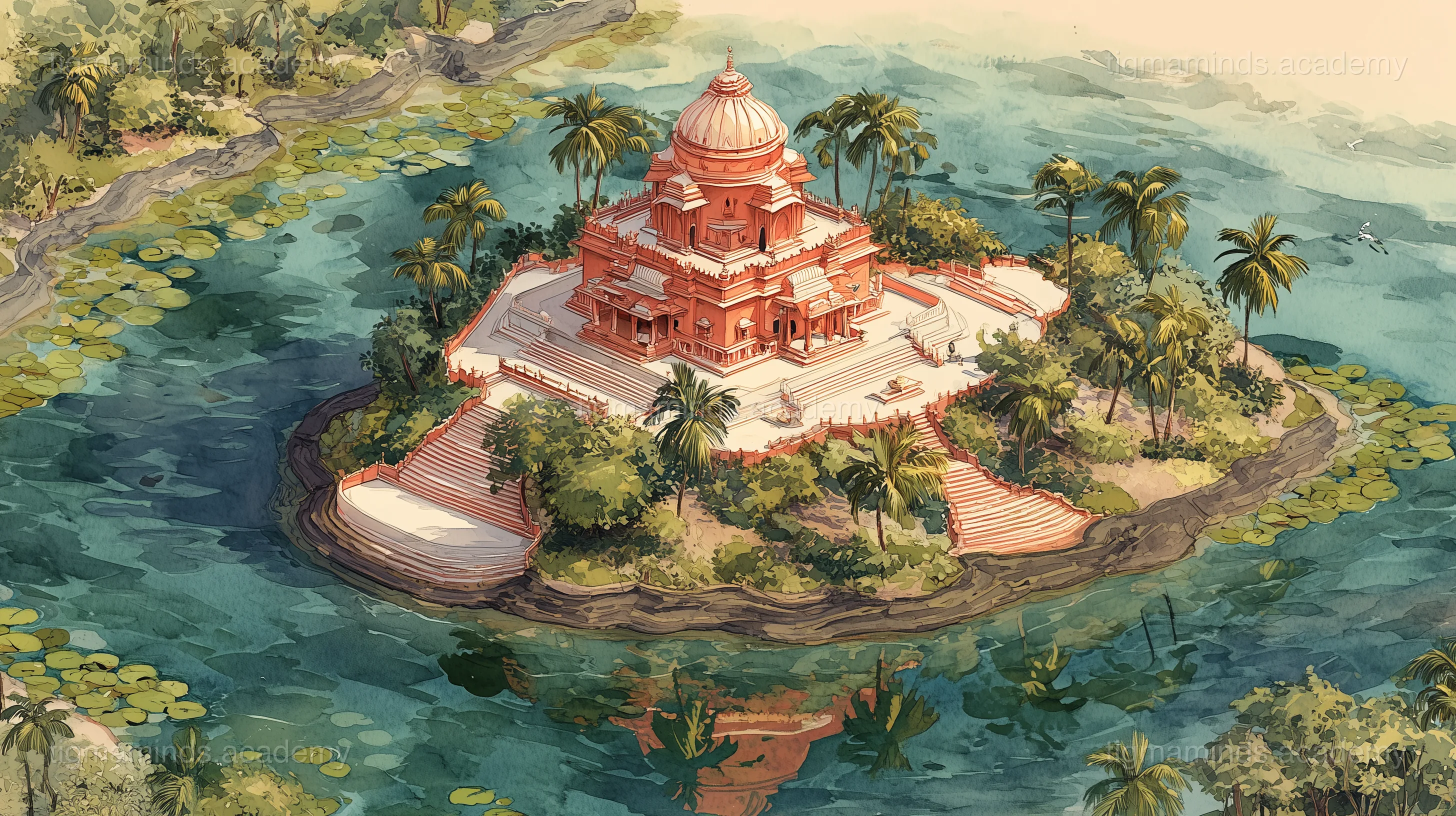
The Tripura Sundari Temple — one of the 51 Shakti Peethas of Hindu tradition — sits atop a small, oval hillock near Udaipur in southern Tripura. The hillock is surrounded by a rectangular lake called Kalyan Sagar, and from above, the hill-in-lake looks remarkably like a turtle — a domed shell rising from water.

Local legend says the hill is the back of Kurma, the turtle avatar of Vishnu, who surfaced here to support the goddess. But Nikhil Jamatia, a sixteen-year-old geology enthusiast from the nearby Jamatia tribal community, had a different question: how did this perfectly shaped hillock end up here?

His answer lay in 50 million years of tectonic violence.

The Collision

"Tripura is a crumpled piece of paper," said Nikhil's geography teacher, Sir Biswajit.

He explained: 50 million years ago, the Indian tectonic plate — a massive slab of Earth's crust — was racing northward at about 15 cm per year (fast, for a continent). It slammed into the Eurasian plate. The collision is still happening — India is still pushing north, compressing everything in between.

The impact created the Himalayas (the crumple zone where the two plates meet). But the compression didn't stop at the mountains. It rippled outward, deforming the land hundreds of kilometres south. Tripura, sitting on the leading edge of the Indian plate, was squeezed from east and west, its rocks folding into a series of anticlines (upward folds) and synclines (downward folds) running roughly north-south.

The hillock beneath the Tripura Sundari Temple is the eroded remnant of one such anticline — a bump in the Earth's crust pushed up by tectonic compression, then worn down by millions of years of rain, rivers, and chemical weathering until only the hard core remained.

Anticlines and Synclines

Sir Biswajit folded a towel to demonstrate. He laid the towel flat on the desk, then pushed the two ends toward each other. The towel buckled, forming alternating ridges (anticlines) and valleys (synclines).

"Tripura's landscape is exactly this," he said. "North-south ridges separated by parallel valleys. The ridges are anticlines — arches of folded rock. The valleys are synclines — troughs. The rivers run along the synclines because that's where water naturally collects."

Nikhil had noticed this pattern. The hills around Udaipur ran in long, narrow ridges from north to south, with flat valleys between them. From satellite images, Tripura looked like a corrugated metal sheet — parallel ridges and grooves, all aligned in the same direction.

"The temple hillock is the core of an anticline," said Sir Biswajit. "The outer layers of softer rock eroded away, leaving only the hard inner rock standing as a dome. The lake formed in the eroded depression around it."

Erosion: Sculpting the Landscape

The shape of the hillock — smooth, oval, dome-like — is the result of differential erosion. Not all rocks erode at the same rate. Soft rocks (shale, mudstone) dissolve and crumble quickly. Hard rocks (sandstone, limestone with silica) resist erosion and stand tall.

In the anticline that became the temple hill, the outer layers were soft shale — easily worn away by Tripura's 2,500 mm of annual rainfall. The inner core was harder sandstone, which resisted erosion and remained as the hillock. The contrast between soft and hard rock created the shape: a dome of hard rock in a depression of eroded soft rock, now filled with water (Kalyan Sagar).

"This is not unique to Tripura," said Sir Biswajit. "The same process created the domes of the Colorado Plateau, the inselbergs (island mountains) of Africa, and Uluru (Ayers Rock) in Australia. Wherever hard rock sits among soft rock, erosion sculpts the landscape into hills-in-plains."

Reading the Rocks

Nikhil visited the hillock and examined the exposed rock faces. He found sedimentary layers — thin, alternating bands of sandstone (hard, pale) and shale (soft, dark), tilted at an angle of about 30° from horizontal.

"The tilt is the evidence of folding," said Sir Biswajit when Nikhil showed him the photographs. "Originally, these layers were deposited horizontally on the sea floor — millions of years of sediment piling up, one layer at a time. When the tectonic compression folded the rock into an anticline, the horizontal layers were tilted. The 30° tilt tells us the fold was moderate — not a dramatic overthrust, but a gentle arching."

Nikhil calculated: if the layers were deposited over 10 million years at a rate of 0.1 mm per year, the total thickness would be 1,000 metres — a full kilometre of sediment, now folded, eroded, and reduced to a small hillock. The temple sits on the compacted remnant of a mountain of ancient seafloor.

"Everything under the temple was once at the bottom of the sea," said Sir Biswajit. "The goddess sits on 50 million years of geology."

The end.

Try It Yourself

Choose your level. Everyone starts with the story — the code gets deeper as you go.

Story Progress

0%

Ready to Start Coding?

Here is a taste of what Level 1 looks like for this lesson:

Level 1: Explorer — Python
# Erosion Simulator: Hard vs Soft Rock
import random

hard_rock = 100   # metres thickness
soft_rock = 100   # metres thickness
erosion_rate_soft = 2.0   # mm/year
erosion_rate_hard = 0.1   # mm/year

for myr in range(50):  # 50 million years
    soft_rock -= erosion_rate_soft * 1000  # mm to m
    hard_rock -= erosion_rate_hard * 1000
    soft_rock = max(0, soft_rock)
    hard_rock = max(0, hard_rock)

print(f"After 50 million years:")
print(f"Hard rock remaining: {hard_rock:.0f}m")
print(f"Soft rock remaining: {soft_rock:.0f}m")
print(f"The hard rock stands {hard_rock - soft_rock:.0f}m above")

This is just the first of 6 coding exercises in Level 1. By Level 4, you will build: Build a Tectonic Folding Simulator.

Free

Level 0: Listener

Stories, science concepts, diagrams, quizzes. No coding.

You are here

Enrolled

Levels 1-4

Python, NumPy, Matplotlib, real projects, mentorship.

Sign Up Free

Stay Updated

Join Waitlist

Get notified when enrollment opens for your area.

Notify Me

Level 0 is always free. Coding levels (1-4) are part of our 12-Month Curriculum.