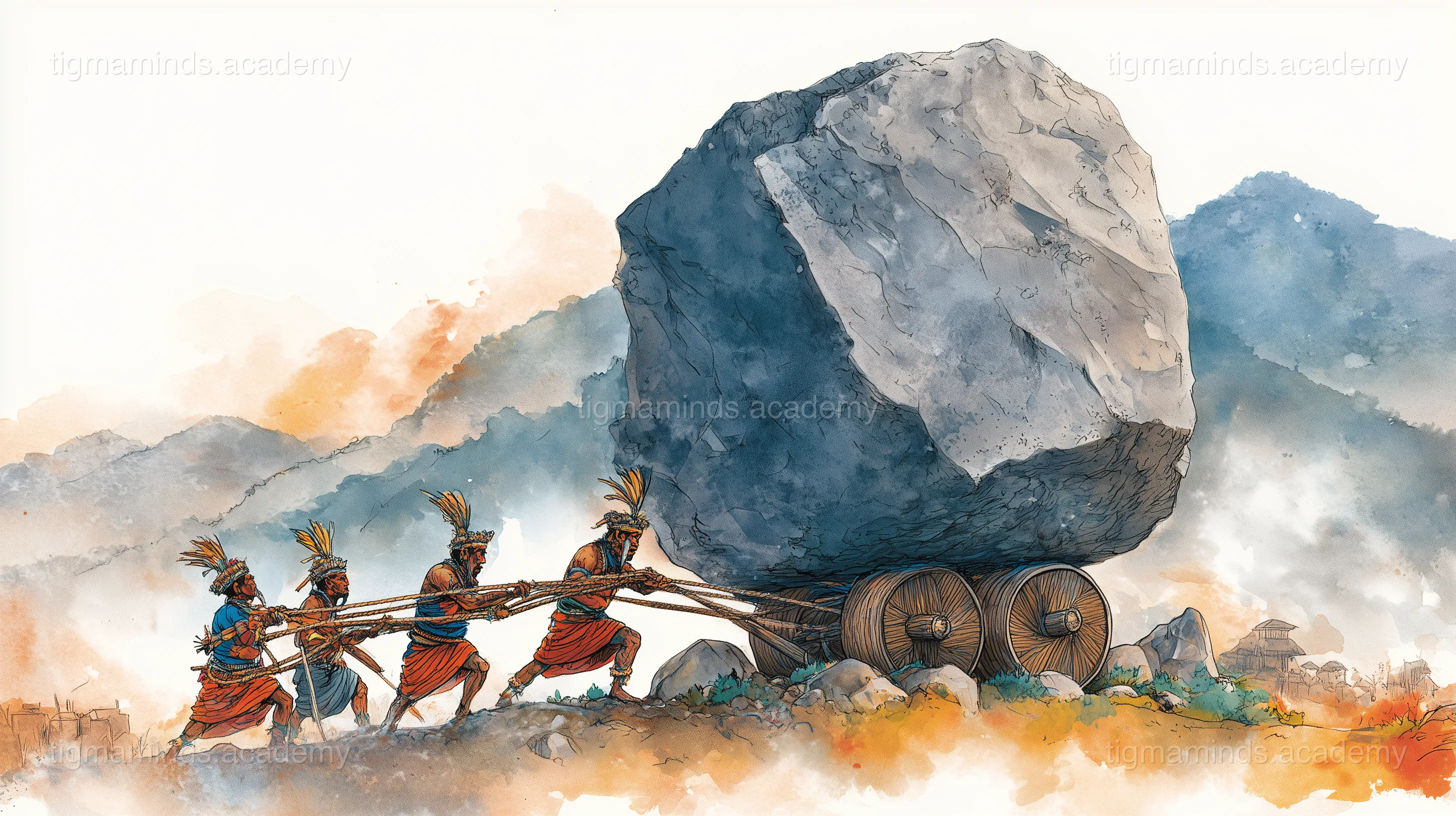
How Naga warriors moved 10-tonne megaliths using nothing but ropes, logs, and the physics of simple machines.
The Feast of Merit
In the Angami Naga villages of the Kohima region, wealth was not measured in gold or land. It was measured in generosity. A wealthy man who wanted respect had to earn it by hosting a great feast — the Feast of Merit — feeding the entire village for days. And to mark the feast permanently, he had to drag a megalith — a massive stone, sometimes weighing 10 tonnes or more — from the quarry to the village, where it would stand forever as a monument to his generosity.
Kezhakeno Iralu — called Kezhako — was seventeen and fascinated by the megaliths that lined the path into his village, Khonoma, one of the oldest continuously inhabited villages in Nagaland. The stones were huge — 3 metres tall, 2 metres wide, and so heavy that even imagining moving them seemed impossible.
"How did they do it?" he asked his grandfather, Apfü Viraho, who remembered the last stone-pulling ceremony held in the 1960s.
"With ropes, logs, and many men," said Apfü. "And with something your physics teacher would call... simple machines."
The Inclined Plane
The quarry was 2 kilometres from the village, uphill. Lifting a 10-tonne stone straight up (even 1 metre) would require a force of about 100,000 Newtons — far beyond what any group of humans could lift directly.
"So they didn't lift it," said Apfü. "They rolled it along an inclined path."
The path from the quarry was graded — a gentle slope, never steeper than about 10°. An inclined plane trades force for distance: to raise a stone 50 metres vertically, you might walk 300 metres along a slope. The force needed is reduced by the ratio of height to slope length.
Force along slope = Weight × sin(θ) = 100,000 × sin(10°) ≈ 17,400 N
That's 17% of the direct lift force. With 100 men pulling (each contributing about 200 N — a firm pull), the team could generate 20,000 N — just enough, with some margin for friction.
Log Rollers
But pulling 10 tonnes across bare ground creates enormous friction. Even on a smooth path, the friction force could equal half the stone's weight — 50,000 N. The inclined plane helped with gravity, but friction would defeat the team.
The solution: log rollers. The villagers placed smooth, round logs under the stone. As the stone was pulled forward, it rolled over the logs instead of dragging on the ground. This converted sliding friction (high) to rolling friction (much lower — about 10% of sliding friction).
With rollers, the friction dropped from ~50,000 N to ~5,000 N. Combined with the inclined plane reduction, the total pulling force needed was approximately: 17,400 (gravity component) + 5,000 (rolling friction) = 22,400 N — achievable by 100–120 strong men pulling in coordination.
Logs that the stone had passed over were carried forward and placed at the front — a process called relay rolling that required coordination, timing, and a team dedicated to log management.
The Rope and Leverage
The ropes were made from cane — strips of rattan woven into cables as thick as a man's wrist. Cane rope has a tensile strength of about 30 MPa — comparable to mild steel wire of the same thickness. It is flexible, lightweight, and doesn't rot quickly.
At difficult sections (steep pitches, sharp turns), the team used levers. Long wooden poles were wedged under the stone's edge, and men pressed down on the free end. A lever with a 3:1 ratio (the load arm is one-third the effort arm) multiplies the input force by 3. Ten men pushing with 500 N each on the long end of a lever could generate 15,000 N at the short end — enough to tip or shift the stone.
The Final Erection
The most dangerous moment was raising the stone upright at its final position. The team dug a deep, sloped pit. The stone was dragged to the pit's edge and tipped in, sliding down the slope until it stood nearly vertical. Then they packed earth around the base.
Kezhako calculated: raising a 10-tonne, 3-metre stone from horizontal to vertical requires work = mgh = 10,000 × 9.8 × 1.5 (centre of gravity rises 1.5 m) = 147,000 Joules. With 100 men working for about 10 minutes, each contributing about 75 Watts (moderate physical effort), total energy = 100 × 75 × 600 = 4,500,000 Joules — more than enough, even accounting for efficiency losses.
The stone at Khonoma still stood, exactly where it was placed perhaps 200 years ago. Kezhako touched its rough surface. No crane. No engine. No machine except the ones invented by physics itself: the inclined plane, the roller, the lever, and the rope.
Simple machines. Simple names. Not so simple to use when the stone weighs as much as an elephant and the hill is steep and the only power source is human muscle and coordinated will.
The end.
Choose your level. Everyone starts with the story — the code gets deeper as you go.
Here is a taste of what Level 1 looks like for this lesson:
# Megalith-Moving Force Calculator
import math
weight = 10000 * 9.8 # 10 tonnes in Newtons
slope_deg = 10
mu_slide = 0.5
mu_roll = 0.03
# Force on inclined plane
slope_force = weight * math.sin(math.radians(slope_deg))
friction_slide = weight * mu_slide * math.cos(math.radians(slope_deg))
friction_roll = weight * mu_roll * math.cos(math.radians(slope_deg))
print(f"Direct lift: {weight:,.0f} N")
print(f"On slope: {slope_force:,.0f} N")
print(f"+ sliding friction: {slope_force + friction_slide:,.0f} N")
print(f"+ rolling friction: {slope_force + friction_roll:,.0f} N")
print(f"Team needed: {int((slope_force + friction_roll) / 200) + 1} people")This is just the first of 6 coding exercises in Level 1. By Level 4, you will build: Build a Megalith-Moving Calculator.
Free
Level 0: Listener
Stories, science concepts, diagrams, quizzes. No coding.
You are here
Level 0 is always free. Coding levels (1-4) are part of our 12-Month Curriculum.
Inclined planes, levers, rollers, and ropes — the physics of moving megaliths with human power.
The big idea: "The Stone Pullers of Nagaland" teaches us about Simple Machines & Mechanical Advantage — and you don't need to write a single line of code to understand it.
Lifting a 10-tonne stone straight up requires a force of 100,000 N — far too much for human muscles. But push it up a gentle slope, and the physics changes dramatically.
An inclined plane reduces the force needed by spreading the work over a longer distance. The force along the slope is: F = W × sin(θ), where W is the weight and θ is the slope angle. At 10°, sin(10°) ≈ 0.17, so the force is only 17% of the weight: 17,000 N instead of 100,000 N.
The trade-off: you must push the stone a longer distance. To raise it 50 metres vertically at a 10° slope, you must push it 50/sin(10°) ≈ 288 metres along the slope. Less force, more distance — but the total work (force × distance) is the same.
Check yourself: If you increase the slope to 20°, what force is needed? What happens to the distance? (sin(20°) ≈ 0.34)
Key idea: An inclined plane reduces the force needed to raise an object by spreading the work over a longer distance. The mechanical advantage equals 1/sin(θ) — a 10° slope gives about 6:1 advantage.
Friction is the force that resists one surface sliding over another. When you drag a heavy stone across ground, friction acts in the opposite direction, trying to stop the motion. The friction force depends on two things: the normal force (how hard the surfaces press together — for a stone on flat ground, this equals its weight) and the coefficient of friction (μ, a number that describes how "grippy" the surfaces are).
For stone dragged on packed earth, μ ≈ 0.5. That means the friction force is half the stone's weight: 50,000 N for a 10-tonne stone. Adding this to the slope component makes the stone nearly impossible to move.
Rolling friction is dramatically lower than sliding friction. When a stone rolls over log rollers, the contact point doesn't slide — it momentarily touches and separates. The coefficient of rolling friction is typically 0.01–0.05 — one-tenth to one-hundredth of sliding friction. With rollers, friction drops from 50,000 N to about 5,000 N.
This is why the wheel was one of the most important inventions in human history. It converts high sliding friction into low rolling friction, making transport of heavy loads practical with human or animal power.
Key idea: Friction resists motion and can be enormous for heavy objects on rough ground. Log rollers reduce friction by 90% or more by converting sliding to rolling contact — the same principle behind wheels.
Access all 130+ lessons, quizzes, interactive tools, and offline activities
A **lever** is a rigid bar that rotates around a pivot point (fulcrum). By placing the fulcrum close to the load and pushing on the far end, you multi...
**Work** = Force × Distance. It is measured in Joules (J). If you push a stone with 20,000 N of force over 300 metres, you do 20,000 × 300 = 6,000,000...