The Silk Road
Network Economics & Epidemiology

The Silk Road

The trade network that connected half the world — economics, disease transmission, and the mathematics of exchange.

Network Economics & Epidemiology12-Month Curriculum 14h

The Story

Seven Thousand Kilometres

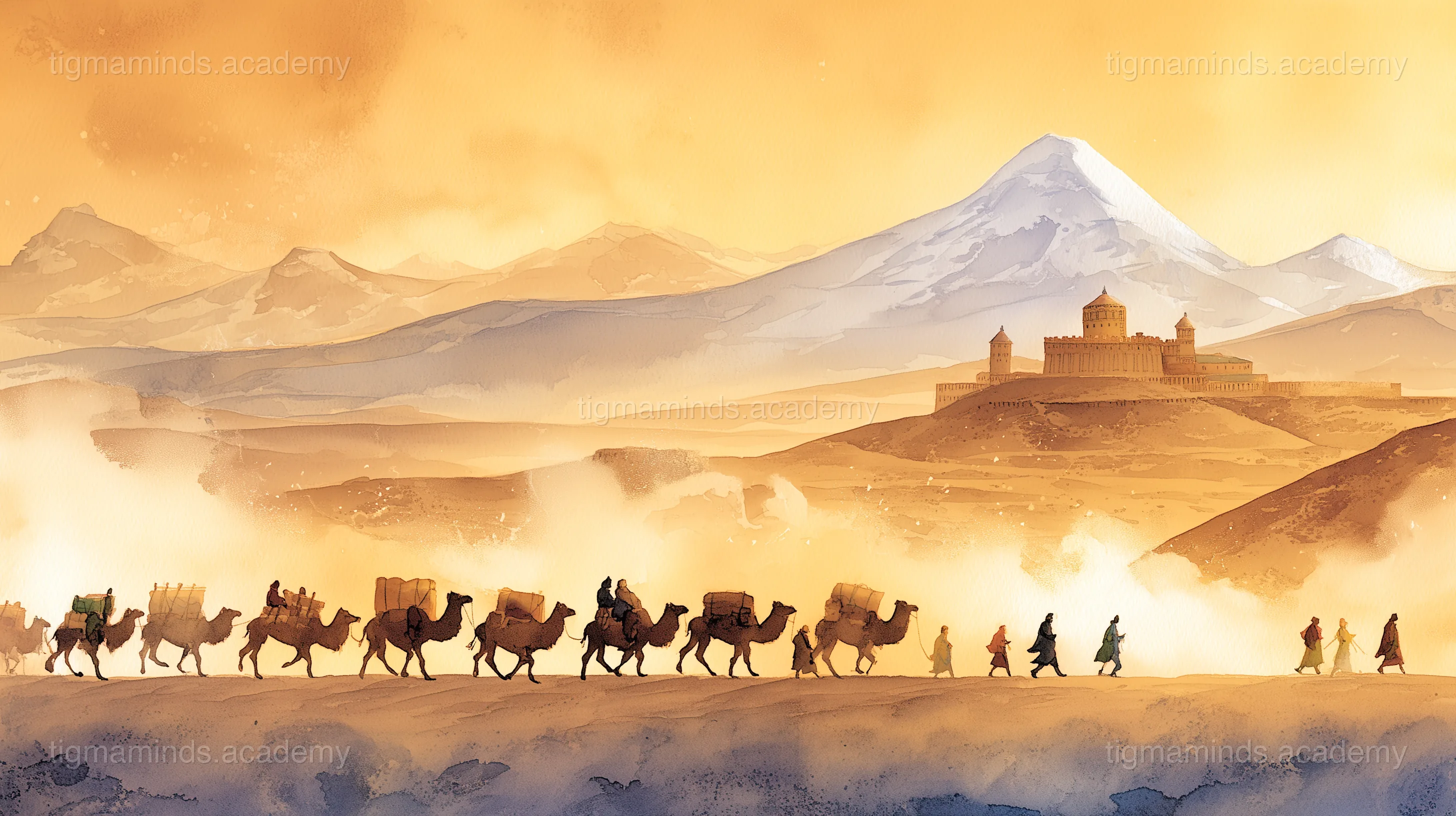
The Silk Road was not a road. It was a network — a web of overland and maritime trade routes stretching 7,000 kilometres from Chang'an (modern Xi'an) in China to Constantinople (modern Istanbul) in the Roman/Byzantine Empire, with branches reaching into India, Persia, Arabia, and East Africa.

For nearly 1,500 years (roughly 130 BCE to 1453 CE), this network was the backbone of Eurasian trade, carrying not just silk but spices, gems, glass, paper, gunpowder, religions, languages, artistic styles, mathematical systems, and diseases between civilizations that would otherwise have known nothing of each other.

No single merchant traveled the entire route. Goods passed through a chain of intermediaries — each one buying at one oasis city, marking up the price, and selling at the next. A bolt of Chinese silk might change hands ten to fifteen times before reaching a Roman market, with the price multiplying at each step.

This is the economics of a supply chain — and the Silk Road was the first global one.

The Price of Distance

The fundamental economic problem of the Silk Road was transport cost. Moving goods overland by camel caravan was expensive — a camel carries approximately 200 kilograms and travels 30-40 kilometres per day. A caravan from China to the Mediterranean took six to twelve months, depending on the route, the season, and the political situation.

This meant that only high-value, low-weight goods were worth trading overland. Silk (worth more than gold by weight in Rome), spices (black pepper was literally used as currency), precious stones, and perfumes could justify the transport cost. Bulk goods like grain, timber, or iron could not.

This economic reality shaped which goods moved and which stayed local — a principle still visible in modern trade. Air freight carries electronics and pharmaceuticals; container ships carry steel and grain. The transport medium determines what's worth trading.

The Mathematics of Exchange

Trade along the Silk Road required currency exchange — a Chinese merchant selling silk in Samarkand couldn't spend Chinese coins there. The solution was a system of exchange rates maintained by money-changers in every major trading city.

But exchange rates weren't just about currency. They encoded information about supply and demand, transport costs, risk premiums, and political stability across the entire network. A rise in the price of silk in Constantinople would ripple backward along the route — money-changers in Antioch would adjust, then those in Baghdad, then Samarkand, then Kashgar — each one passing the price signal westward, delayed by the speed of travel.

This is an early example of information propagation through a network — the same phenomenon that drives modern financial markets, where price signals travel at the speed of light through fiber-optic cables instead of at the speed of a camel.

Disease on the Road

The Silk Road carried more than goods. It carried pathogens.

The Black Death — the bubonic plague that killed an estimated 75-200 million people in Eurasia between 1346 and 1353 — traveled the Silk Road. The bacterium Yersinia pestis, carried by fleas on rats, moved westward along the trade routes from Central Asia to the ports of the Black Sea, then by ship to Italy, and then throughout Europe.

The speed of the plague's spread was determined by the speed of trade — roughly 2-5 kilometres per day along overland routes, faster along sea routes. Modern epidemiologists have modeled the plague's spread using SIR (Susceptible-Infected-Recovered) models — the same mathematical framework used to model COVID-19 — and found that the Black Death's transmission dynamics closely match predictions based on medieval trade route geography and traffic volume.

This was the first global pandemic — and it was a direct consequence of the first global trade network. Connectivity has costs as well as benefits.

The Technology Transfer

The Silk Road's greatest legacy was not any single traded good but the transfer of technologies between civilizations:

Paper traveled west from China (invented 105 CE) to the Islamic world (8th century) to Europe (12th century), enabling the explosion of literacy that preceded the printing press.

The compass traveled the same route, reaching European sailors in the 12th century and enabling the Age of Exploration.

Arabic numerals (originally Indian) traveled west along trade routes, reaching Europe in the 13th century via Fibonacci's Liber Abaci, replacing the cumbersome Roman numeral system and making modern mathematics possible.

Gunpowder traveled from China to the Islamic world to Europe, transforming warfare and ending the feudal era.

Each of these transfers changed the receiving civilization fundamentally — but with a delay. Paper took 1,100 years to travel from China to Europe. The compass took 200 years. In the modern world, technology transfer is nearly instantaneous — a research paper published in Beijing is read in Boston the same day. But the Silk Road teaches us that the speed of knowledge transfer shapes the pace of civilization.

The End and the Echo

The Silk Road declined after the fall of Constantinople to the Ottomans in 1453, which disrupted overland trade, and the opening of maritime routes around Africa by the Portuguese, which made sea trade cheaper than land trade.

But the Silk Road's pattern — a network of routes connecting centers of production to centers of consumption, with intermediaries marking up prices at each node — is the template for every trade network since. The Internet, global shipping, financial markets, and even social media follow the same network topology: hubs, routes, intermediaries, and the relentless flow of goods, information, and (occasionally) disease along the paths of least resistance.

The end.

Try It Yourself

Choose your level. Everyone starts with the story — the code gets deeper as you go.

Story Progress

0%

Ready to Start Coding?

Here is a taste of what Level 1 looks like for this lesson:

Level 1: Explorer — Python
import numpy as np
import matplotlib.pyplot as plt

# Your first data analysis with Python
data = [45, 52, 38, 67, 41, 55, 48]  # measurements
mean = np.mean(data)

plt.bar(range(len(data)), data)
plt.axhline(mean, color='red', linestyle='--', label=f'Mean: {mean:.1f}')
plt.xlabel("Sample")
plt.ylabel("Value")
plt.title("Network Economics & Epidemiology — Sample Data")
plt.legend()
plt.show()

This is just the first of 6 coding exercises in Level 1. By Level 4, you will build: Build a Trade Network Simulator.

Free

Level 0: Listener

Stories, science concepts, diagrams, quizzes. No coding.

You are here

Enrolled

Levels 1-4

Python, NumPy, Matplotlib, real projects, mentorship.

Sign Up Free

Stay Updated

Join Waitlist

Get notified when enrollment opens for your area.

Notify Me

Level 0 is always free. Coding levels (1-4) are part of our 12-Month Curriculum.