Aerodynamics, biomimicry, and the engineer who understood flight 400 years before the Wright brothers.
The Bird Watcher
In the year 1505, a 53-year-old painter, engineer, and anatomist named Leonardo da Vinci sat on a hillside near Fiesole, above Florence, and watched a kite — the bird, not the toy — riding the wind.
He had been watching birds for thirty years. Not casually — obsessively. His notebooks contain hundreds of sketches of birds in flight: wings extended, wings folded, wings twisting, wings catching gusts, wings diving. He noted the angle of each feather, the curve of each wingtip, the way the tail shifted to compensate for changes in wind direction.
From these observations, Leonardo derived principles of aerodynamics that would not be formally stated by scientists until centuries later. He understood lift — that a curved surface moving through air generates an upward force. He understood drag — that air resists the motion of any object through it. He understood center of gravity — that a flying machine must balance its weight precisely or it will tumble.
And he designed machines that he believed could carry a human being into the sky.
The Ornithopter
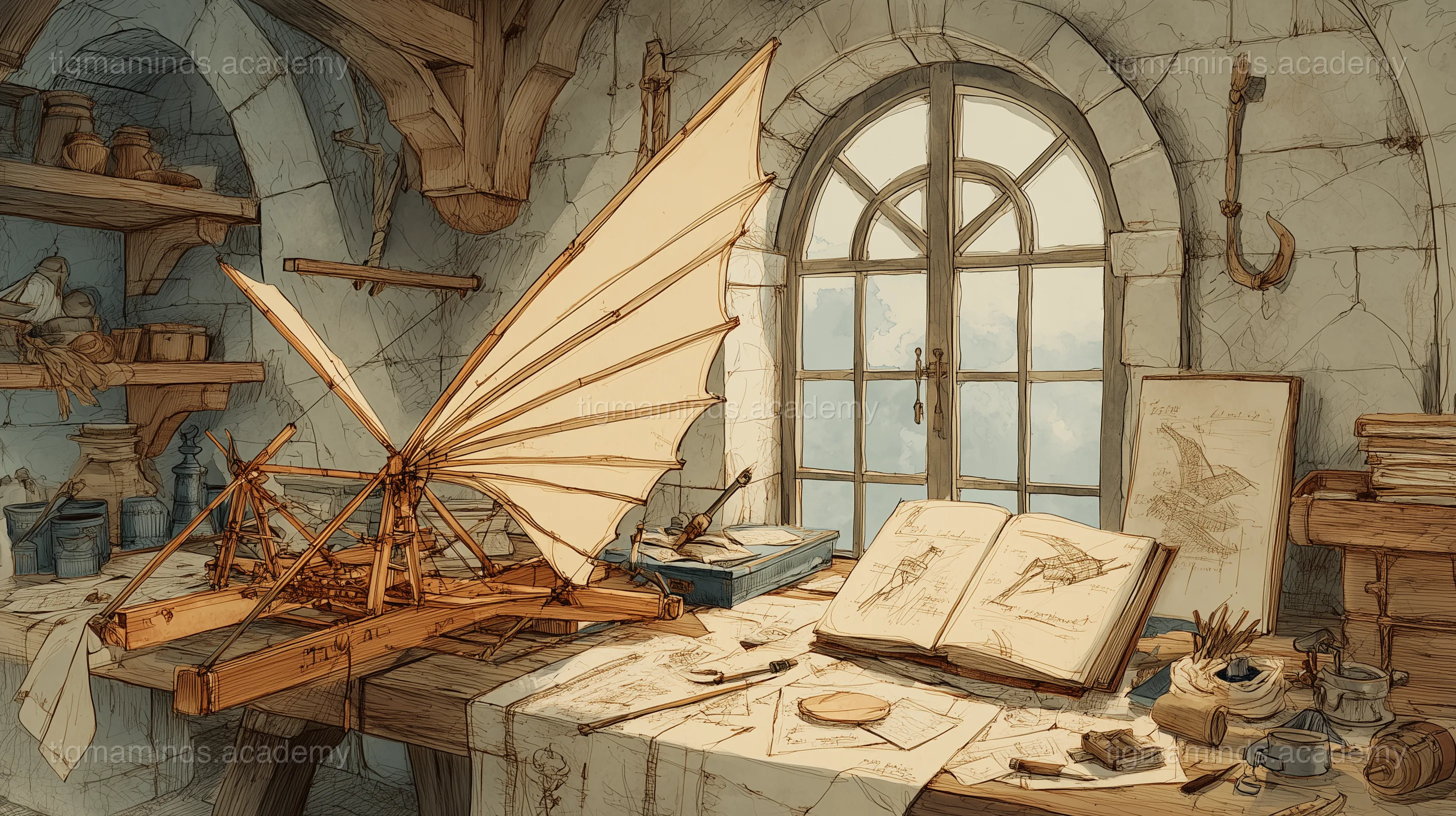
Leonardo's most famous flying machine is the ornithopter — a human-powered device with flapping wings, modeled on the flight of birds and bats.
His design (drawn around 1485-1490) shows a wooden frame with articulated wings spanning about 10 metres. The pilot lies face-down in a harness and operates the wings by pushing pedals with his feet and pulling levers with his hands. The wings are covered in raw silk treated with starch — lightweight, airtight, and strong.
The ornithopter would not have worked. Leonardo made a fundamental error: he overestimated human power output and underestimated the power required for flapping flight.
A bird's flight muscles make up 15-25% of its body mass — the pectoral muscles of a pigeon are enormous relative to its body. A human's flight-relevant muscles are a small fraction of body mass, and human sustained power output is only about 75 watts — roughly the power of a single light bulb. A human-powered ornithopter would need at least 1,500 watts for sustained flight — twenty times more than a human can produce.
But Leonardo's error was quantitative, not conceptual. His understanding of aerodynamic principles was remarkably sound.
The Glider
Later in his career, Leonardo shifted from flapping flight to gliding — and here his designs come much closer to working.
His hang glider design (Codex Atlanticus, circa 1500) shows a triangular wing with a rigid frame and a cambered (curved) surface — the same basic shape used by modern hang gliders. The pilot hangs below the wing in a harness, shifting body weight to steer.
Modern engineers who have analyzed Leonardo's glider designs believe they would have worked — at least for short, descending flights from a hilltop. The wing area, aspect ratio, and camber are all within the range that produces useful lift at human-scale speeds.
In 2002, a skydiver named Adrian Nicholas built a glider to Leonardo's specifications — using materials available in the 15th century (canvas, rope, wood) — and successfully flew it for a short distance after being released from a hot air balloon. The glider was stable and produced lift exactly as Leonardo's drawings predicted. Nicholas described it as "beautifully balanced."
The Science in the Notebooks
Leonardo's notebooks contain insights that anticipate modern aerodynamics by centuries:
On lift: "The air which is struck with greater speed by the object is compressed to a greater degree." This is a qualitative statement of Bernoulli's principle — that faster-moving air has lower pressure — though Bernoulli wouldn't derive it mathematically until 1738.
On Newton's third law: "For every action there is an equal and opposite reaction — the wing pushes the air down, and the air pushes the wing up." Newton published this in 1687, 182 years after Leonardo wrote it.
On center of pressure: "If the center of pressure is in front of the center of gravity, the machine will pitch nose-down." This is the fundamental stability criterion for aircraft, formally derived by George Cayley in the early 1800s.
On turbulence: Leonardo's drawings of water flowing around obstacles — vortices, eddies, chaotic swirls — are the earliest systematic observations of turbulence. He recognized that flow patterns could be smooth (what we now call laminar) or chaotic (turbulent), and that the transition depended on speed and obstacle shape. The mathematical description of turbulence remains one of the unsolved problems in physics — it was one of the seven Millennium Prize Problems posed by the Clay Mathematics Institute in 2000.
Why He Never Flew
Leonardo never built a full-scale flying machine. He may have tested models — his notebooks mention experiments with small devices dropped from towers — but there's no evidence he ever attempted a human flight.
The reason is likely practical rather than theoretical. Leonardo understood, at least intuitively, the scaling problem: a design that works at model scale may not work at full scale, because weight increases as the cube of the scaling factor while wing area increases only as the square. A bird-sized ornithopter works; a human-sized one doesn't — because the human is proportionally far heavier relative to wing area.
This is the square-cube law in action — the same law that explains why the Pyramids are the shape they are, why elephants have thick legs, and why insects can survive falls that would kill a human.
The Legacy
Leonardo da Vinci died in 1519. His flying machine notebooks were scattered, hidden in private collections, and largely unknown until the 19th century. When they were finally published and studied, engineers were astonished at how close Leonardo had come — how many of the fundamental principles he had grasped through pure observation and reasoning.
The Wright brothers finally achieved powered flight in 1903, using a biplane glider with a gasoline engine — a machine that Leonardo could not have built (he had no engine) but would have understood completely. The principles are the same: generate lift with a cambered wing, control pitch, roll, and yaw with movable surfaces, and provide enough thrust to overcome drag.
Four hundred years separated Leonardo's notebooks from the Wright Flyer. The science was there all along. What was missing was the engine — and an era willing to take the risk of trying.
The end.
Choose your level. Everyone starts with the story — the code gets deeper as you go.
Here is a taste of what Level 1 looks like for this lesson:
import numpy as np
import matplotlib.pyplot as plt
# Your first data analysis with Python
data = [45, 52, 38, 67, 41, 55, 48] # measurements
mean = np.mean(data)
plt.bar(range(len(data)), data)
plt.axhline(mean, color='red', linestyle='--', label=f'Mean: {mean:.1f}')
plt.xlabel("Sample")
plt.ylabel("Value")
plt.title("Aerodynamics & Biomimicry — Sample Data")
plt.legend()
plt.show()This is just the first of 6 coding exercises in Level 1. By Level 4, you will build: Build a Flight Simulator.
Free
Level 0: Listener
Stories, science concepts, diagrams, quizzes. No coding.
You are here
Level 0 is always free. Coding levels (1-4) are part of our 12-Month Curriculum.
The physics of flight — lift, drag, wing design, the square-cube law, and why Leonardo's glider would have worked.
The big idea: "Leonardo's Flying Machines" teaches us about Aerodynamics & Biomimicry — and you don't need to write a single line of code to understand it.
Hold a piece of paper flat in front of your mouth. Let the far edge hang down. Now blow over the top of the paper. What happens? The paper rises — even though you're blowing over it, not under it.
This is lift — the upward force that keeps birds, planes, and gliders in the air. It works because of a principle discovered by Daniel Bernoulli (1738, but understood intuitively by Leonardo 200 years earlier): faster-moving air has lower pressure than slower-moving air.
A wing (or your piece of paper) is shaped so that air flows faster over the top and slower under the bottom. The higher pressure beneath pushes upward; the lower pressure above creates a partial vacuum that pulls upward. Together, these create lift — an upward force that can support the weight of a bird, a paper airplane, or a 400-tonne Boeing 747.
Leonardo observed this in birds: he noted that the curved, arched shape of a bird's wing was essential — flat wings don't generate lift. He called this curvature "the belly of the wing," and modern engineers call it camber. Every aircraft wing, from the Wright Flyer to the Airbus A380, has a cambered shape — curved on top, flatter on the bottom.
Try this: Cut a strip of paper about 3 cm wide and 20 cm long. Hold one short end just below your lower lip and blow hard across the top surface. The free end of the strip rises and flutters — lifted by the low-pressure zone your breath creates above it. You've just demonstrated the same lift that holds a 747 in the air.
Key idea: Lift is generated when air moves faster over the top of a wing than under the bottom, creating lower pressure above and higher pressure below. The net upward force supports the aircraft's weight. Wing camber (curvature) is essential — flat surfaces don't generate lift.
Stick your hand out of a moving car window. Feel the push? That's drag — the resistance that air exerts on anything moving through it. Drag always opposes motion, and it increases with speed.
There are two kinds of drag. Parasitic drag is caused by the air smashing into the front of the object — it depends on the object's cross-sectional area and shape. A flat plate produces much more parasitic drag than a teardrop shape (streamlined). This is why cars, planes, and fish are all tapered — streamlining reduces parasitic drag.
Induced drag is the price of generating lift. When a wing creates lift, it also deflects air downward (Newton's third law — if the wing pushes air down, the air pushes the wing up). But this downward deflection creates swirling vortices at the wingtips, which waste energy. Longer, narrower wings produce less induced drag — which is why albatrosses (wingspan 3.5 metres, narrow wings) can glide for hours, while chickens (short, broad wings) can barely fly.
Leonardo observed both types of drag in birds. He noted that birds tuck their feet and tail during fast flight (reducing parasitic drag) and spread their wings wide during soaring (reducing induced drag). He applied these observations to his flying machine designs — making them streamlined and giving them long, narrow wings.
Prediction: A parachute is designed to create MAXIMUM drag (to slow your fall). What shape should it be? (A large, flat canopy — the opposite of streamlined. Maximum cross-sectional area, maximum air resistance.)
Key idea: Drag is the air resistance that opposes motion. Parasitic drag depends on shape (streamlining reduces it). Induced drag is the energy cost of generating lift (longer wings reduce it). Birds optimise for both, and Leonardo's designs copied their solutions.
Access all 130+ lessons, quizzes, interactive tools, and offline activities
Leonardo's most famous design — the **ornithopter** — was a human-powered machine with flapping wings. The pilot would lie face-down and pump the wing...
An ant can carry **50 times its own body weight**. An elephant can barely carry **its own** body weight. Both are made of similar biological materials...