The Rubber Trees of Tripura
Polymer Chemistry & Materials Science

The Rubber Trees of Tripura

How latex from a tree becomes the rubber in your shoes — the chemistry of polymers.
Polymer Chemistry & Materials Science12-Month Curriculum 10h

The Story

The White Blood

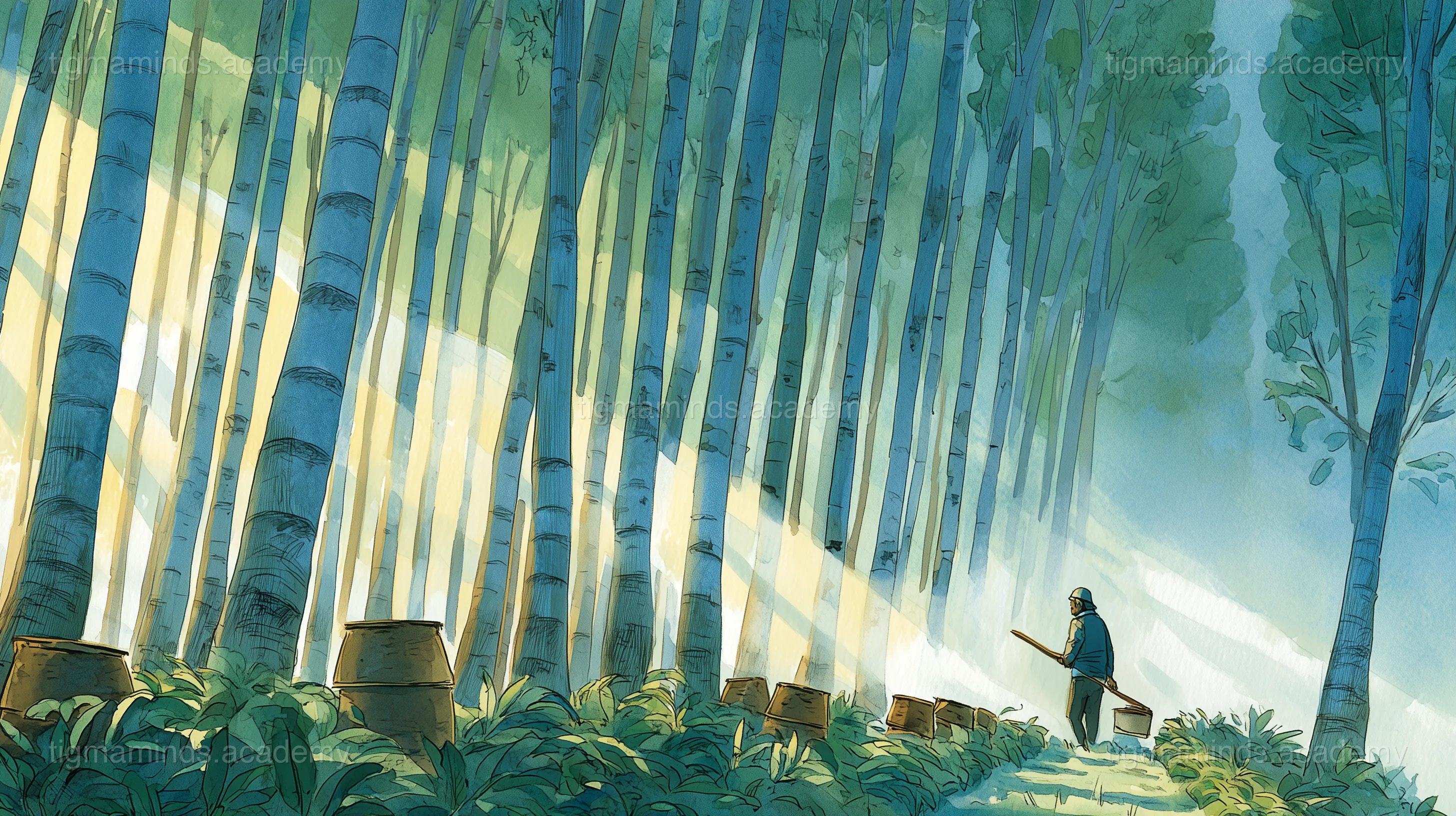
Tripura is India's second-largest rubber producer, a fact that surprises most people who associate rubber with Kerala. Across the low hills of Sabroom, Belonia, and Amarpur, rows of Hevea brasiliensis — the Para rubber tree — stand in perfect lines, their grey bark scored with diagonal cuts that weep a milky white fluid.

This fluid is latex — and a boy named Suman Tripura, from the Tripura tribe (the same name as the state), knew it as intimately as he knew his own name. His father tapped rubber trees for a living, rising at 3 AM every morning to make the cuts before the heat of the day slowed the flow.

"Why so early?" Suman asked.

"The latex flows best when it's cool," said his father. "Heat makes the tree close its latex vessels. By 9 AM, the flow has almost stopped."

The family earned about ₹400 per day from tapping — enough for food, school fees, and the occasional festival. The latex was sold to a collection centre, which sold it to a factory in Agartala, which processed it into sheets that were shipped to tyre factories in Tamil Nadu.

From a tree in Tripura to a tyre on a car in Chennai. The journey was chemistry.

What Is Latex?

Latex is not sap. Sap carries water and nutrients through the tree (like blood carries oxygen in your body). Latex is a separate fluid produced by specialised cells called laticifers, and its function is defensive: when an insect chews through the bark, latex flows out and hardens, sealing the wound and trapping the insect in a sticky, rubbery plug.

Under a microscope, latex is a colloid — tiny particles of rubber (0.5–5 micrometres) suspended in water. The rubber particles are made of a molecule called polyisoprene: long chains of a small repeating unit called isoprene (C₅H₈), linked end to end like a train of identical carriages.

A single polyisoprene chain can contain 10,000 to 100,000 isoprene units, making it a very long, flexible molecule. These long chains are tangled together like cooked spaghetti — and this tangling is what gives rubber its remarkable property: elasticity.

Why Rubber Stretches

Suman's science teacher, Miss Rupa Chakma, brought a rubber band to class.

"Watch," she said, stretching it to three times its length. When she let go, it snapped back to its original size.

"Why does it do that?" she asked.

"Because it's rubber," said a student.

"That's a label, not an explanation. Let me tell you why rubber stretches."

She drew a diagram. "In unstretched rubber, the polyisoprene chains are tangled and coiled randomly — like a bowl of cooked spaghetti. When you stretch the rubber, you're pulling the chains out straight, aligning them in one direction. But the chains want to be tangled — the tangled state has higher entropy (disorder), and nature prefers disorder."

"When you release the rubber, the chains snap back to their tangled, high-entropy state. This is called entropic elasticity — the rubber band is not pulled back by a force like a spring; it is pulled back by the tendency of its molecules to return to disorder."

Vulcanisation: Charles Goodyear's Accident

Raw latex rubber has a problem: it gets sticky in heat and brittle in cold. In 1839, Charles Goodyear accidentally dropped a mixture of rubber and sulfur on a hot stove and discovered that the heat created a material that was elastic in any weather.

He had discovered vulcanisation — the process of adding sulfur to rubber and heating it. The sulfur atoms form cross-links between the polyisoprene chains, connecting them like rungs on a ladder. These cross-links prevent the chains from sliding past each other permanently, so the rubber always returns to its original shape.

Few cross-links → soft, stretchy rubber (like a rubber band) Moderate cross-links → firm, resilient rubber (like a tyre) Many cross-links → hard, rigid rubber (like ebonite, used in bowling balls)

"Vulcanisation is what turns raw Tripura latex into useful rubber," said Miss Rupa. "Without it, your shoes would melt in summer and crack in winter."

From Tree to Tyre

Suman followed the latex from his father's collection cup to the factory. The process:

1. Collection: Latex drips into cups attached below the bark cuts. Each tree yields about 30 mL per day. 2. Coagulation: At the factory, formic acid is added to the latex. The acid neutralises the negative charges on the rubber particles, causing them to clump together. The result is a white, rubbery lump. 3. Sheeting: The clumps are passed through rollers that squeeze out water and flatten them into thin sheets. 4. Smoking/Drying: The sheets are hung in a smokehouse where wood smoke preserves them (the phenols in smoke are antioxidants that prevent the rubber from degrading). 5. Vulcanisation: At the tyre factory, the rubber sheets are mixed with sulfur, carbon black (for strength), and other additives, then heated to 140–160°C in moulds. The sulfur forms cross-links. The result: a finished tyre.

"One rubber tree produces enough latex for about one tyre per year," said the factory guide. "A single car needs four tyres. So your family car needs four trees, tapped every day for a year."

Suman thought about his father, cutting bark in the dark at 3 AM. Four trees. One car. A whole year.

Chemistry connects them.

The end.

Try It Yourself

Choose your level. Everyone starts with the story — the code gets deeper as you go.

Story Progress

0%

Ready to Start Coding?

Here is a taste of what Level 1 looks like for this lesson:

Level 1: Explorer — Python
# Rubber Cross-Link Properties
cross_links = int(input("Cross-links per 100 units (1-50): ") or "5")

if cross_links < 3:
    props = "Very soft, sticky — raw latex"
elif cross_links < 8:
    props = "Soft and stretchy — rubber band"
elif cross_links < 20:
    props = "Firm and resilient — car tyre"
elif cross_links < 35:
    props = "Stiff — shoe sole"
else:
    props = "Hard and rigid — ebonite / bowling ball"

stretch = max(0, 800 - cross_links * 15)
print(f"Cross-links: {cross_links}/100 units")
print(f"Properties: {props}")
print(f"Max stretch: {stretch}%")

This is just the first of 6 coding exercises in Level 1. By Level 4, you will build: Build a Polymer Properties Simulator.

Free

Level 0: Listener

Stories, science concepts, diagrams, quizzes. No coding.

You are here

Enrolled

Levels 1-4

Python, NumPy, Matplotlib, real projects, mentorship.

Sign Up Free

Stay Updated

Join Waitlist

Get notified when enrollment opens for your area.

Notify Me

Level 0 is always free. Coding levels (1-4) are part of our 12-Month Curriculum.