
How Tripura's tribes mapped the calendar to the sky — astronomy, lunar cycles, and timekeeping.
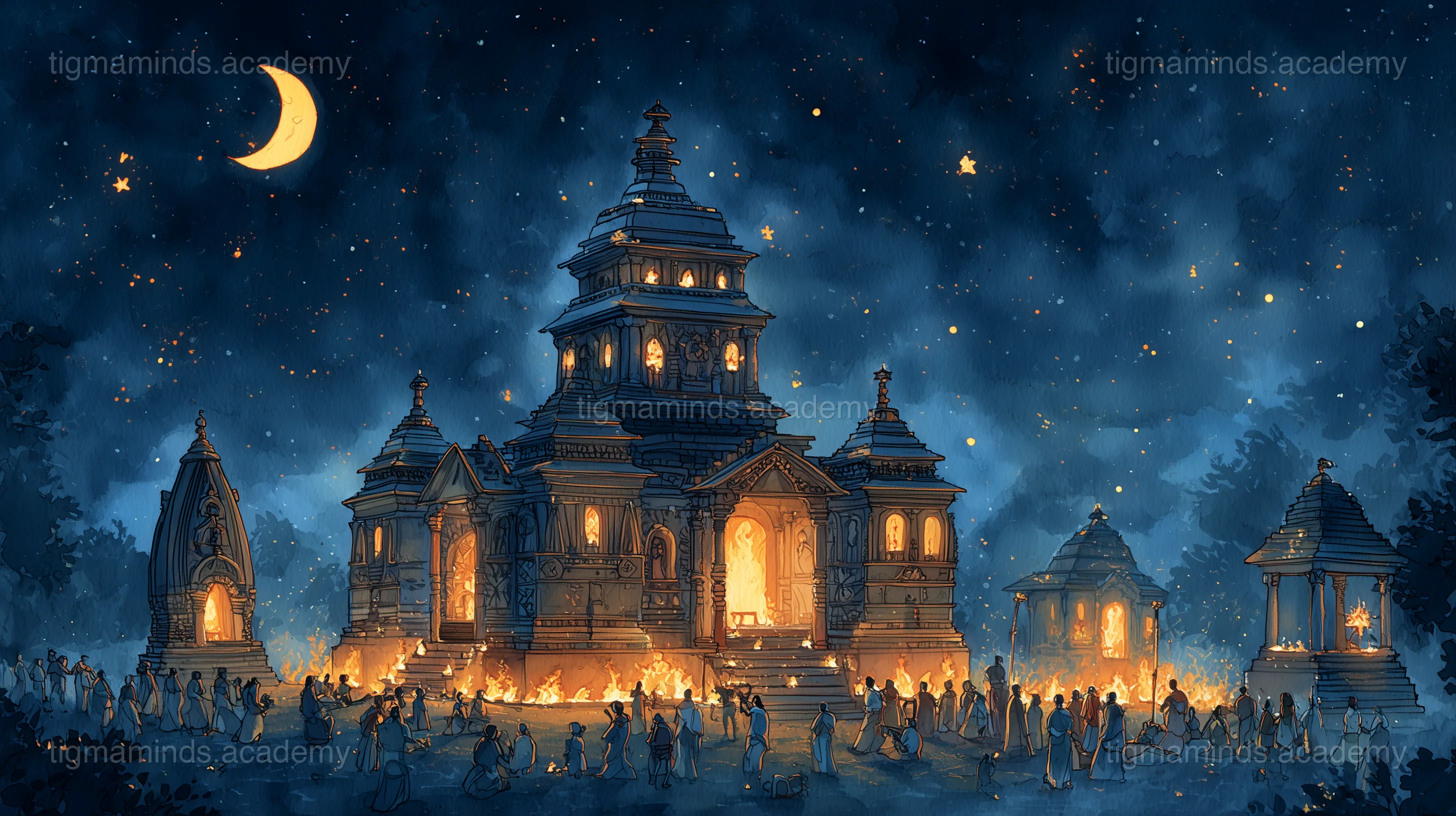
Kharchi Puja
Every year in July, when the monsoon clouds sit heavy over Tripura, the people gather at the Chaturdasha Devata Temple — the Temple of Fourteen Gods — in Old Agartala to celebrate Kharchi Puja, one of the oldest festivals in the state.
Fourteen deities are worshipped together, one for each day of the lunar fortnight. The festival lasts exactly seven days, aligned with the waning phase of the moon in the month of Ashadha. The timing is not random — it is astronomical.
A girl named Monika Debbarma, from the Debbarma clan of Tripura's Kokborok-speaking tribes, was fifteen and curious about everything. She noticed that Kharchi Puja never fell on the same date twice.
"Baba," she asked her father, "why does Kharchi move every year?"
"Because the moon does not agree with the sun," said her father. And that was more literally true than Monika realised.
Two Calendars, Two Speeds
The solar calendar (the Gregorian calendar used worldwide) is based on the Earth's orbit around the Sun: one year = 365.25 days (approximately). Each month is about 30–31 days, and the dates stay roughly aligned with the seasons.
The lunar calendar is based on the Moon's orbit around Earth: one lunar cycle (new moon to new moon) = 29.53 days. Twelve lunar months = 354.37 days — about 11 days shorter than a solar year.
This means lunar dates drift backward through the solar calendar by 11 days each year. A festival on July 15 this year might fall on July 4 next year and June 23 the year after. This is why Islamic festivals like Ramadan shift through the seasons, and why Hindu festivals like Diwali and Kharchi Puja fall on different Gregorian dates each year.
"The fourteen gods follow the moon," Monika's science teacher, Miss Jayanti, explained. "The festival is fixed to the 8th day of the dark fortnight (waning moon) of Ashadha. That lunar date is constant, but its solar date changes every year."
The Phases of the Moon
Miss Jayanti drew the Moon's orbit on the board. "The Moon takes 29.53 days to go from new moon to new moon. During this cycle, it shows different phases:"
New Moon → Waxing Crescent → First Quarter → Waxing Gibbous → Full Moon → Waning Gibbous → Third Quarter → Waning Crescent → New Moon
"Each phase takes about 3.7 days. The dark fortnight (Krishna Paksha) is the 14-day period from full moon to new moon, when the Moon appears to shrink. The bright fortnight (Shukla Paksha) runs from new moon to full moon."
"The fourteen gods are mapped one-to-one to the fourteen days of the lunar fortnight," said Miss Jayanti. "Each god corresponds to a specific tithi — a lunar day. This is not coincidence; it is an ancient astronomical calendar embedded in the religious practice."
How Tribes Tracked Time
Monika learned that Tripura's tribes had tracked the Moon for centuries, long before written calendars. The Kokborok language has specific names for each lunar phase, and agricultural decisions — planting, harvesting, fishing — were timed to the lunar cycle.
"Why would farming follow the moon and not the sun?" Monika asked.
"Several reasons," said Miss Jayanti. "First, the moon is easier to observe — you can see its phase change nightly, providing a natural day-counter. Second, tides (in coastal areas) follow the moon, affecting fishing. Third, some traditional beliefs hold that sap flow, germination, and pest activity follow lunar cycles — modern science is still investigating whether this is true."
She added: "But the most practical reason is that the lunar calendar divides neatly into halves (fortnights) and quarters (weeks), providing a convenient rhythm for work and rest. The seven-day week in most cultures comes from the quarter-moon cycle: new moon to first quarter ≈ 7 days."
Eclipse as Evidence
Monika's deepest question came after she watched a lunar eclipse from her rooftop. The full moon dimmed and turned blood-red as Earth's shadow crept across its face.
"If the moon orbits Earth and Earth orbits the Sun, why don't we get an eclipse every month?"
"Because the Moon's orbit is tilted," said Miss Jayanti. "It's inclined about 5° from Earth's orbital plane. Most months, the Moon passes slightly above or below Earth's shadow — no eclipse. Eclipses happen only when the Moon's orbital plane intersects Earth's orbital plane at the exact time of a full moon (lunar eclipse) or new moon (solar eclipse). This intersection happens at two points called nodes, and the Moon crosses a node about twice a year."
The ancient tribes of Tripura knew eclipses were coming. They didn't know orbital mechanics, but they knew the pattern: eclipses repeat in cycles of approximately 18 years, 11 days, and 8 hours — a cycle the Babylonians called the Saros. After one Saros, the Sun, Moon, and Earth return to approximately the same relative positions, and similar eclipses recur.
"Your ancestors tracked the sky without telescopes, without mathematics, without writing," said Miss Jayanti. "They used observation, memory, and patience. The fourteen gods are not just religion. They are an astronomical record — a calendar encoded in worship."
The end.
Choose your level. Everyone starts with the story — the code gets deeper as you go.
Here is a taste of what Level 1 looks like for this lesson:
# Moon Phase Calculator
from datetime import datetime, timedelta
# Known new moon: Jan 11, 2024
ref_new_moon = datetime(2024, 1, 11)
synodic = 29.53 # days
today = datetime.now()
days_since = (today - ref_new_moon).total_seconds() / 86400
phase_day = days_since % synodic
phases = ["New Moon", "Waxing Crescent", "First Quarter",
"Waxing Gibbous", "Full Moon", "Waning Gibbous",
"Third Quarter", "Waning Crescent"]
idx = int(phase_day / (synodic / 8))
print(f"Today: {phases[min(idx, 7)]}")
print(f"Day {phase_day:.1f} of lunar cycle")This is just the first of 6 coding exercises in Level 1. By Level 4, you will build: Build a Lunar Calendar and Eclipse Predictor.
Free
Level 0: Listener
Stories, science concepts, diagrams, quizzes. No coding.
You are here
Level 0 is always free. Coding levels (1-4) are part of our 12-Month Curriculum.
Moon phases, lunar vs solar calendars, eclipses, and the Saros cycle — the astronomy embedded in Tripura's Festival of Fourteen Gods.
The big idea: "The Festival of Fourteen Gods" teaches us about Astronomy & Lunar Cycles — and you don't need to write a single line of code to understand it.
The Moon doesn't produce its own light — it reflects sunlight. As it orbits Earth (once every 29.53 days), different portions of its sunlit half face us, creating the phases.
At new moon, the Moon is between Earth and the Sun. Its sunlit side faces away from us — we see only the dark side. At full moon (about 15 days later), Earth is between the Moon and Sun. We see the entire sunlit face. Between these, we see crescents, quarters, and gibbous (more than half) phases.
The cycle is consistent: new moon → waxing crescent → first quarter (right half lit) → waxing gibbous → full moon → waning gibbous → third quarter (left half lit) → waning crescent → new moon. The 29.53-day cycle is called the synodic period.
Check yourself: If today is a full moon, approximately when will the next new moon be? And the next full moon after that?
Key idea: Moon phases result from seeing different portions of the Moon's sunlit half as it orbits Earth. The complete cycle (synodic period) takes 29.53 days, providing a natural calendar for ancient peoples.
A solar year (Earth's orbit around the Sun) takes 365.25 days. A lunar year (12 lunar months × 29.53 days) takes 354.37 days. The difference is about 11 days per year.
Purely lunar calendars (like the Islamic Hijri calendar) let this drift accumulate. Ramadan, for example, moves backward through the solar year by about 11 days annually, completing a full cycle every 33 years. In some years, Ramadan falls in summer; in others, winter.
Lunisolar calendars (used in Hindu, Chinese, Hebrew, and many tribal traditions) solve this by occasionally adding an extra month — an intercalary month or "leap month." The Hindu calendar adds an extra month (Adhik Maas) about every 32.5 months, keeping festivals roughly aligned with the same season.
Tripura's Kharchi Puja uses the lunisolar Hindu calendar, so it always falls in July or early August (monsoon season) — the intercalary month corrections prevent it from drifting into winter.
Key idea: Lunar and solar years differ by ~11 days. Purely lunar calendars drift through the seasons. Lunisolar calendars add leap months to stay aligned — which is why Kharchi Puja always falls in monsoon season.
Access all 130+ lessons, quizzes, interactive tools, and offline activities
If the Moon orbits Earth once a month, and Earth orbits the Sun, you might expect a solar eclipse every new moon (Moon between Earth and Sun) and a lu...
Tripura's tribal astronomers had no telescopes, no computers, and no written mathematics. They tracked the sky using **naked-eye observation**, **oral...