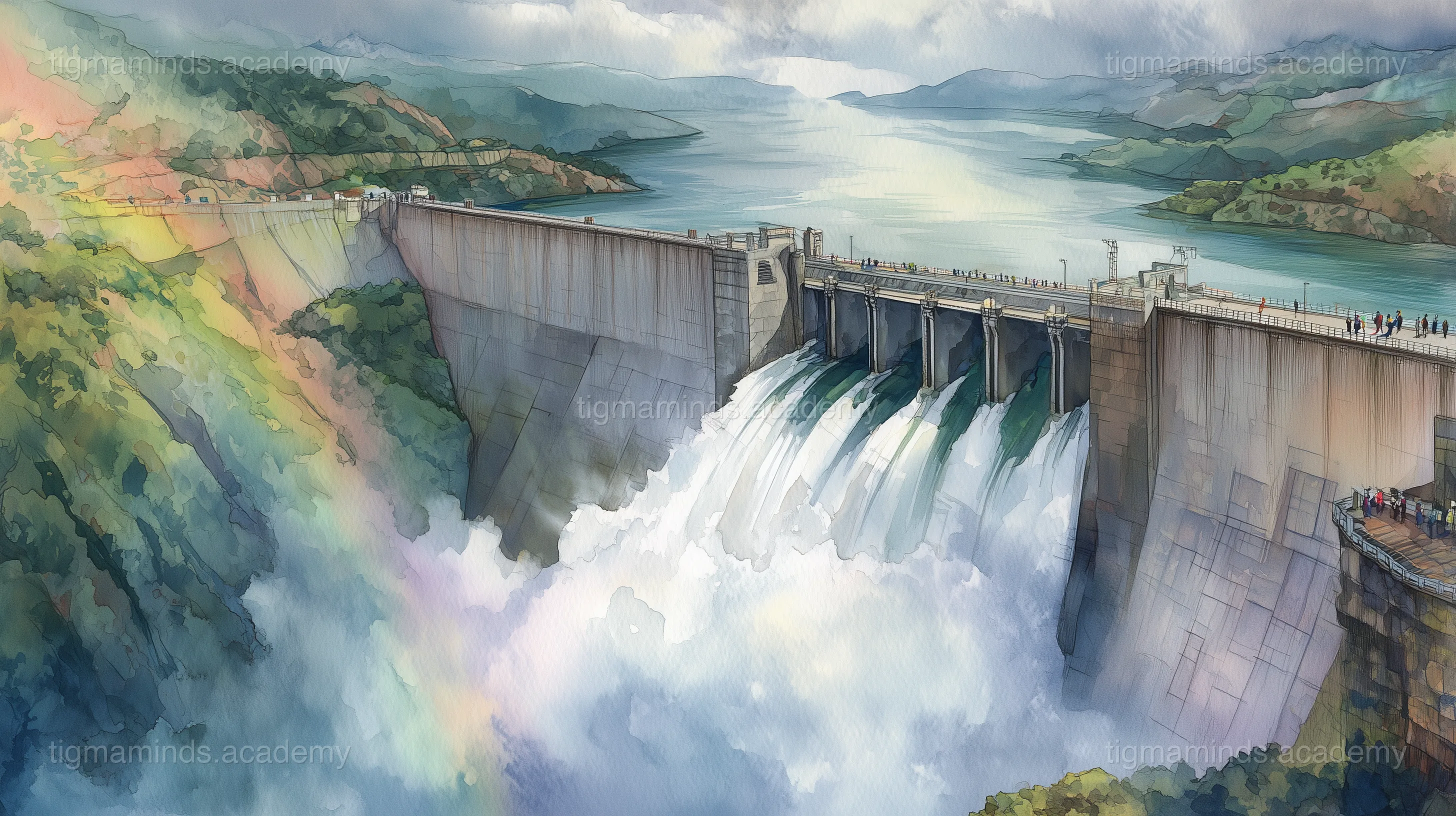
Hydraulic pressure, potential energy, and turbines — the physics of one of India's largest dams.
The Monsoon Gates
Kavitha was twelve years old the first time she saw the flood gates open at Nagarjuna Sagar Dam.
Her father, Rajan, was a civil engineer at the dam — one of the largest masonry dams in the world, built across the Krishna River in Telangana. It had been completed in 1967, rising 124 metres from its foundation to its crest, stretching 1.6 kilometres across the river valley. Behind it lay a reservoir that, at full capacity, held 11.6 billion cubic metres of water — enough to irrigate over a million hectares of farmland across Andhra Pradesh and Telangana.
Every monsoon season, when the Krishna River swelled with rain from the Western Ghats, the dam operators had to release water through the 26 crest gates to prevent the reservoir from overtopping. Kavitha's father had talked about this process many times at dinner, but talking was not the same as seeing.
On that August morning, standing on the observation deck with her father, Kavitha watched as the first gate opened. A wall of water — white, roaring, astonishing in its power — surged through the gate and plummeted down the spillway into the river below. The ground vibrated under her feet. The air filled with mist. The noise was so intense that she couldn't hear her own voice when she tried to speak.
"How much water is that?" she shouted into her father's ear.
"At full release," Rajan shouted back, "the spillway can discharge 45,000 cubic metres per second. That's enough water to fill an Olympic swimming pool every fifteenth of a second."
Kavitha stared at the white torrent and asked the question that would change her understanding of physics: "Where does all that power come from?"
The Secret of Height
Rajan was a patient teacher. That evening, after the noise of the spillway had faded, he sat with Kavitha at the kitchen table and drew a diagram.
"Water at the top of the dam is 124 metres above the base," he said. "It's just sitting there, not moving. But it has something valuable: height. And height, when you have gravity, means potential energy — stored energy that can be released."
He held up a tennis ball at arm's length above the table. "This ball isn't moving. It has no kinetic energy. But the moment I release it" — he let go, and the ball bounced off the table — "gravity pulls it down, and all that stored potential energy converts to kinetic energy — the energy of motion."
"Water at the top of a dam works exactly the same way. Every kilogram of water at 124 metres has potential energy equal to mass times gravity times height — that's 1 kg times 9.8 m/s-squared times 124 metres = 1,215 joules. That's enough energy to power a 100-watt light bulb for twelve seconds. Now multiply that by the millions of kilograms flowing through the gates every second."
Kavitha did some mental arithmetic. If 45,000 cubic metres of water (each cubic metre weighing 1,000 kg) flowed per second at full discharge, that was 45 million kilograms per second. Multiply by 1,215 joules per kilogram...
"That's over 54 billion joules per second," she said, stunned. "That's 54 gigawatts."
"Well, not all of it is captured," Rajan said. "Most of the spillway discharge just falls and dissipates as heat and turbulence. But the water that goes through the power station — that's where we capture a portion of that energy."
Pressure at the Bottom
A few days later, Rajan took Kavitha to the base of the dam to see the power station. Inside were rows of massive turbines — each one connected to a generator that converted the spinning motion into electricity. Nagarjuna Sagar had a total installed capacity of 816 megawatts — enough to power more than half a million homes.
"The turbines don't sit at the top of the dam," Kavitha observed. "They're at the bottom. Why?"
"Because of hydraulic pressure," Rajan said. "Water pressure increases with depth. At the surface of the reservoir, the pressure is just atmospheric — about 101,000 pascals. But at the base of the dam, 124 metres below the surface, the water pressure is enormous."
He wrote the formula: Pressure = density times gravity times depth. That's 1,000 kg/m-cubed times 9.8 m/s-squared times 124 metres = 1,215,200 pascals — about 12 atmospheres. Twelve times the air pressure at sea level, pressing against every square centimetre of the dam's base.
"This pressure is what drives the turbines," Rajan continued. "We channel the water from the bottom of the reservoir through large pipes called penstocks that direct it at the turbine blades. The water at the bottom is under enormous pressure, so it flows through the penstocks at very high speed. That fast-moving water spins the turbine, the turbine spins the generator, and the generator produces electricity."
Kavitha looked at the massive concrete wall. "So the dam has to hold back 12 atmospheres of pressure at the base? How does it not collapse?"
The Gravity Dam
"That," said Rajan, "is the most important question in dam engineering."
He explained that Nagarjuna Sagar is a gravity dam — a dam that resists the horizontal force of the water using its own weight. The dam is shaped like a triangle in cross-section: enormously thick at the base (over 30 metres) and narrower at the top. The weight of all that masonry — millions of tonnes of stone and concrete — presses straight down, creating a frictional force against the foundation rock that prevents the dam from sliding forward.
"Think of it this way," Rajan said. "Imagine pushing a heavy bookshelf across the floor. The heavier the bookshelf, the harder it is to slide. That's friction — and friction is proportional to weight. The dam works the same way. The water pushes horizontally; the dam's weight pushes vertically; and the friction between the dam's base and the bedrock resists the horizontal push."
But weight alone isn't enough. The dam must also resist overturning — the tendency to tip forward like a domino. This is why the triangular cross-section is critical. The wide, heavy base creates a centre of gravity that is far back from the water face, making it extremely difficult for the water's push to tip the structure forward. It's the same reason a pyramid is nearly impossible to knock over.
Kavitha thought about this. "So the dam is basically just a giant stone wedge that's so heavy it can't be pushed or tipped?"
"Exactly," her father said. "No moving parts. No steel cables. No clever mechanisms. Just weight, friction, and geometry. That's a gravity dam."
The Turbine
The next week, during a scheduled maintenance shutdown, Rajan arranged for Kavitha to see one of the turbines up close. It was a Francis turbine — a type of reaction turbine used in dams with medium to high heads (water height). The runner — the spinning part — was a massive steel disc with curved blades arranged in a spiral pattern, nearly three metres in diameter.
"Water enters the turbine housing through the penstock," Rajan explained, pointing at the enormous pipe that fed into the turbine casing. "It flows through guide vanes that direct it at the runner blades at the optimal angle. The water pushes against the curved blades, transferring its kinetic energy to the runner, which spins at about 150 revolutions per minute. The runner is connected by a shaft to the generator above, which converts the rotational energy into electrical energy."
Kavitha traced the path of the water in her mind: rain falls on the Western Ghats, flows into the Krishna River, collects behind the dam, gains potential energy from the 124-metre height, flows down the penstock under hydraulic pressure, converts potential energy to kinetic energy, spins the turbine, turns the generator, and becomes electricity that lights homes hundreds of kilometres away.
"It's all just gravity," she said. "The sun evaporates water from the ocean, lifts it into clouds, drops it as rain on the mountains, and gravity pulls it downhill to the dam. The dam just captures the energy of that fall."
Rajan looked at his daughter with surprise. "That's exactly right. Hydroelectric power is really just solar power with a delay. The sun provides the energy to lift the water; the dam captures the energy when it falls."
The Numbers
That evening, Kavitha calculated the efficiency of Nagarjuna Sagar. The dam's 816 megawatt capacity meant it could produce about 2.7 billion kilowatt-hours of electricity per year (running at typical load factors). This powered irrigation pumps that fed water to rice paddies, cotton fields, and sugarcane plantations across the Nagarjuna Sagar left and right canals — a network of over 200,000 kilometres of channels serving millions of farmers.
She also learned the human cost. The reservoir had submerged dozens of villages when it was filled. Thousands of families had been displaced. The ancient Buddhist ruins on Nagarjunakonda island — archaeological treasures from the 2nd century CE — had to be excavated and relocated before the waters rose. The dam fed millions, but it had also taken.
Engineering, Kavitha was learning, was never just about physics. It was about trade-offs — potential energy against displaced lives, megawatts against submerged history. The numbers in the formulas were clean. The decisions behind them were not.
The end.
Choose your level. Everyone starts with the story — the code gets deeper as you go.
Here is a taste of what Level 1 looks like for this lesson:
import numpy as np
import matplotlib.pyplot as plt
# Your first data analysis with Python
data = [45, 52, 38, 67, 41, 55, 48] # measurements
mean = np.mean(data)
plt.bar(range(len(data)), data)
plt.axhline(mean, color='red', linestyle='--', label=f'Mean: {mean:.1f}')
plt.xlabel("Sample")
plt.ylabel("Value")
plt.title("Hydraulic Pressure, Potential Energy & Turbines — Sample Data")
plt.legend()
plt.show()This is just the first of 6 coding exercises in Level 1. By Level 4, you will build: Build a Hydroelectric Power Calculator.
Free
Level 0: Listener
Stories, science concepts, diagrams, quizzes. No coding.
You are here
Level 0 is always free. Coding levels (1-4) are part of our 24-Week Bootcamp.
The physics of Nagarjuna Sagar Dam — how height creates energy, pressure drives turbines, and gravity holds back a river.
The big idea: "The Dam at Nagarjuna Sagar" teaches us about Hydraulic Pressure, Potential Energy & Turbines — and you don't need to write a single line of code to understand it.
Hold a ball at shoulder height. Is it doing anything? It is not moving, not bouncing, not spinning. It looks completely inactive. But the moment you release it, it accelerates downward and hits the floor with a thud. Where did that energy come from?
The energy was there all along — stored invisibly as gravitational potential energy. Any object that is above the ground and can fall has potential energy. The higher it is, the more it has. The heavier it is, the more it has. The formula is simple: Potential Energy = mass x gravity x height (PE = mgh). For a 1 kg ball held 2 metres high, that is 1 x 9.8 x 2 = 19.6 joules of stored energy.
Now scale this up to a dam. Nagarjuna Sagar holds water at 124 metres above the turbines. Every single kilogram of water at that height stores 1 x 9.8 x 124 = 1,215 joules of potential energy. The reservoir holds billions of kilograms. That is an almost incomprehensible amount of stored energy — all of it courtesy of gravity and height.
Here is the beautiful part: that energy came from the sun. Sunlight evaporated water from the ocean, lifting it against gravity into the atmosphere. Clouds carried it over the Western Ghats. Monsoon rains dropped it at high elevation. Gravity pulled it downhill into the Krishna River and into the reservoir. The dam simply captures the last step of this journey — the energy of falling water.
Key idea: Gravitational potential energy (PE = mgh) is energy stored by virtue of height. The higher and heavier an object, the more energy it stores. A dam captures the potential energy of water held at great height, converting it to electricity as the water falls.
Dive to the bottom of a swimming pool — even a 2-metre pool — and you feel pressure in your ears. Dive deeper in a lake, and the pressure increases. What is causing this?
Every layer of water above you has weight, and that weight presses down on you. At 1 metre depth, you have 1 metre of water pressing on you. At 10 metres, you have 10 metres. The formula is Pressure = density x gravity x depth (P = rho x g x h). Water has a density of 1,000 kg per cubic metre. At 10 metres depth, the pressure is 1,000 x 9.8 x 10 = 98,000 pascals — nearly one full atmosphere on top of the atmospheric pressure already present.
At the base of Nagarjuna Sagar Dam, 124 metres below the reservoir surface, the pressure is 1,000 x 9.8 x 124 = 1,215,200 pascals — about 12 atmospheres. That means every square metre of the dam's base faces a force of 1.2 million newtons — roughly the weight of 120 tonnes pressing horizontally against the wall.
This enormous pressure is both the challenge and the resource. The challenge: the dam must withstand it without cracking or sliding. The resource: when this pressurised water is channelled through penstocks to turbines, it flows at tremendous speed, carrying the energy that spins generators and produces electricity. Without depth, there is no pressure, and without pressure, there is no power.
Key idea: Hydraulic pressure increases linearly with depth: P = density x gravity x depth. At the base of a 124-metre dam, pressure reaches about 12 atmospheres. This pressure is what drives water through turbines at high speed to generate electricity.
Access all 130+ lessons, quizzes, interactive tools, and offline activities
Try this experiment. Place a heavy book on a table and push it sideways with your finger. It resists — you have to push fairly hard to slide it. Now p...
Blow on a pinwheel. It spins. You have just converted the kinetic energy of your breath into rotational energy of the pinwheel. A hydroelectric turbin...