The Silver Inlay of Bidar
Electrochemistry, Alloys & Oxidation-Reduction

The Silver Inlay of Bidar

Electrochemistry, alloys, and oxidation-reduction — the chemistry behind Bidriware's black-and-silver beauty.

Electrochemistry, Alloys & Oxidation-ReductionAll Tracks 10h

The Story

The Apprentice

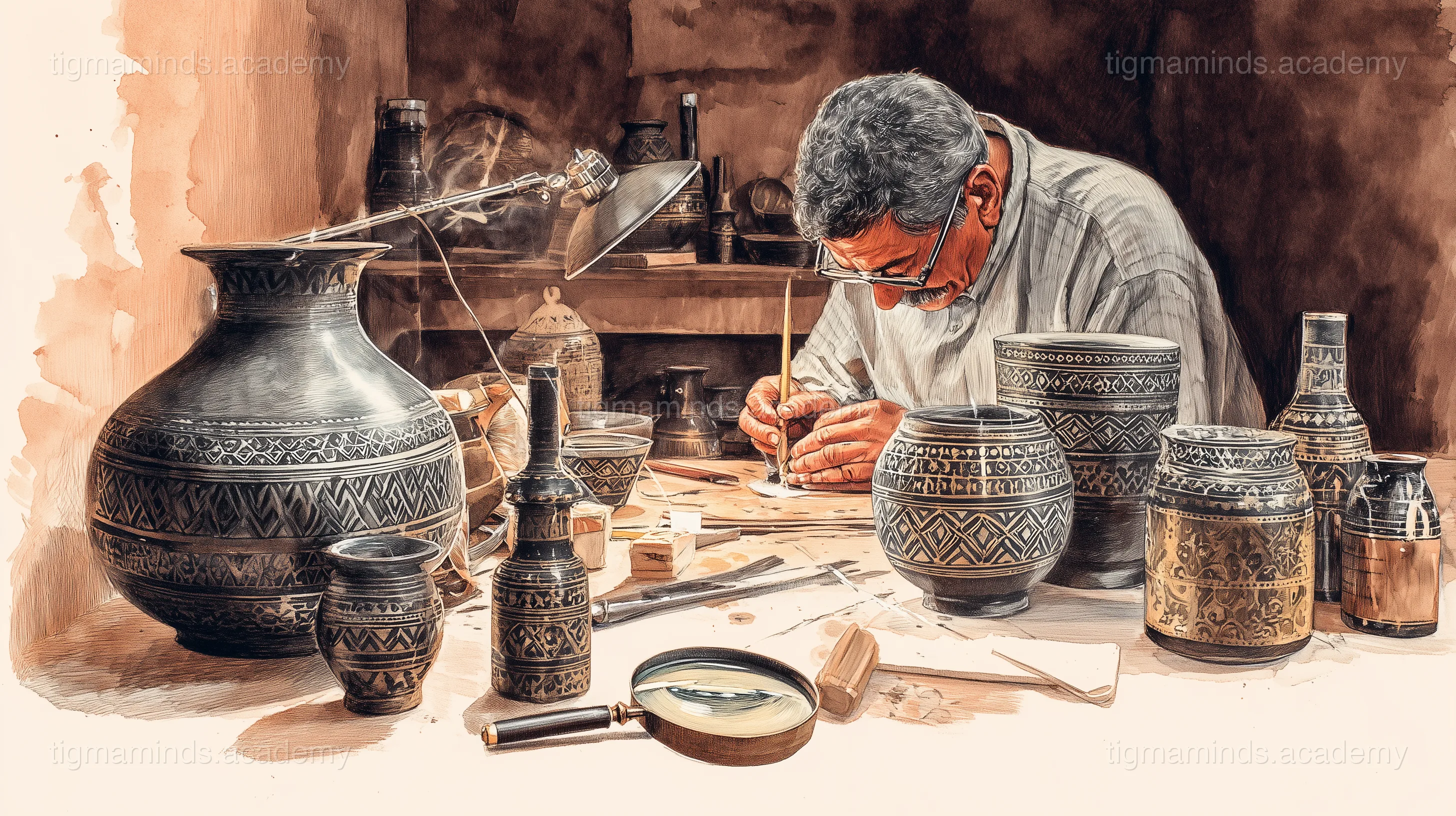
In the old city of Bidar, in the northernmost district of Karnataka that borders Telangana, a sixteen-year-old boy named Irfan sat in his uncle Khaleel's workshop and watched him do something that looked like alchemy.

Khaleel was a Bidriware artisan — a practitioner of a craft that had been born in Bidar during the Bahmani Sultanate in the 14th century and had been practised, refined, and passed from master to apprentice for over six hundred years. Bidriware is a form of metal craft in which intricate designs are inlaid in silver (or sometimes gold) onto a base of darkened zinc alloy — creating objects of striking black-and-silver beauty: vases, boxes, hookahs, jewellery, plates.

Irfan had been watching his uncle work for a year, helping with small tasks — filing, polishing, fetching materials. But today, for the first time, Khaleel was going to explain the entire process from start to finish. Not just the how, but the why.

"Every step in Bidriware," Khaleel said, "is chemistry. The old masters didn't call it that. They called it ilm — knowledge. But it's chemistry."

The Alloy

The first step was making the base metal. Khaleel placed a crucible in his small furnace and added chunks of zinc — a silvery-grey metal — and a small amount of copper. "The ratio matters," Khaleel said. "About 90 to 94 percent zinc, 6 to 10 percent copper. Too much copper and the alloy becomes too hard to engrave. Too little and it's too soft to hold a shape."

Irfan knew from school that an alloy is a mixture of metals, created by melting them together. The atoms of the two metals intermix at the molecular level, creating a material with properties different from either pure metal. Pure zinc is brittle and has a low melting point (420 degrees Celsius). Pure copper is soft and ductile. But when you combine them in the right proportions, you get an alloy that is harder than zinc, more workable than copper, and has a melting point low enough for a small workshop furnace.

Khaleel poured the molten alloy into a mould — a flat sheet for a plate, a cylindrical form for a vase. When it cooled and solidified, it was a dull, greyish piece of metal. Nothing beautiful about it. Yet.

The Engraving

Khaleel clamped the cast piece on his workbench and picked up a set of fine steel chisels. Over the next several hours, he engraved the design into the surface — cutting thin, precise grooves and channels into the zinc alloy. The design was a geometric pattern of interlocking stars and arabesques, traditional to Bidar's Persian-influenced aesthetic.

"The grooves need to be undercut," Khaleel explained, tilting his chisel at an angle. "See? The channel is wider at the bottom than at the top — like a dovetail joint. When I press the silver wire into this groove, the wider bottom locks it in place. It can't fall out because the opening is narrower than the channel beneath."

This was mechanical engineering at the microscale: a dovetail lock — the same principle used in woodworking joints, in keystone arches, in the interlocking blocks of ancient Incan walls. The geometry itself provided the grip, without glue, solder, or any adhesive.

The Silver Inlay

Now came the most delicate step. Khaleel took thin silver wire — pure silver, 99.9% — and pressed it into the engraved grooves using a blunt tool. He tapped gently but firmly, forcing the soft silver into the undercut channels. Silver is one of the most malleable and ductile metals known — it can be hammered into sheets thinner than paper and drawn into wire finer than a human hair. This extreme softness is what allows it to be pressed into the tiny grooves and conform perfectly to the shape of the channel.

Irfan watched as the silver filled the design like rivers filling channels on a map. Khaleel worked with extraordinary precision — any excess silver on the surface would need to be filed away, and filing too aggressively would damage the zinc alloy base.

"Why silver?" Irfan asked. "Why not aluminium or steel?"

"Two reasons," Khaleel said. "First, silver is soft enough to press into the grooves without cracking. Steel would shatter. Aluminium would oxidise and discolour. Second, silver doesn't react with the darkening solution we'll use next. That's the key to the whole craft."

The Darkening: Oxidation in Action

This was the step that fascinated Irfan most. Khaleel prepared a paste of soil from the Bidar fort — a specific type of earth that is rich in ammonium chloride (sal ammoniac) and potassium nitrate (saltpetre). He mixed the soil with water to form a slurry and coated the entire piece with it.

"The soil from Bidar is special," Khaleel said. "The fort is built on laterite rock, and centuries of human habitation have enriched the soil with specific chemical salts. Craftsmen have tested soil from other regions — it doesn't work as well."

What happened next was an oxidation-reduction reaction — the fundamental chemistry of electron transfer. The ammonium chloride and potassium nitrate in the soil reacted with the zinc in the alloy. Zinc is a reactive metal — it readily gives up electrons (is oxidised). The chloride and nitrate ions in the soil acted as oxidising agents, accepting those electrons and converting the zinc surface to zinc oxide and zinc chloride — both of which are dark black in colour.

But the silver did not react. Silver is a noble metal — it sits low on the reactivity series, meaning it does not easily give up electrons. The soil paste could oxidise the zinc but had no effect on the silver.

When Khaleel washed off the soil paste and buffed the piece, the result was dramatic: the zinc alloy surface had turned a deep, permanent, velvety black, while the silver inlay gleamed brilliantly against it. Black metal, bright silver. The contrast was stunning.

"The silver resists because it's noble," Khaleel said. "The zinc darkens because it's reactive. That's not art technique — that's the reactivity series at work."

The Reactivity Series

Irfan went home that evening and looked up the reactivity series in his chemistry textbook. It was a ranking of metals by how readily they give up electrons: Potassium — Sodium — Calcium — Magnesium — Aluminium — Zinc — Iron — Lead — Copper — Silver — Gold — Platinum. Metals at the top are extremely reactive — they explode on contact with water. Metals at the bottom are extremely unreactive — they resist corrosion and maintain their lustre for centuries.

Zinc sits in the middle of the series — reactive enough to be oxidised by the chemicals in Bidar soil, but stable enough to hold its shape. Silver sits near the bottom — unreactive enough to resist the same treatment completely.

The entire beauty of Bidriware depends on this gap in the reactivity series. If both metals reacted, both would turn black and there would be no contrast. If neither reacted, both would stay shiny and there would be no pattern. It works because zinc is reactive and silver is not. Six hundred years of craftsmen selected these exact metals for exactly this reason — whether or not they used the word "electrochemistry."

The Finished Piece

Three weeks after he started, Khaleel handed Irfan the finished vase. It was a masterpiece of chemistry disguised as art. The black zinc alloy surface absorbed light like velvet. The silver arabesques caught and reflected it like mirrors.

"Remember," Khaleel said. "This craft survived six hundred years not because it's pretty. It survived because the chemistry is perfect. The alloy is right. The engraving locks the silver. The soil oxidises the zinc. And the silver stays noble. Change any one of those things and the whole craft falls apart."

Irfan turned the vase in the lamplight, watching the silver stars rotate against their black sky. He was holding a lesson in metallurgy, electrochemistry, and materials science — a lesson that had been taught by hand, in a workshop in Bidar, for six centuries.

The end.

Try It Yourself

Choose your level. Everyone starts with the story — the code gets deeper as you go.

Story Progress

0%

Ready to Start Coding?

Here is a taste of what Level 1 looks like for this lesson:

Level 1: Explorer — Python
import numpy as np
import matplotlib.pyplot as plt

# Your first data analysis with Python
data = [45, 52, 38, 67, 41, 55, 48]  # measurements
mean = np.mean(data)

plt.bar(range(len(data)), data)
plt.axhline(mean, color='red', linestyle='--', label=f'Mean: {mean:.1f}')
plt.xlabel("Sample")
plt.ylabel("Value")
plt.title("Electrochemistry, Alloys & Oxidation-Reduction — Sample Data")
plt.legend()
plt.show()

This is just the first of 6 coding exercises in Level 1. By Level 4, you will build: Build a Reactivity Series Simulator.

Free

Level 0: Listener

Stories, science concepts, diagrams, quizzes. No coding.

You are here

Enrolled

Levels 1-4

Python, NumPy, Matplotlib, real projects, mentorship.

Sign Up Free

Stay Updated

Join Waitlist

Get notified when enrollment opens for your area.

Notify Me

Level 0 is always free. Coding levels (1-4) are part of our 24-Week Bootcamp.