The Kuchipudi Dancer's Anklet
Sound Waves, Resonance & Harmonics

The Kuchipudi Dancer's Anklet

Sound waves, resonance, and harmonics hidden in a grandmother's bronze anklets.
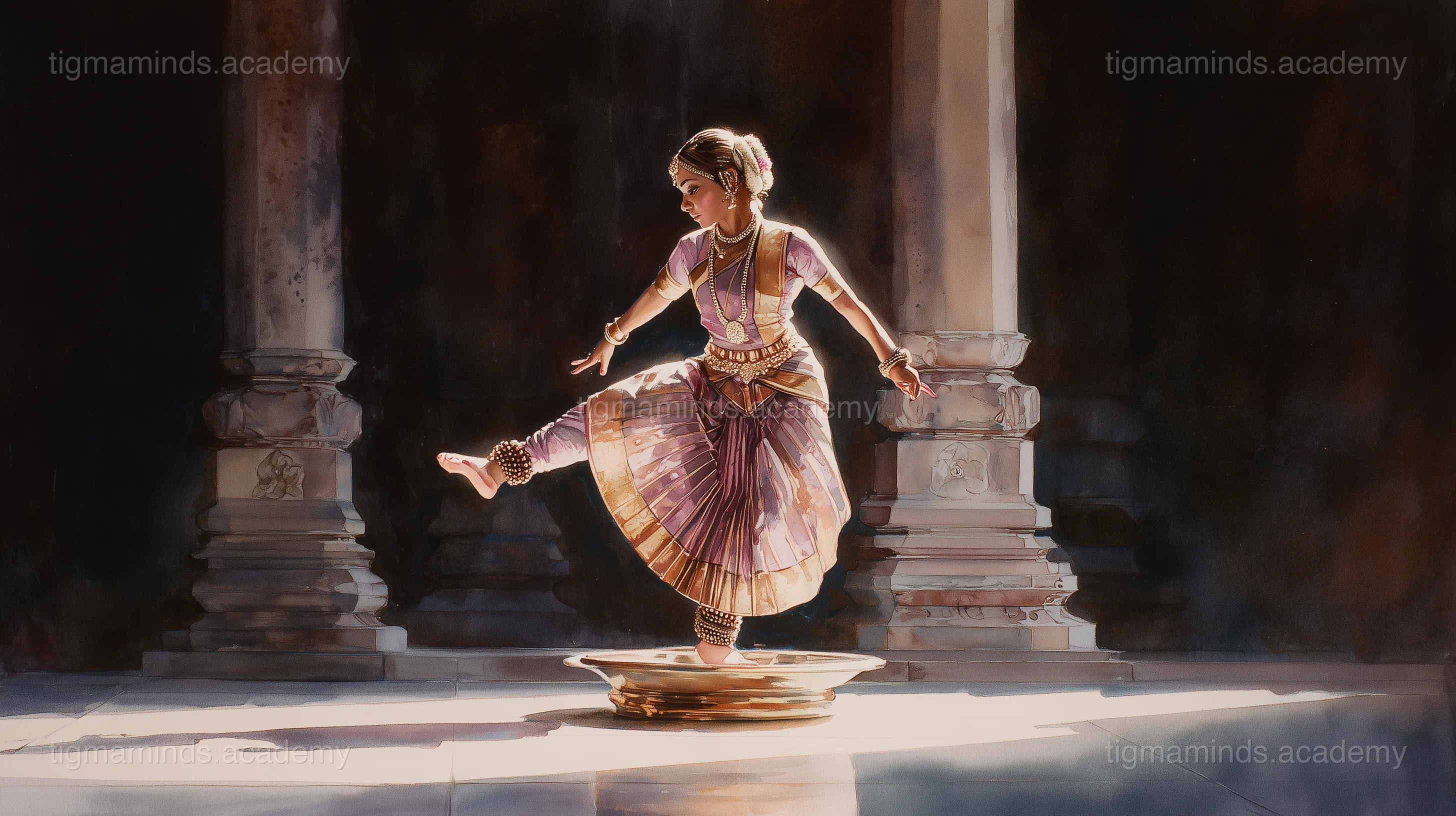
Sound Waves, Resonance & HarmonicsAll Tracks 10h

The Story

The Old Anklets

In the village of Kuchipudi, on the banks of the Krishna River in Andhra Pradesh, a fifteen-year-old dancer named Meenakshi was preparing for her arangetram — her debut solo performance. She had trained for nine years under her guru, learning the precise footwork, the expressive hand gestures called mudras, and the rhythmic patterns called jatis that make Kuchipudi one of the most demanding classical dance forms in India.

Everything was ready except one thing: her anklets.

Meenakshi's mother had bought her a new pair of ghungroos — anklets with small bells — from a shop in Vijayawada. They were bright and shiny, made of nickel-plated steel, and they made a sharp, tinkling sound when she stamped her feet. But when her grandmother, Saraswamma, heard them during a practice session, she shook her head.

"Those are not dance bells," Saraswamma said. "Those are noise."

She went to an old wooden trunk in the back room and pulled out a cloth bundle. Inside were a pair of anklets that looked nothing like the new ones. The bells were darker, heavier, slightly uneven in size. They were made of bronze — an alloy of copper and tin — and they had been made by hand by a bell-maker in the village of Kondapalli more than sixty years ago.

Saraswamma tied them around her own ankles and stamped once on the wooden floor. The sound was completely different. It was deeper, richer, warmer. It seemed to fill the room rather than pierce it. It lingered in the air for a long moment after her foot had stopped moving.

"Hear that?" Saraswamma said. "That is what a dancer's bell should sound like. The new ones are louder, but loud is not the same as beautiful."

Why Do They Sound Different?

Meenakshi was puzzled. Both anklets had bells. Both made sound when struck. Why did the old bronze bells sound so much better than the new steel ones?

She took one bell from each anklet and held them up. The bronze bell was slightly larger, slightly heavier, and when she tapped it with her fingernail, it vibrated visibly for a long time — she could feel it humming in her fingertips for three or four seconds. The steel bell was lighter, and when she tapped it, it made a sharp click and stopped almost immediately.

She asked her physics teacher, Mr. Subramaniam, about it the next day. He smiled. "You have just discovered three things about sound that most people never notice," he said. "You have discovered timbre, harmonics, and damping."

He drew a wave on the blackboard. "When a bell vibrates, it doesn't just vibrate at one frequency. It vibrates at many frequencies simultaneously — a fundamental frequency and a whole series of harmonics on top of it. The fundamental is the lowest note — it's what you hear as the 'pitch' of the bell. The harmonics are higher frequencies — multiples of the fundamental — and they're what give the bell its character, its colour."

"A bronze bell," he continued, "produces harmonics that are mathematically related to the fundamental — clean multiples like 2x, 3x, 4x. Your ear perceives these as pleasant, musical, harmonious. A cheap steel bell produces harmonics that are not clean multiples — they're slightly off, creating a jangling, harsh quality. Same volume, same pitch, but completely different character."

The Science of Bronze

Mr. Subramaniam was a thorough man. He was not satisfied with explaining just the harmonics. He wanted Meenakshi to understand why bronze was special.

"Bronze is an alloy — a mixture of copper and tin," he said. "Typically about 80% copper and 20% tin for bell bronze. The two metals dissolve into each other at the atomic level, creating a crystal structure that is harder and more elastic than either metal alone."

He explained that when a bell is struck, the metal deforms slightly and then springs back — this is elasticity. The speed at which the vibration travels through the metal depends on the material's elastic modulus — a measure of how stiff it is — and its density. Bronze has a particular combination of stiffness and density that produces a vibration speed which generates well-ordered harmonic series.

Steel, by contrast, is stiffer but denser in a different ratio. Its harmonic series is less orderly. Furthermore, steel's internal grain structure absorbs vibrational energy faster — the sound dies out quickly. This rapid energy loss is called damping. Bronze has very low damping, which is why a bronze bell can ring for many seconds while a steel bell stops almost immediately.

"This is why every great bell in the world — church bells, temple bells, the Liberty Bell — is made of bronze," Mr. Subramaniam said. "Not because of tradition. Because of physics."

Resonance on the Wooden Stage

But the story of Meenakshi's anklets did not end with the bells themselves. During her next practice on the traditional wooden stage at the village kalakshetram (arts hall), she noticed something else. When she stamped a particular rhythm — ta-ka-dhi-mi, ta-ka-dhi-mi — at a certain speed, the entire wooden floor seemed to come alive. The sound grew louder, richer, almost as if the floor itself were singing.

She stamped faster. The effect diminished. She stamped slower. It diminished. But at that exact tempo, the floor amplified her bells as if by magic.

"That is resonance," Mr. Subramaniam told her when she described it. "Every object has a natural frequency — the frequency at which it naturally vibrates. When you stamp at a rhythm that matches the natural frequency of the wooden stage, the floor absorbs energy from each stamp and adds it to its own vibration. The vibrations build on each other, getting bigger and bigger. The floor becomes an amplifier."

He told her about the famous example of the Tacoma Narrows Bridge in Washington State, USA, which collapsed in 1940 when wind gusts matched its natural frequency and caused the entire bridge to oscillate violently until it tore itself apart. Resonance could make music, but it could also destroy structures.

Meenakshi realised that the Kuchipudi masters had known this for centuries — not in the language of physics, but in the language of practice. The traditional Kuchipudi stage was made of teak wood of a specific thickness, and the dancers learned rhythmic patterns at tempos that resonated with that wood. The music, the bells, the stage, and the dancer's feet were all tuned to each other like instruments in an orchestra.

The Arangetram

On the night of her arangetram, Meenakshi wore her grandmother's bronze anklets. The stage was lit with oil lamps. The mridangam drummer set the rhythm. The veena player began the melody.

When Meenakshi struck her first tattu — a sharp, flat-footed stamp — the bronze bells rang out across the hall. The sound was not just a click or a jingle. It was a musical note, rich with harmonics, sustained by low damping, amplified by the resonant wooden stage. It blended with the mridangam and the veena as if it belonged in the melody.

She danced for two hours. The audience swayed with the rhythms. At the end, Saraswamma was in the front row, wiping her eyes. Not because the dance was beautiful — though it was — but because she could hear in those bells the sound of her own arangetram, sixty years ago, when the same bronze bells had rung on her ankles.

After the performance, a younger student asked Meenakshi why she didn't use the shiny new anklets. Meenakshi thought about frequencies and damping coefficients and harmonic series, and then she said what her grandmother had said:

"Those are not dance bells. Those are noise."

She was right. And now she knew why.

The end.

Try It Yourself

Choose your level. Everyone starts with the story — the code gets deeper as you go.

Story Progress

0%

Ready to Start Coding?

Here is a taste of what Level 1 looks like for this lesson:

Level 1: Explorer — Python
import numpy as np
import matplotlib.pyplot as plt

# Your first data analysis with Python
data = [45, 52, 38, 67, 41, 55, 48]  # measurements
mean = np.mean(data)

plt.bar(range(len(data)), data)
plt.axhline(mean, color='red', linestyle='--', label=f'Mean: {mean:.1f}')
plt.xlabel("Sample")
plt.ylabel("Value")
plt.title("Sound Waves, Resonance & Harmonics — Sample Data")
plt.legend()
plt.show()

This is just the first of 6 coding exercises in Level 1. By Level 4, you will build: Build a Harmonic Frequency Analyzer.

Free

Level 0: Listener

Stories, science concepts, diagrams, quizzes. No coding.

You are here

Enrolled

Levels 1-4

Python, NumPy, Matplotlib, real projects, mentorship.

Sign Up Free

Stay Updated

Join Waitlist

Get notified when enrollment opens for your area.

Notify Me

Level 0 is always free. Coding levels (1-4) are part of our 24-Week Bootcamp.