The Terracotta Horse of Bankura
Kiln Chemistry & Ceramic Science

The Terracotta Horse of Bankura

Kiln chemistry, heat transfer, and ceramic science in the making of Bengal's most iconic clay sculpture.

Kiln Chemistry & Ceramic Science12-Month Curriculum 12h

The Story

The Competition

Mrinmoy Pal was seventeen years old and he had a problem.

In six weeks, the annual Mritshilpa Mela — the Clay Sculpture Fair — would be held in the town of Bankura, 230 kilometres northwest of Kolkata, in the red laterite country of western Bengal. Potters from across the district would bring their finest work. Government buyers would be there. Export agents from Kolkata and Delhi would be there. A prize-winning piece could transform a family workshop's fortunes for a generation.

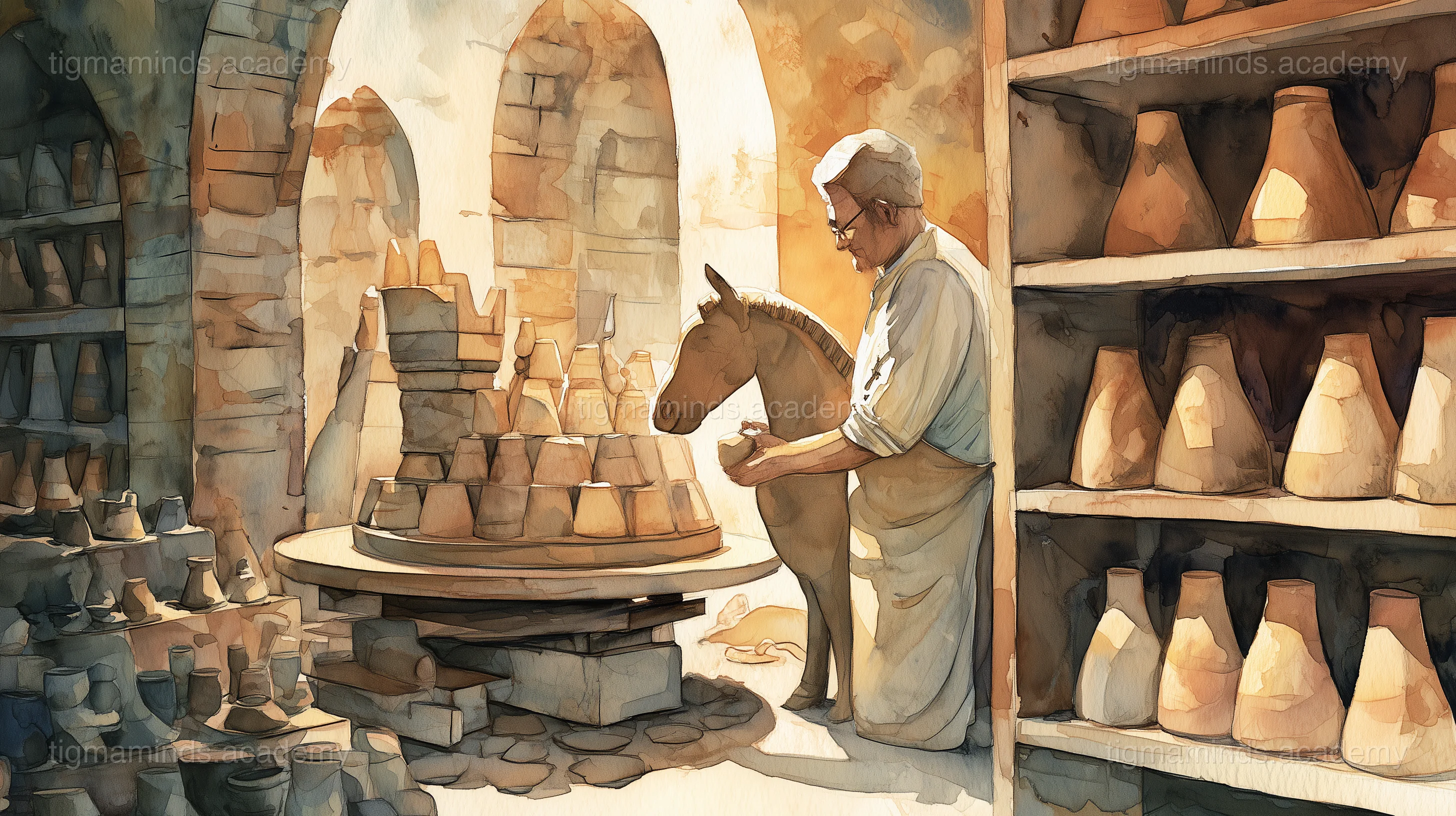
Mrinmoy's family had made Bankura horses for five generations. The Bankura horse — called ghora in Bengali — is a hollow terracotta figure of a horse, standing anywhere from six inches to five feet tall. It has a distinctive posture: head held high, neck arched, ears pricked forward, legs planted wide. The surface is smooth and burnished, usually left in the natural red-brown of fired terracotta or sometimes painted with white kaolin slip and geometric patterns in red and black.

The Bankura horse is not just a tourist souvenir. It is a sacred object — traditionally placed at the base of village trees as an offering to the local deity Dharma Thakur. It is also a national emblem: in 2018, the Indian government adopted the Bankura horse as the official symbol of Indian handicrafts, and it appears on the logo of the All India Handicrafts Board. To make a Bankura horse that is technically flawless — evenly fired, structurally sound, with that particular warm red tone — is one of the hardest things a Bengali potter can do.

Mrinmoy's grandfather Gopinath Pal had won the Mela three times. His father Shankar Pal had won it once, twenty years ago, with a four-foot horse that now stood in the foyer of a Delhi hotel. Mrinmoy had never entered. This year, his grandfather had decided it was time.

"You will make a three-foot horse," Gopinath said. "And you will fire it yourself. Alone."

Mrinmoy stared. He had shaped hundreds of horses on the wheel, painted dozens, loaded the kiln many times. But he had never fired one alone. Firing was the critical stage — the stage where chemistry either rewarded patience or punished carelessness. A horse could be perfectly shaped, perfectly painted, and still come out of the kiln cracked, warped, or the wrong colour. Firing was where potters failed.

The Clay

The first problem was the clay itself.

Not all clay is suitable for large terracotta work. Mrinmoy needed alluvial clay from the banks of the Dwarakeshwar River, which runs through Bankura district. This clay has the right combination of plasticity (it holds its shape when moulded), tensile strength (it does not crack as it dries), and mineral content (specifically, iron oxide, which gives terracotta its characteristic red colour).

Gopinath took Mrinmoy to the riverbank. "Feel the clay," he said. Mrinmoy dug a fistful from a fresh-cut bank. It was smooth, slightly greasy, and held the impression of his fingers perfectly.

"This clay has been deposited by the river over thousands of monsoons," Gopinath explained. "The water sorts the particles by size. Sand sinks first — the heavy grains. Then silt. Then the finest particles — the clay proper — settle last, in thin layers. That is why the best clay is always at the top of the bank, not the bottom."

Back at the workshop, Mrinmoy spent three days preparing the clay: soaking it in water, treading it with his feet to remove air bubbles, wedging it by hand on a stone slab until it had a uniform, plastic consistency. Air bubbles were the enemy. A single trapped bubble, invisible to the eye, would expand violently in the kiln as it heated, blowing a hole through the wall of the horse. Every bubble had to be found and expelled, through hours of kneading and slamming the clay against stone.

He also mixed in a small percentage of grog — ground-up fragments of previously fired terracotta, crushed to a coarse powder. Grog serves two purposes: it reduces shrinkage during drying and firing (because it has already been fired once, it will not shrink again), and it creates tiny internal channels that allow steam to escape from the clay during the early stages of firing. Without grog, a thick-walled piece like a Bankura horse would almost certainly crack as the water inside turned to steam and tried to force its way out.

Building the Horse

Mrinmoy shaped the horse over five days, using the coil-and-slab technique traditional to Bankura. He did not use a potter's wheel for the body — wheels are for round vessels, and a horse is not round. Instead, he rolled long coils of clay and built the body up in rings, smoothing each coil into the one below with a wooden paddle. The legs were shaped separately and attached when the body was leather-hard — dry enough to bear weight but wet enough to bond. The head was sculpted by hand, the ears pulled from the neck with his fingertips, the mane scored with a comb.

The entire horse was hollow. A solid three-foot figure would weigh over 80 kilograms and would be almost impossible to fire evenly — the outside would vitrify while the centre was still raw. Worse, the enormous amount of water trapped inside a solid mass would create explosive steam pressure. So the walls of the horse were a uniform 2 centimetres thick — thin enough to heat evenly, thick enough to be strong.

After shaping, the horse dried for two weeks in the shade of the workshop. Not in the sun — direct sun would dry the outside too fast, causing the surface to shrink while the inside was still wet, and the horse would crack. Gopinath had a saying: "The sun is the potter's enemy before the kiln, and the kiln is the potter's friend."

The Kiln

Gopinath's kiln was a downdraft kiln, built of brick, shaped like a beehive, about two metres in diameter and two metres tall. The fire was set in a firebox at the front. The hot gases rose over a low wall called a bag wall, flowed across the top of the kiln chamber (where the pottery was stacked), and then were pulled downward through the pottery and out through flues in the floor, which connected to a chimney at the rear.

This design — fire at the front, exhaust at the back and bottom — forced the hot gases to travel the longest possible path through the kiln, ensuring that every piece was exposed to heat from all sides. A simpler updraft kiln (fire at the bottom, exhaust at the top) heats the bottom much more than the top, producing uneven firing. The downdraft design was Bankura's secret: centuries of potting tradition had converged on the most thermodynamically efficient kiln geometry.

Mrinmoy loaded the horse into the kiln on a bed of sand (which allows the piece to slide as it shrinks, preventing stress cracks) and sealed the door with brick and mud.

The Firing

This was the critical day.

Gopinath stood outside the kiln as Mrinmoy lit the fire. "You will bring the temperature up slowly," the old man said. "Twenty degrees per hour for the first four hours. If you rush, the horse dies."

The first phase was called water smoking — heating the clay from room temperature to about 200 degrees Celsius. During this phase, the free water trapped between clay particles turned to steam and escaped through the pores. If the temperature rose too fast, the steam could not escape quickly enough and the pressure would crack the clay from inside. The grog in the mix helped, creating tiny escape channels, but patience was still essential.

Between 200 and 400 degrees, the clay went through a quiet phase — little visible change, but the chemically bonded water (water molecules locked into the crystal structure of the clay minerals) was being driven off. This water was harder to remove than the free water because it was part of the mineral itself. The clay was becoming permanently different from raw clay — it could never be softened with water again.

At 573 degrees, something sudden happened: the quartz inversion. Quartz crystals — tiny grains of silicon dioxide scattered through the clay — underwent a sudden change in crystal structure, expanding by about 2 percent in an instant. This expansion was dangerous. If the temperature passed through 573 degrees too quickly, the sudden expansion would crack the piece. Mrinmoy watched the pyrometric cones — small triangular markers made of clay that bend at specific temperatures — and held the fire steady as the kiln crawled through the danger zone.

Above 573 degrees, Mrinmoy increased the firing rate. At 600 to 800 degrees, the organic matter in the clay — fragments of ancient plants, roots, humus — burned away, sometimes producing visible flames at the chimney top. The clay body was now permanently hard but still porous.

Between 800 and 1000 degrees, the clay minerals began to break down and reform. The iron oxide that gave the clay its red colour began to react with the silica and alumina, forming new mineral compounds. The exact colour of the finished piece depended on the atmosphere inside the kiln at this stage: an oxidising atmosphere (plenty of air) would produce the classic terracotta red, because the iron remained as ferric oxide (Fe2O3). A reducing atmosphere (restricted air, excess carbon monoxide) would turn the iron to ferrous oxide (FeO), producing grey or black.

Mrinmoy kept the firebox stoked with dry wood and the air vents open. He wanted red. For sixteen hours, he fed the fire, watched the pyrometric cones, and listened to the kiln. Experienced potters say they can hear the kiln "breathe" — the sound of the draft changes as the temperature rises and the flue gases shift.

At hour fourteen, the temperature reached 980 degrees. The pyrometric cone for 980 degrees bent, touching the shelf. Mrinmoy held the fire at this temperature for two hours — a soak — to ensure the heat had penetrated evenly to the centre of every piece.

Then he sealed the air vents and the firebox door. The kiln would cool on its own, as slowly as it had heated. Cooling too fast would cause thermal shock — the outside contracting while the inside was still expanded — and the horse would crack. The quartz inversion point at 573 degrees was dangerous in both directions: the crystals would shrink suddenly on cooling, just as they had expanded on heating. Mrinmoy would not open the kiln for 48 hours.

The Opening

Two days later, Mrinmoy unsealed the kiln door and reached inside.

The horse stood on its bed of sand, intact. Its surface was a deep, warm red — the unmistakable colour of properly oxidised terracotta. He tapped it with his knuckle. It rang — a clear, high note, like a bell. A dull thud would have meant underfiring, incomplete sintering. The ring meant the clay particles had fused properly, that the silica matrix was continuous, that the piece was sound.

He lifted it out. It was lighter than the raw horse had been — all the water was gone, burned away in the kiln. The surface had a subtle sheen where the burnishing he had done before firing had compressed the surface particles into a smooth, semi-vitrified skin.

Gopinath took the horse, turned it slowly in his hands, and examined the base, the legs, the hollow interior through the opening in the belly.

"No cracks," he said. "Good colour. Even firing. The ring is clean."

He set it down on the workshop table.

"Now make four more," he said. "One good horse is luck. Five good horses is skill."

Mrinmoy sat down at his worktable, reached for a ball of clay, and began again.

The end.

Try It Yourself

Choose your level. Everyone starts with the story — the code gets deeper as you go.

Story Progress

0%

Ready to Start Coding?

Here is a taste of what Level 1 looks like for this lesson:

Level 1: Explorer — Python
import numpy as np
import matplotlib.pyplot as plt

# Your first data analysis with Python
data = [45, 52, 38, 67, 41, 55, 48]  # measurements
mean = np.mean(data)

plt.bar(range(len(data)), data)
plt.axhline(mean, color='red', linestyle='--', label=f'Mean: {mean:.1f}')
plt.xlabel("Sample")
plt.ylabel("Value")
plt.title("Kiln Chemistry & Ceramic Science — Sample Data")
plt.legend()
plt.show()

This is just the first of 6 coding exercises in Level 1. By Level 4, you will build: Build a Kiln Firing Simulator.

Free

Level 0: Listener

Stories, science concepts, diagrams, quizzes. No coding.

You are here

Enrolled

Levels 1-4

Python, NumPy, Matplotlib, real projects, mentorship.

Sign Up Free

Stay Updated

Join Waitlist

Get notified when enrollment opens for your area.

Notify Me

Level 0 is always free. Coding levels (1-4) are part of our 12-Month Curriculum.