
How Mizo blacksmiths turned mountain rock into steel — the chemistry of smelting.
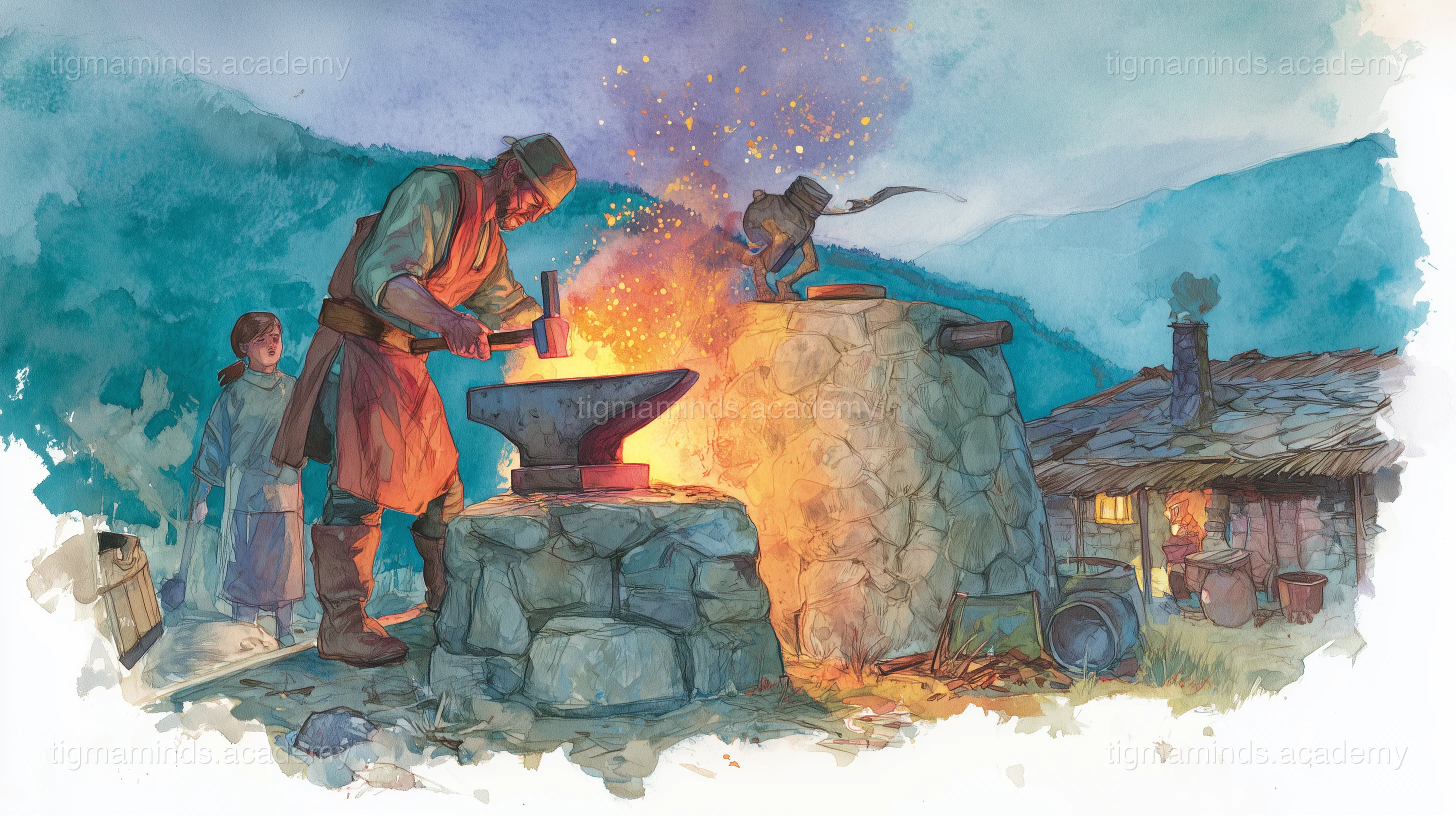
The Red Rock
Long before the British surveyors came to map the hills, before the missionaries came to teach new alphabets, before anyone from the plains knew the name "Mizoram," the Mizo people were already masters of iron.
In the village of Lunglei, set on a ridge where the morning mist pooled like a lake in the valley below, a boy named Thangzuala watched his uncle, Pu Remruata, prepare the forge.
Pu Remruata was a thirdeng — a blacksmith — and he was one of the last who still smelted iron from raw ore, the old way. Most smiths now bought their iron in bars from the Silchar market. But Pu Remruata said the market iron was dead.
"Iron from the mountain has a soul," he told Thangzuala. "It remembers the fire that made it."
Finding the Ore
Pu Remruata took Thangzuala up the hillside to a place where the soil was stained red and orange. He dug out a handful of the reddish rock and held it up.
"This is iron ore," he said. "The red colour comes from rust — iron that has bonded with the oxygen in the air over millions of years. Our job is to separate the iron from the oxygen."
Thangzuala hefted the rock. It was surprisingly heavy.
"How do you separate them?" he asked.
"With fire and carbon," said Pu Remruata. "Fire gives us heat. Carbon steals the oxygen. What's left is pure iron."
The Furnace
Back at the forge, Pu Remruata showed Thangzuala the clay furnace — a waist-high structure shaped like a fat chimney, built from termite-mound clay mixed with rice husk (which burned away during firing, leaving tiny pores that insulated the furnace and prevented cracking).
"The furnace has to reach at least 1,200°C," said Pu Remruata. "That's hot enough to make the ore soft and sticky, so the iron can separate from the slag."
To reach that temperature, they used charcoal — made by burning hardwood in a covered pit until nothing but carbon remained. The charcoal served two purposes: it was the fuel that generated heat, and its carbon was the chemical agent that stripped oxygen from the iron ore.
Pu Remruata layered the furnace: a bed of charcoal, a layer of crushed ore, another layer of charcoal, another layer of ore, and so on, like a lasagna of fire and stone. Then he sealed the top and began pumping the bellows.
The Reaction
"Watch the smoke," said Pu Remruata as he worked the goatskin bellows, forcing air into the base of the furnace through a clay pipe called a tuyère.
At first, the smoke was thick and white — water vapour from the clay and ore. Then it turned grey — carbon dioxide from the burning charcoal. Then the top of the furnace began to glow cherry-red, and the smoke thinned to a shimmer of heat.
Inside the furnace, at 1,200°C, the carbon from the charcoal was doing its work. Each carbon atom was bonding with oxygen atoms from the iron ore, forming carbon dioxide (CO₂) gas that floated up and out through the smoke. This is the central reaction of iron smelting:
Iron oxide + Carbon → Iron + Carbon dioxide 2Fe₂O₃ + 3C → 4Fe + 3CO₂
The oxygen that had held the iron captive for millions of years was being stolen, atom by atom, by carbon. What was left behind was metallic iron — soft, glowing, and pure.
The Bloom
After six hours of continuous pumping — Thangzuala took turns at the bellows until his arms burned — Pu Remruata broke open the furnace. Inside, nestled in a bed of grey ash and glassy slag, was a rough, spongy lump of iron called a bloom.
The bloom was not yet usable. It was full of trapped slag, air pockets, and uneven carbon content. Pu Remruata pulled it out with long iron tongs, placed it on his anvil, and began to hammer.
Each blow of the hammer squeezed out impurities and closed air pockets. The iron slowly transformed from a spongy, crumbly lump into a dense, gleaming bar. This process — forging — realigned the iron's crystal structure, making it stronger and more uniform.
"This is why I say market iron is dead," said Pu Remruata, hammering steadily. "Market iron was smelted in a factory. It was never hammered by a person who understood it. This iron —" he struck a ringing blow — "this iron knows my hammer."
Making It Steel
Pure iron is actually quite soft. A pure iron knife would bend like a wet noodle. To make it hard and sharp — to make steel — you need to add a precise amount of carbon.
Pu Remruata did this by heating the iron bar to white-hot and then pressing it into a bed of charcoal powder. At high temperature, carbon atoms migrate from the charcoal into the surface of the iron — a process called carburisation. The carbon atoms wedge themselves between the iron atoms in the crystal lattice, making it much harder to deform.
Too little carbon (below 0.2%) and the steel is too soft. Too much (above 2%) and it becomes brittle — it shatters instead of bending. The sweet spot for a knife blade is 0.5–0.8% carbon. Pu Remruata tested this by flexing the blade: if it bent and sprang back, the carbon was right. If it bent and stayed bent, he needed more carbon. If it cracked, too much.
"A good thirdeng does not need a laboratory," said Pu Remruata. "He has his eyes, his ears, and his hands. The colour of the heat tells him the temperature. The ring of the hammer tells him the density. The flex of the blade tells him the carbon."
Quenching
The final step was the most dramatic. Pu Remruata heated the blade to bright cherry-red — about 800°C — and then plunged it into a trough of water.
The water erupted into steam. The blade screamed — a high, singing tone that echoed off the valley walls. In that instant of violent cooling, the crystal structure of the steel locked into a pattern called martensite — extremely hard but brittle. Pu Remruata then gently reheated the blade to 200°C (a process called tempering) to relieve some of the brittleness while keeping most of the hardness.
The result: a dao — a Mizo machete — that could split bamboo with a single stroke and hold its edge through a day of jungle clearing.
Thangzuala held the finished dao, still warm from tempering. The blade had a blue-grey sheen, like a mountain at twilight. He could see his face reflected in it — distorted, stretched, like looking into the future.
"Pu," he said, "will you teach me?"
Pu Remruata smiled. "I already have. You just watched a mountain become a blade. Now do it again — a hundred times — until your hands know what your eyes have seen."
The end.
Choose your level. Everyone starts with the story — the code gets deeper as you go.
Here is a taste of what Level 1 looks like for this lesson:
# Iron-Carbon Phase Predictor
carbon_pct = float(input("Carbon %: ") or "0.5")
if carbon_pct < 0.02:
phase = "Pure iron (ferrite) — very soft"
elif carbon_pct < 0.25:
phase = "Low-carbon steel — soft, ductile"
elif carbon_pct < 0.6:
phase = "Medium-carbon steel — strong, used for rails"
elif carbon_pct < 1.5:
phase = "High-carbon steel — hard, used for blades"
elif carbon_pct < 2.0:
phase = "Very high-carbon steel — spring steel"
else:
phase = "Cast iron — very hard but brittle"
print(f"{carbon_pct}% carbon → {phase}")This is just the first of 6 coding exercises in Level 1. By Level 4, you will build: Build a Steel Phase Diagram Explorer.
Free
Level 0: Listener
Stories, science concepts, diagrams, quizzes. No coding.
You are here
Level 0 is always free. Coding levels (1-4) are part of our 12-Month Curriculum.
Reduction reactions, crystal structure, and the chemistry that turns mountain rock into steel — learned from Mizo blacksmiths.
The big idea: "The Iron Smiths of the Lushai Hills" teaches us about Metallurgy & Chemistry of Iron — and you don't need to write a single line of code to understand it.
Iron ore is red because it contains iron oxide — iron atoms bonded to oxygen atoms. Rust on a bicycle chain is the same thing: iron + oxygen = iron oxide. The oxygen holds on tight.
To get pure iron, you need to rip the oxygen away. This is called reduction — removing oxygen from a compound. The opposite process — adding oxygen — is called oxidation. (Think "oxidation = oxygen added.") Rusting is oxidation. Smelting is reduction. They are exact opposites.
Carbon is the thief that steals the oxygen. At high temperatures (above 700°C), carbon atoms have more affinity for oxygen than iron does. So carbon grabs the oxygen atoms from the iron oxide, forming carbon dioxide (CO₂) gas. The chemical equation is: 2Fe₂O₃ + 3C → 4Fe + 3CO₂. The iron is left behind, free and metallic.
Check yourself: When an iron nail rusts in wet air, is the iron being oxidised or reduced? When Pu Remruata smelts iron ore, is the iron being oxidised or reduced?
Key idea: Smelting is a reduction reaction: carbon steals oxygen from iron oxide at high temperature, releasing pure iron and CO₂ gas. It reverses millions of years of natural rusting.
Pure iron is soft. You can bend it with your hands. This is because iron atoms are arranged in a regular crystal lattice, and the layers of atoms can slide over each other easily — like stacked playing cards sliding apart.
Adding a small amount of carbon (0.2–2%) transforms iron into steel. Carbon atoms are smaller than iron atoms, and they wedge themselves into the gaps between iron atoms in the crystal lattice. These carbon "roadblocks" prevent the layers from sliding, making the metal much harder to deform.
The amount of carbon determines the type of steel: Low-carbon steel (0.05–0.25% C) is soft and bendy — used for car bodies and wire. Medium-carbon steel (0.25–0.6% C) is stronger — used for rails and gears. High-carbon steel (0.6–1.5% C) is very hard — used for knives, springs, and swords. Above 2% carbon, the material becomes cast iron — extremely hard but brittle (it shatters rather than bending).
Pu Remruata's flex test was checking exactly this. Too soft = too little carbon. Cracks = too much. Springs back = just right. A thousand years of blacksmith experience, encoded in a simple physical test that maps directly to the iron-carbon phase diagram.
Key idea: Carbon atoms wedge between iron atoms in the crystal lattice, preventing layers from sliding. More carbon = harder steel, but too much makes it brittle. The sweet spot for blades is 0.5–0.8%.
Access all 130+ lessons, quizzes, interactive tools, and offline activities
When steel is heated above 800°C, the atoms rearrange into a phase called **austenite** — a face-centred cubic crystal where carbon dissolves evenly t...
Pu Remruata knew the temperature of his iron by its colour. Every hot object glows — and the colour of that glow directly indicates its temperature. T...