The Hawk of the Blue Mountain
Aerodynamics & Soaring Flight

The Hawk of the Blue Mountain

How raptors ride invisible rivers of air — the physics of soaring without flapping.
Aerodynamics & Soaring Flight12-Month Curriculum 10h

The Story

Phawngpui

At the southern tip of Mizoram rises Phawngpui — the Blue Mountain — the highest peak in the state at 2,157 metres. The Mizo people call it the "abode of the gods" because its summit is almost always wrapped in cloud, and the sky above it is the domain of hawks.

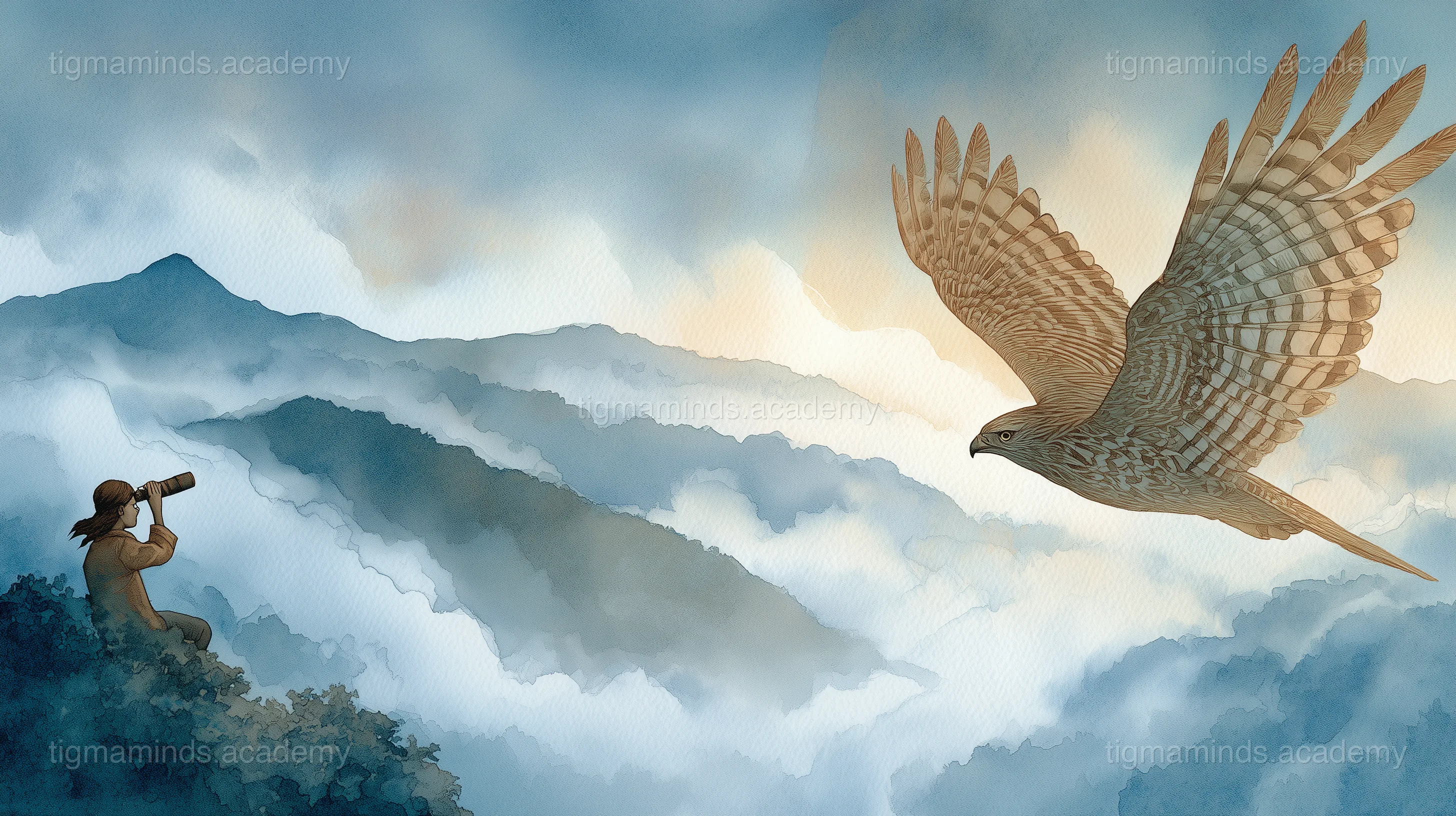
A girl named Lalbiakzuali — everyone called her Zuali — lived in the village of Thaltlang, the highest town in Mizoram, perched on a ridge just below Phawngpui. From her schoolroom window, she could watch the hawks.

They were Jerdon's Bazas — medium-sized raptors with crested heads and barred underparts. They spent most of the day soaring above the ridgeline, almost never flapping their wings. They just hung in the air, motionless, as if gravity had forgotten about them.

"How do they do it?" Zuali asked her science teacher, Pu Lalrinawma. "They don't flap. They barely move. But they don't fall."

"They're not fighting gravity," said Pu Lalrinawma. "They're using it. Come — I'll show you."

The Invisible River

Pu Lalrinawma took Zuali to the ridge on a sunny afternoon. He picked up a handful of dry leaves and tossed them off the cliff. Instead of falling straight down, the leaves shot upward, tumbling high above the ridge before drifting away.

"The sun heats the rock face," he explained. "The rock heats the air touching it. Hot air is less dense than cold air, so it rises. This rising column of warm air is called a thermal. The hawks ride the thermals like an elevator."

Zuali watched. Sure enough, the hawks were circling in tight spirals directly above the sunlit rock face — where the thermal was strongest. They circled upward without a single wing beat, climbing hundreds of metres on nothing but warm air.

"But thermals go straight up," said Zuali. "How do the hawks travel sideways? I've seen them fly across the entire valley without flapping."

Ridge Lift

Pu Lalrinawma pointed to the ridge itself. "When wind hits a mountain ridge, it has nowhere to go but up. The air is forced over the top, creating a band of rising air along the entire length of the ridge. This is called ridge lift, and it's even more reliable than thermals because it works whenever the wind blows."

He drew a diagram in his notebook: wind approaching a ridge as horizontal arrows, then curving upward as they hit the slope, creating a region of rising air just in front of and above the ridgeline.

"The hawks fly back and forth along the ridge, staying inside this band of rising air. As long as the wind blows, they never need to flap. They can patrol the entire ridge — kilometres — using zero muscular energy."

Zuali was amazed. "So the wind does all the work?"

"Gravity does the work of pulling the bird down. The rising air does the work of pushing it back up. The bird just balances the two. It's the same principle as a surfer riding a wave — the wave does the work, the surfer just steers."

Glide Ratio

The next Saturday, Pu Lalrinawma brought Zuali back to the ridge with a notebook and a pair of binoculars. "Today," he said, "we're going to measure a hawk's glide ratio."

He explained: when a bird glides in still air (no thermals, no ridge lift), it slowly loses altitude. The glide ratio is the distance it travels forward divided by the altitude it loses. A ratio of 10:1 means the bird moves 10 metres forward for every 1 metre it drops.

"A sparrow has a glide ratio of about 4:1 — it drops fast. An albatross has about 20:1 — it barely drops at all. A hawk falls somewhere in between, maybe 10:1 to 15:1."

They watched a Jerdon's Baza leave a thermal and glide across a gap between two ridges. Using landmarks to estimate distance and the height difference between the two ridges, they calculated:

Distance forward: approximately 800 metres Altitude lost: approximately 60 metres Glide ratio: 800 ÷ 60 ≈ 13:1

"That means the hawk moves 13 metres forward for every 1 metre it sinks," said Zuali. "So if a thermal lifts it 300 metres, it can glide 300 × 13 = 3,900 metres — nearly 4 kilometres — before it needs another thermal."

"Now you understand how they cross the valley without flapping," said Pu Lalrinawma.

The Shape of Soaring

Zuali noticed that the hawks' wings were broad and had "fingers" — separate feathers splayed at the tips, like a spread hand. She asked why.

"Those are called slotted wing tips," said Pu Lalrinawma. "Each finger-feather creates a tiny vortex of air at the tip. These vortices reduce a phenomenon called induced drag — the drag created by lift itself. Less drag means a better glide ratio."

He showed her a picture of a modern airplane winglet — the upward-curved tip on the wing of a Boeing 737. "Aircraft engineers copied this from hawks and eagles. It's called biomimicry — designing technology by imitating nature. Those winglets save airlines millions of litres of fuel every year."

Zuali looked up at the hawks spiralling above Phawngpui. She had always thought of flying as something birds did with muscles — beating wings, pushing air. But these hawks flew with physics. They read the invisible architecture of the atmosphere — thermals, ridge lift, wind gradients — and navigated it with precision.

No engine. No fuel. Just understanding the air.

"I want to design gliders," said Zuali.

Pu Lalrinawma smiled. "Start by watching the hawks. They've been designing gliders for 50 million years."

The end.

Try It Yourself

Choose your level. Everyone starts with the story — the code gets deeper as you go.

Story Progress

0%

Ready to Start Coding?

Here is a taste of what Level 1 looks like for this lesson:

Level 1: Explorer — Python
# Hawk Soaring Range Calculator
altitude = 400     # metres gained in thermal
glide_ratio = 13   # metres forward per metre dropped

max_range = altitude * glide_ratio
print(f"Altitude: {altitude}m")
print(f"Glide ratio: {glide_ratio}:1")
print(f"Max range: {max_range}m ({max_range/1000:.1f} km)")

# Can the hawk reach prey 3km away?
prey_dist = 3000
if max_range >= prey_dist:
    surplus = max_range - prey_dist
    print(f"Yes! Arrives with {surplus}m of range to spare")
else:
    deficit = prey_dist - max_range
    print(f"No — needs {deficit}m more altitude")

This is just the first of 6 coding exercises in Level 1. By Level 4, you will build: Build a Soaring Flight Simulator.

Free

Level 0: Listener

Stories, science concepts, diagrams, quizzes. No coding.

You are here

Enrolled

Levels 1-4

Python, NumPy, Matplotlib, real projects, mentorship.

Sign Up Free

Stay Updated

Join Waitlist

Get notified when enrollment opens for your area.

Notify Me

Level 0 is always free. Coding levels (1-4) are part of our 12-Month Curriculum.