The Building of the Pyramids
Geometry, Mechanics & Logistics

The Building of the Pyramids

Geometry, ramp physics, and the logistics of moving 2.3 million stone blocks.
Geometry, Mechanics & Logistics12-Month Curriculum 12h

The Story

The Foreman's Count

Around 2560 BCE, a quarry foreman named Meryre stood in the limestone quarries at Tura, on the east bank of the Nile, and did the arithmetic.

The Great Pyramid of Pharaoh Khufu would contain 2.3 million blocks of stone. Each block weighed between 2 and 15 tonnes. The Pharaoh wanted it finished in 20 years.

Meryre picked up his reed pen and did the calculation that every engineer since has verified:

2,300,000 blocks ÷ 20 years ÷ 365 days = 315 blocks per day.

Every single day, for twenty years, his quarry teams and the workers at Giza would need to cut, transport, and place one block every five minutes during a twelve-hour working day.

Meryre looked at the number. He looked at the river. He looked at the distant plateau where the pyramid would stand. Then he called his team leaders together.

"We're going to need a system," he said.

Not Slaves — Engineers

The old myth says the pyramids were built by slaves. This is wrong. Archaeological evidence from the workers' village at Giza — discovered in 1990 — tells a different story.

The builders were skilled workers and conscripted labourers — Egyptian farmers who worked on the pyramid during the Inundation, the annual Nile flood that covered their fields for three months and left them with nothing to farm. They were organized into crews of about 2,000, each divided into named gangs ("Friends of Khufu", "Drunkards of Menkaure") that competed against each other.

They ate beef, bread, and beer — a diet better than most Egyptians could afford. They received medical care: skeletons found in the workers' cemetery show healed bones, amputations with clean cuts, and even evidence of brain surgery. When workers died, they were buried in their own tombs near the pyramid — an honour that would never be given to slaves.

This was a national project, not a slave operation. And it was managed with an efficiency that modern logistics companies study.

The Quarry

Most of the pyramid's stone came from quarries less than a kilometre from the building site — the Giza plateau is itself a massive limestone formation. Workers cut blocks by hammering wooden wedges into channels chiselled in the rock face, then soaking the wedges with water. Wood expands when wet. The expansion force — several tonnes per square centimetre — split the rock along clean, predictable planes.

The outer casing stones — the smooth, white limestone that originally covered the entire pyramid and made it gleam in the sunlight — came from the Tura quarries across the Nile. These were floated across the river on barges during the Inundation, when the floodwaters brought the river level almost to the base of the plateau.

The granite for the internal chambers came from Aswan, 800 kilometres upstream. These blocks — some weighing 80 tonnes — were transported on massive barges during the flood season, riding the high water downstream.

Moving the Blocks

How do you move a 2.5-tonne block of limestone without wheels, pulleys, or draft animals?

The answer was discovered in a painting in the tomb of Djehutihotep (circa 1900 BCE), which shows workers dragging a colossal statue on a sledge while one man stands at the front pouring water on the sand ahead of the sledge.

In 2014, physicists at the University of Amsterdam proved that this worked. Dry sand piles up in front of a sledge, creating resistance. But when the sand is wet to the right proportion — about 2-5% water by volume — the grains lock together and the surface becomes firm and slippery. The friction force drops by 50%.

This means a team of 20 men could drag a 2.5-tonne block on a wet-sand path — a task that would require 40 men on dry sand. Over millions of blocks, that water reduced the total workforce by half.

The Ramp Question

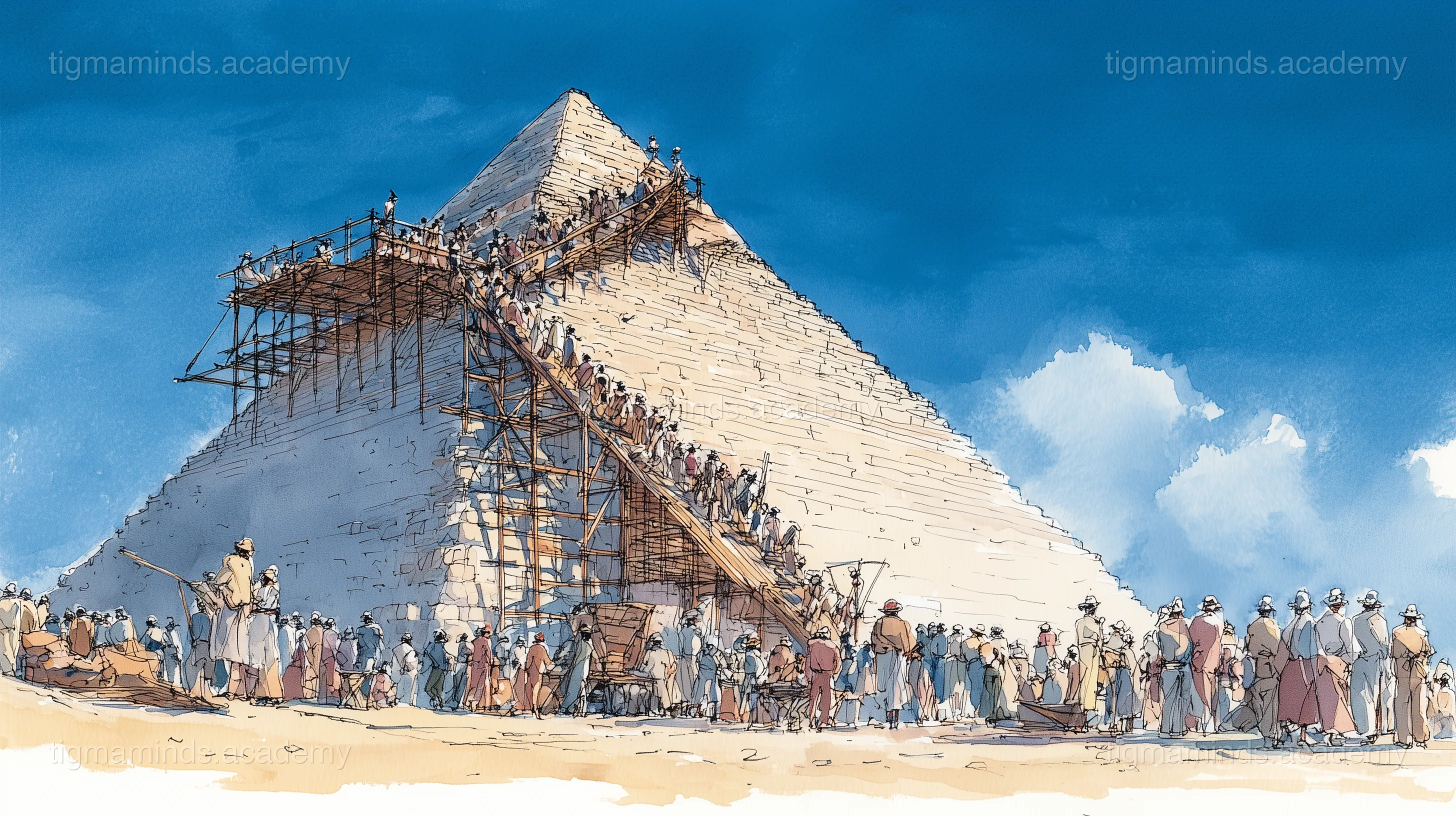
The blocks were cut. They were dragged to the site. But now they needed to go up.

The Great Pyramid is 146 metres tall — the height of a 48-storey building. How do you raise 2.3 million blocks to heights like that?

The most widely accepted theory today is the internal ramp theory, proposed by French architect Jean-Pierre Houdin in 2007. Instead of building a massive external ramp (which would require almost as much material as the pyramid itself), Houdin proposed that the builders used a spiral ramp inside the pyramid, just beneath the outer surface.

The physics of ramps is straightforward: a ramp is an inclined plane, one of the six simple machines. It trades distance for force. A ramp with a 7% grade (the maximum slope a team of men can haul a heavy load up) means that to raise a block 1 metre vertically, you must drag it approximately 14 metres along the ramp.

For the Great Pyramid, this means the internal ramp would have been approximately 1.6 kilometres long, spiralling up inside the pyramid. Each block would have been dragged along this ramp, around the corners (using a rotating platform at each turn), and placed from the inside.

The Astronomical Alignment

The Great Pyramid is aligned to true north with an error of 3/60 of a degree — an accuracy that is almost impossible to achieve without modern instruments.

The Egyptians did it using stars. The method, demonstrated by astronomer Kate Spence in 2000, uses two stars in the northern sky — Kochab (in Ursa Minor) and Mizar (in Ursa Major). In 2467 BCE, when the Great Pyramid was being aligned, these two stars were equidistant from the celestial pole. A vertical line through both stars pointed to true north.

By hanging a plumb line and aligning it with these two stars simultaneously, the Egyptian surveyors could establish a north-south line on the ground with extraordinary precision. The entire pyramid — all 230 metres of each base side — was then squared from this line using nothing more than ropes, pegs, and the Pythagorean theorem (which the Egyptians knew, a thousand years before Pythagoras).

The Shape

Why a pyramid? Why not a cube, or a dome, or a tower?

The answer is the square-cube law. When you scale up a structure, its volume (and therefore its weight) increases as the cube of the scaling factor, but the area of its base (which supports that weight) increases only as the square. This means tall, narrow structures become unstable — they crush their own foundations.

A pyramid solves this problem elegantly. Its weight is distributed over a wide base, and each successive layer is smaller than the one below it. The compressive stress at any point in the pyramid is well within the strength of limestone. The shape is inherently stable — it's one of the few shapes that can be scaled up almost indefinitely without failing.

Meryre's Legacy

The Great Pyramid was completed in approximately 20 years, right on schedule. It stood 146 metres tall, weighed 6 million tonnes, and was the tallest man-made structure on Earth for 3,800 years — until Lincoln Cathedral surpassed it in 1311 CE.

Meryre and his quarry teams cut and delivered their 315 blocks per day, every day, for two decades. They did it without wheels, without iron tools, without pulleys, without cranes. They did it with copper chisels, wooden sledges, wet sand, ramps, ropes, and the most underrated engineering tool of all: organisation.

The Great Pyramid is not a mystery. It is a logistics problem, solved with extraordinary competence by people who understood materials, forces, and mathematics — four thousand five hundred years ago.

The end.

Try It Yourself

Choose your level. Everyone starts with the story — the code gets deeper as you go.

Story Progress

0%

Ready to Start Coding?

Here is a taste of what Level 1 looks like for this lesson:

Level 1: Explorer — Python
import numpy as np
import matplotlib.pyplot as plt

# Your first data analysis with Python
data = [45, 52, 38, 67, 41, 55, 48]  # measurements
mean = np.mean(data)

plt.bar(range(len(data)), data)
plt.axhline(mean, color='red', linestyle='--', label=f'Mean: {mean:.1f}')
plt.xlabel("Sample")
plt.ylabel("Value")
plt.title("Geometry, Mechanics & Logistics — Sample Data")
plt.legend()
plt.show()

This is just the first of 6 coding exercises in Level 1. By Level 4, you will build: Build a Pyramid Construction Planner.

Free

Level 0: Listener

Stories, science concepts, diagrams, quizzes. No coding.

You are here

Enrolled

Levels 1-4

Python, NumPy, Matplotlib, real projects, mentorship.

Sign Up Free

Stay Updated

Join Waitlist

Get notified when enrollment opens for your area.

Notify Me

Level 0 is always free. Coding levels (1-4) are part of our 12-Month Curriculum.