The Woodpecker's Drum
Biomechanics & Skull Design

The Woodpecker's Drum

Drumming without brain damage — impact biomechanics.
Biomechanics & Skull Design12-Month Curriculum 12h

The Story

The Idea

It was the barking deer who had the idea. He had been listening to the sounds of the forest in Manas National Park — the whoops of gibbons, the trills of sunbirds, the rumble of elephants — and one morning he said, "We should put all these sounds together. We should have a concert."

The animals were excited. Everyone wanted to perform. The hoolock gibbon volunteered to sing — his whooping call could carry across five kilometres of forest. The cicadas offered their buzzing chorus. The elephants would provide the bass with their deep rumbles. The frogs of the marshland promised a rhythm section of croaks and chirps.

"But who will keep the beat?" asked the old langur, who had once watched humans play drums at a village festival. "Music without a beat is just noise."

The Audition

Several animals tried. The elephant stomped his foot, but the ground shook so much that the frogs bounced out of their puddles. The barking deer barked rhythmically, but his bark was too sharp and made the birds flinch. The wild boar tried tapping a hollow log with his snout, but he kept getting distracted by grubs inside it.

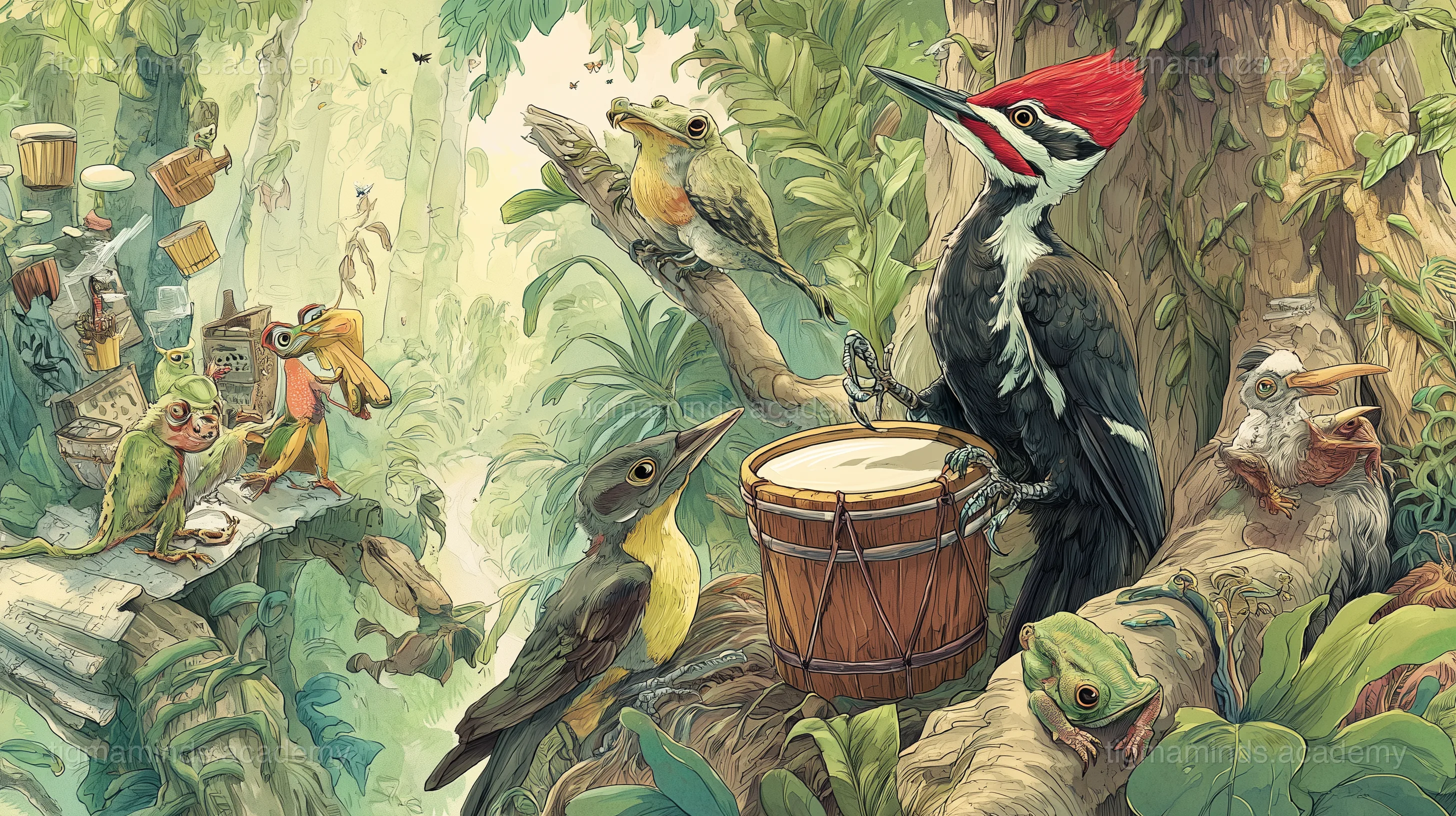
Then, from high in a sal tree, came a sound: tak-tak-tak-tak-tak. Steady. Precise. Musical. Everyone looked up.

A greater flameback woodpecker — golden-backed, red-crested, magnificent — was drumming on a dead branch. His beak struck the wood in a perfect rhythm, fast enough to sound like a drumroll, steady enough to march to.

"That's it!" cried the langur. "That's the beat we need!"

Rehearsal in the Canopy

The woodpecker, whose name was Thoka, was flattered but nervous. "I just drum to find insects," he said. "I've never played for an audience."

"You've been playing for the whole forest every day," said the langur. "You just didn't know we were listening."

The rehearsals began. Thoka drummed a steady tak-tak-tak on the sal tree. The gibbons timed their whoops to his beat. The cicadas buzzed in between. The frogs filled the gaps with short, sharp chirps. The elephants rumbled on the downbeat, like a bass drum at the bottom of an orchestra.

It was rough at first. The gibbons came in too early. The frogs couldn't agree on which croak to use. The elephants rumbled too loud and drowned everyone out. But Thoka kept drumming, steady and patient, and one by one the other animals found their place in the rhythm.

The Concert

On the night of the full moon, the animals of Manas gathered in a forest clearing. The moon hung low and golden, casting long shadows through the sal and teak trees. Fireflies drifted like floating candles.

Thoka began. Tak-tak-tak-tak-tak. The rhythm filled the clearing, steady as a heartbeat. Then the frogs joined — croak-croak, chirp. Then the cicadas — a rising buzz that swelled and faded. Then the gibbons — long, soaring whoops that sailed over the treetops like songs from another world.

And beneath it all, the elephants rumbled — a sound so deep you felt it in your bones rather than heard it in your ears.

The forest concert lasted until dawn. No one clapped — animals don't clap — but the silence that followed was the deepest, most respectful silence the forest had ever known.

The Drummer's Gift

After that night, the animals of Manas held a concert every full moon. And every time, Thoka the woodpecker started it. He was never the loudest, never the most melodic, never the most spectacular. But without his steady drumming, the music fell apart. He was the heartbeat of the forest — the one who kept everyone together.

If you visit Manas National Park and listen carefully, you'll hear Thoka's descendants drumming in the sal trees. Tak-tak-tak-tak-tak. It sounds like a bird looking for insects. But the animals know better. It's the drummer warming up, keeping the beat, holding the forest together — one steady tap at a time.

The end.

Try It Yourself

Choose your level. Everyone starts with the story — the code gets deeper as you go.

Story Progress

0%

Ready to Start Coding?

Here is a taste of what Level 1 looks like for this lesson:

Level 1: Explorer — Python
# How much force does a woodpecker's brain feel?
# Compare woodpecker vs human using F = ma

g = 9.8  # m/s² (Earth's gravity)

# Woodpecker stats
wp_brain_kg = 0.002     # 2 grams
wp_g_force = 1200       # g's per peck
wp_force = wp_brain_kg * wp_g_force * g

# Human stats
hu_brain_kg = 1.4       # 1,400 grams
hu_concussion_g = 100   # g's for concussion
hu_force = hu_brain_kg * hu_concussion_g * g

print(f"Woodpecker brain force: {wp_force:.1f} N")
print(f"  (like holding {wp_force/g:.0f} apples)")
print(f"Human concussion force: {hu_force:.1f} N")
print(f"  (like a {hu_force/g:.0f} kg weight on your head)")
print(f"\nWoodpecker handles {wp_g_force/hu_concussion_g:.0f}x")
print(f"more g-force but feels {hu_force/wp_force:.0f}x less force!")

This is just the first of 6 coding exercises in Level 1. By Level 4, you will build: Model Woodpecker Impact Forces.

By Level 4, enrolled students build: Model Woodpecker Impact Forces

Free

Level 0: Listener

Stories, science concepts, diagrams, quizzes. No coding.

You are here

Enrolled

Levels 1-4

Python, NumPy, Matplotlib, real projects, mentorship.

Sign Up Free

Stay Updated

Join Waitlist

Get notified when enrollment opens for your area.

Notify Me

Level 0 is always free. Coding levels (1-4) are part of our 12-Month Curriculum.