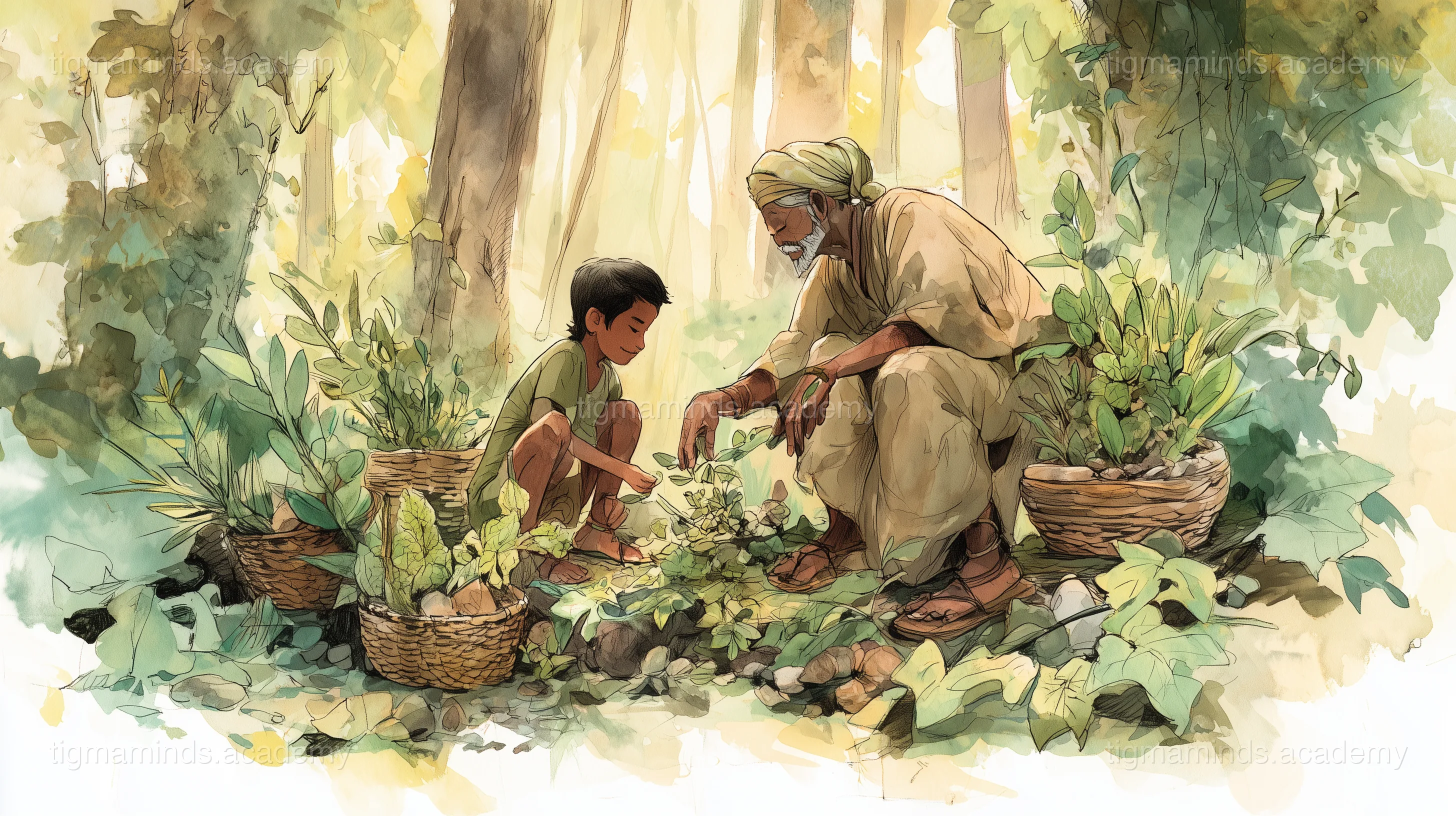
Medicinal plants and pharmacology.
The Boy Who Was Always Sick
In a Tiwa village perched on a misty hill in central Assam, there lived a boy named Hambir who caught every illness the seasons could throw at him. Monsoon fevers. Winter coughs. Spring allergies that made his eyes water like tiny rivers. The other children ran and climbed and swam; Hambir sat on the veranda with a blanket around his shoulders, sneezing.
“Take him to Oja Mahir,” the neighbours told his mother. “The old healer knows things the hospital doesn’t.”
Oja Mahir lived at the edge of the village, in a bamboo house surrounded by a garden that looked more like a forest. Plants grew everywhere — on the ground, up the walls, hanging from the roof, spilling out of pots made from hollowed logs. The air smelled of ginger and basil and something sharp that made Hambir’s nose tingle.
The First Lesson
“So you’re the boy who is always sick,” said Oja Mahir, peering at Hambir through eyebrows thick as caterpillars. He was very old — so old that nobody knew his exact age — but his hands were steady and his eyes were bright.
“Can you cure me?” asked Hambir.
“I can do better,” said the old healer. “I can teach you to cure yourself. But it will take time. You will have to come here every morning and learn.”
Hambir’s mother agreed. And so, every morning at dawn, Hambir walked to the healer’s garden and began his education in the pharmacy of the forest.
The first lesson was simple. Oja Mahir pointed to a plant with broad, fuzzy leaves. “This is manimuni,” he said. “People of Assam have used it for centuries. Eat two leaves every morning and your memory will sharpen. It also heals wounds.”
“How does a plant heal a wound?” asked Hambir.
“How does your body grow taller?” the healer replied. “Some things work without needing to explain themselves.”
The Forest Pharmacy
Over the following weeks, Hambir learned the names and uses of dozens of plants. Neem leaves for skin infections. Tulsi tea for colds. Turmeric paste for inflammation. Bael fruit for stomach troubles. Black pepper and honey for stubborn coughs that refused to leave.
But Oja Mahir taught more than recipes. He taught Hambir to observe. “Watch the animals,” he said. “When a wild elephant has a stomach ache, she eats clay from the riverbank. When a monkey has a fever, he chews neem bark. The animals were the first doctors. We Tiwa people learned from them.”
Hambir began keeping a notebook. He drew each plant carefully, writing its Tiwa name, its uses, and where to find it. The notebook grew thick. His sneezes grew fewer.
The Test
One rainy afternoon, a child from the neighbouring village arrived at Oja Mahir’s door, crying. Her little brother had stepped on a thorn and the wound had turned angry and red.
Oja Mahir looked at Hambir. “What would you do?”
Hambir’s heart raced, but his hands were steady — the healer’s hands. He cleaned the wound with boiled water and turmeric. He crushed fresh manimuni leaves into a paste and applied it as a poultice. He wrapped the foot in a clean banana leaf and told the girl to change the dressing every morning.
Three days later, the wound was healing cleanly. The girl’s family brought Oja Mahir a basket of oranges in thanks. The old healer passed the basket to Hambir.
“You earned these,” he said.
The Apprentice Becomes the Keeper
Hambir wasn’t always sick anymore. The daily walks, the fresh herbs, the knowledge of what his body needed — all of it had made him strong. But more than that, he had found his purpose.
When Oja Mahir was too old to tend his garden, Hambir took over. He expanded it, planting new species he found on forest walks, labelling each one in Tiwa and English. He became the village’s young healer — not a replacement for modern medicine, but a keeper of the old knowledge that the forests had been offering for free all along.
“Plants are the original pharmacy,” Hambir would tell the children who visited his garden. “They were here before pills, before hospitals, before doctors with degrees. They don’t charge money. They just grow, and heal, and ask nothing in return.”
The end.
Choose your level. Everyone starts with the story — the code gets deeper as you go.
Here is a taste of what Level 1 looks like for this lesson:
import numpy as np
import matplotlib.pyplot as plt
# Your first data analysis with Python
data = [45, 52, 38, 67, 41, 55, 48] # measurements
mean = np.mean(data)
plt.bar(range(len(data)), data)
plt.axhline(mean, color='red', linestyle='--', label=f'Mean: {mean:.1f}')
plt.xlabel("Sample")
plt.ylabel("Value")
plt.title("Medicinal Plants — Sample Data")
plt.legend()
plt.show()This is just the first of 6 coding exercises in Level 1. By Level 4, you will build: Research Plants That Became Medicines.
Free
Level 0: Listener
Stories, science concepts, diagrams, quizzes. No coding.
You are here
Level 0 is always free. Coding levels (1-4) are part of our 12-Month Curriculum.
Medicinal plants and pharmacology.
The big idea: "The Witch Doctor's Apprentice" teaches us about Medicinal Plants — and you don't need to write a single line of code to understand it.
Plants cannot run from herbivores, so they evolved chemical warfare. Phytochemicals are secondary metabolites — molecules not essential for basic growth and reproduction but critical for defense, signaling, and competition. They include alkaloids (caffeine, morphine, nicotine), terpenes (menthol, camphor), phenolics (tannins, flavonoids), and glycosides (digitalis from foxglove).
These molecules are "secondary" only in name — they are ecologically primary. Alkaloids taste bitter and are often toxic, deterring herbivores. Tannins bind to proteins in an herbivore's gut, reducing nutrient absorption. Volatile terpenes attract pollinators or repel insects. Some phenolics absorb UV radiation, protecting plant DNA from sun damage. Each phytochemical is a solution to a specific ecological problem.
The forests of Northeast India are extraordinarily rich in phytochemical diversity because they sit within the Indo-Burma biodiversity hotspot, where high species diversity drives an evolutionary arms race between plants and herbivores. More herbivore species means more diverse chemical defenses, which means more potential medicines. This is why traditional healers in the region have such extensive pharmacopeias — they are drawing from one of the richest chemical libraries on Earth.
Key idea: Plants produce phytochemicals as chemical weapons against herbivores and pathogens — these defensive molecules are the raw material for most traditional medicines and many modern drugs.
Roughly 25% of all modern pharmaceuticals are derived from or inspired by plant compounds. Aspirin comes from willow bark (salicylic acid). The cancer drug taxol comes from Pacific yew bark. The malaria treatment artemisinin comes from sweet wormwood (Artemisia annua), used in Chinese traditional medicine for over 2,000 years. The heart drug digoxin comes from foxglove, known to European herbalists for centuries.
Modern drug discovery from plants follows a pipeline: ethnobotanical survey (documenting which plants traditional healers use and for what), extraction (isolating chemical fractions from the plant), bioassay (testing each fraction for biological activity against a target disease), identification (determining the molecular structure of active compounds using mass spectrometry and NMR), and optimization (modifying the molecule to improve potency, reduce side effects, or make it easier to synthesize).
This pipeline is expensive and slow — typically 10–15 years and over $1 billion from plant collection to approved drug. Only about 15% of the world's estimated 300,000 plant species have been investigated for medicinal chemistry. Northeast India alone has over 3,000 species used in traditional medicine, the vast majority never screened by modern methods. Each species that goes extinct before investigation is a library book burned before reading.
Key idea: About 25% of modern drugs come from plants — the drug discovery pipeline goes from traditional knowledge to chemical isolation to clinical testing, and most of the world's medicinal plants have never been scientifically investigated.
Access all 130+ lessons, quizzes, interactive tools, and offline activities
Traditional medicine is sometimes dismissed as unscientific, but it represents an enormous body of **empirical knowledge** accumulated through centuri...
freq = 45, pulse_rate = 2 → DANGER