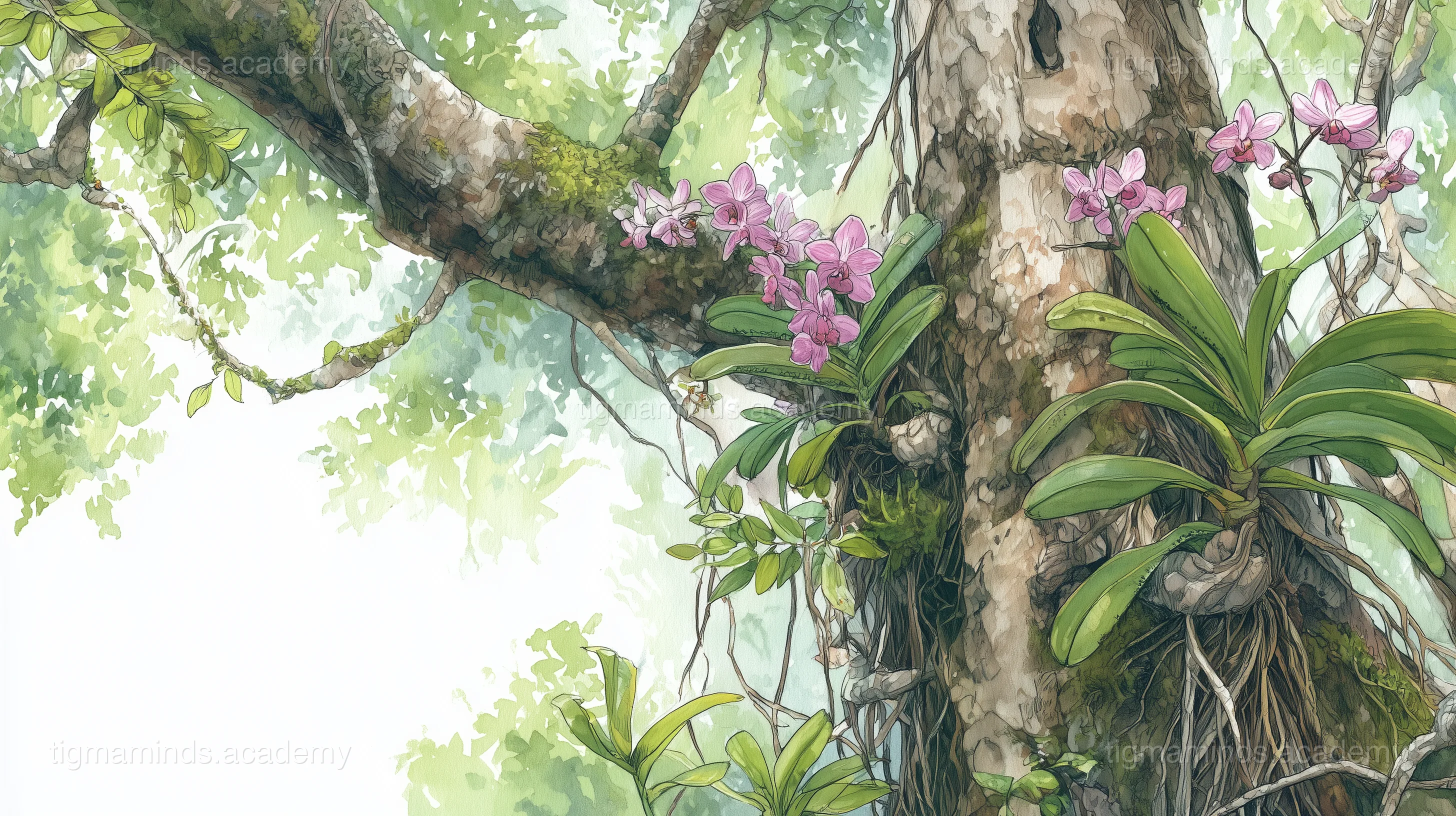
Epiphytes and symbiosis.
The Flower That Had No Home
Long ago, in the misty forests of Meghalaya, every flower had a home. Roses lived in gardens. Lotuses lived in ponds. Sunflowers lived in open fields where the sun could find them. But the orchid had no home at all.
She was a beautiful flower — delicate purple petals, a lip shaped like a tiny slipper, and a scent so faint you had to lean in close to smell it. But she had no roots strong enough to grip the earth, and every time she tried to plant herself in the ground, the monsoon rains washed her away.
"I need a home," said the orchid, tumbling down a hillside for the third time that week. "But the ground doesn't want me."
The Offer from the Vine
A climbing vine overheard the orchid's troubles. "Come live on me!" said the vine. "I wrap around everything — fences, walls, other plants. You can cling to me and I'll carry you upward."
The orchid tried. She wrapped her thin roots around the vine and held on. But the vine grew fast and wild, twisting and squeezing. Within a week, the orchid felt crushed.
"You're growing too fast," gasped the orchid. "I can't breathe."
"That's how I grow," said the vine. "I take what I need. If you can't keep up, that's your problem."
The orchid let go and drifted away on the wind.
The Tree's Invitation
A great hollong tree — one of the tallest trees in the Northeast — watched the orchid floating past and said, gently, "Little flower, why are you crying?"
"I have no home," said the orchid. "The ground is too wet, the vine is too rough, and I am too small to stand alone."
The hollong tree stretched out a broad branch. "Sit here," he said. "There is sunlight up here, and mist for moisture, and my bark is rough enough for your roots to grip. You are welcome to stay as long as you like."
"But won't I hurt you?" asked the orchid. "Won't my roots steal your food?"
The hollong tree laughed — a deep, creaking laugh that shook his highest leaves. "Your roots don't reach my heartwood. You sit on my surface, catching rain and mist and air. You take nothing from me. You are not a parasite — you are a guest."
Growing Without Taking
The orchid settled onto the hollong tree's branch. She wrapped her silvery roots around the bark — not digging in, not stealing sap, just holding on. She drank from the mist. She ate from the air. She made her own food from sunlight, the way all green things do.
And she bloomed. Purple and white and gold, high above the forest floor, where butterflies and sunbirds could find her. Other orchids saw her and floated up to join her — on oak trees, on magnolias, on the sacred fig trees near the village.
Soon the forest was decorated with orchids, each one perched on a branch like a jewel on a crown. Not one tree complained, because not one orchid took more than she needed.
The Lesson in the Canopy
The people of Assam and the hills of the Northeast have always loved orchids. They call them kopou phool in Assam, and wear them during Rongali Bihu as a sign of beauty and grace. But the orchid's truest beauty is not in her petals — it is in the way she lives.
She grows on others without burdening them. She rises high without pushing anyone down. She blooms brilliantly without stealing anyone else's light. She proves that you can grow — tall and beautiful and strong — without taking a single thing that isn't freely given.
Next time you see a wild orchid clinging to a tree branch in the forests of Northeast India, remember: she is not a thief. She is a guest. And the tree is happy to have her.
The end.
Choose your level. Everyone starts with the story — the code gets deeper as you go.
Here is a taste of what Level 1 looks like for this lesson:
# Map epiphyte distribution on a tree
import matplotlib.pyplot as plt
# Data from a tree survey
heights = [0.5, 1.0, 1.5, 2.0, 3.0, 4.0, 5.0, 6.0, 8.0]
species_count = [2, 3, 5, 8, 12, 15, 11, 7, 3]
plt.figure(figsize=(8, 6))
plt.barh(heights, species_count, height=0.4,
color='#d946ef', alpha=0.7)
plt.ylabel('Height on tree (m)')
plt.xlabel('Number of epiphyte species')
plt.title('Vertical Distribution of Epiphytes')
plt.show() # Where is the sweet spot?This is just the first of 6 coding exercises in Level 1. By Level 4, you will build: Survey Epiphytes in Your Local Area.
Free
Level 0: Listener
Stories, science concepts, diagrams, quizzes. No coding.
You are here
Level 0 is always free. Coding levels (1-4) are part of our 12-Month Curriculum.
Epiphytes and symbiosis.
The big idea: "Why Wild Orchids Grow on Trees" teaches us about Epiphytes & Symbiosis — and you don't need to write a single line of code to understand it.
The story tells us the orchid is "not a thief but a guest." Let’s test that claim with biology. An epiphyte is a plant that grows on another plant purely for physical support — like sitting on a chair. The chair holds your weight but you do not eat the chair. A parasite, by contrast, actively steals nutrients from the host — like a tick feeding on blood.
Orchid roots look alarming — silvery tendrils gripping the bark. But look closely: they do NOT penetrate the bark. They wrap around it for grip, and their outer layer — the velamen — is a sponge made of dead cells that absorbs water from rain, mist, and humid air in less than one second. The orchid makes its own food via photosynthesis, just like any green plant. It takes nothing from the tree.
Check yourself: Mistletoe also grows on trees. But mistletoe sends root-like structures called haustoria INTO the tree’s vascular tissue to steal water and sugar. Is mistletoe an epiphyte or a parasite? (Answer: parasite.) Can you explain the difference in one sentence before reading on?
Key idea: Epiphytes like orchids use trees only as platforms — their roots grip without penetrating, and velamen absorbs water from the air. Parasites like mistletoe penetrate the host and steal nutrients. The key test: does it tap the sap?
Below the forest floor, a hidden internet runs through the soil. Mycorrhizal fungi form threadlike networks called hyphae that connect tree roots to each other and to surrounding plants. The deal is simple mutualism: the fungus delivers water and minerals (especially phosphorus) that its fine threads can reach far better than roots; the tree delivers sugar from photosynthesis. Both partners benefit.
Orchids are the most extreme users of this network. Their seeds are dust-like specks weighing as little as 0.05 mg — they contain almost zero stored food. When an orchid seed lands on bark or soil, it cannot germinate without a compatible fungal partner. The fungus feeds the tiny seedling until it grows leaves and can photosynthesize. Some orchid species never develop chlorophyll at all — they parasitize the fungal network their entire lives.
Predict before you read: If you cut down the largest tree in a forest, what happens to the seedlings growing in its shade? Through the mycorrhizal network, that big tree was actually feeding sugar to those shaded seedlings. Remove the tree and you may kill the seedlings too — not by blocking light, but by cutting the underground food supply.
Key idea: Mycorrhizal fungi connect trees underground into a "Wood Wide Web" that shares nutrients and signals. Orchid seeds cannot germinate without these fungal partners — the forest is far more interconnected below ground than above.
Access all 130+ lessons, quizzes, interactive tools, and offline activities
**Symbiosis** means "living together," and it exists on a spectrum. At one end: **mutualism** (both benefit — fungus gets sugar, plant gets minerals)....
Orchids are the most species-rich family of flowering plants — approximately 28,000 species, about 10% of all flowering plants on Earth. Yet they are ...