Why the Muga Silk Is Golden
Biology & Materials Science

Why the Muga Silk Is Golden

The world's only golden silk comes from Assam. A folktale about generosity and the sun's gift.
Biology & Materials Science12-Month Curriculum 12h

Duration

3 sessions × 2 hours (6 hours total)

Track

12-Month Curriculum

Prerequisites

None

Materials

9 items needed

Learning Objectives

  • Describe the biology of silk production — from silkworm diet to protein extrusion
  • Explain why muga silk is golden at the molecular level (xanthurenic acid in fibroin)
  • Design and execute materials science experiments: tensile strength, water absorption, UV resistance
  • Compare natural and synthetic fibres using the scientific method and present findings in a formal report

Materials List

  • Fibre samples: cotton thread, nylon line, silk thread (any type), polyester thread
  • Microscope (40x minimum) or USB digital microscope
  • Glass slides and slide covers
  • Small weights (washers, coins, or a kitchen scale)
  • Ruler and clamp or binder clip for tensile testing
  • Small containers for water absorption test
  • UV lamp or access to direct sunlight
  • Lab notebook or printed worksheet
  • Optional: muga silk sample (available online from Assam weavers)

Prerequisites

No prior science lab experience required • Basic understanding of measurement (grams, centimeters) • Ability to follow a written procedure and record observations

The Story

The Grey Silk

Once, long before anyone can remember, all silk was grey. Every silkworm in every forest spun grey threads, and the weavers of Assam wove grey cloth, and everyone wore grey clothes that looked like fog.

"I wish our silk had colour," sighed a young weaver named Malini, sitting at her loom in Sualkuchi, the silk village by the river. "Even the river has more colour than our cloth."

The Silkworm's Journey

In the som tree above Malini's house lived a tiny silkworm named Muga. Muga was different from the other worms — she was curious, and she listened to humans.

"If Malini wants colour," thought Muga, "I will find some."

So Muga set off on a journey — the longest journey any silkworm had ever taken. She crawled from the som tree to the river, from the river to the tea gardens, from the tea gardens to the hills. She asked the green leaves for their colour, but the leaves said, "Our green fades in autumn." She asked the red flowers, but they said, "Our red wilts in a week."

She needed a colour that would never fade.

The Sun's Bargain

Muga crawled to the highest hill she could find and called out to the Sun.

"Sun!" she cried. "You are the only colour that never fades. Will you give me some of your gold?"

The Sun looked down and laughed warmly. "Little worm, I have been shining for a billion years and no one has ever asked me for a gift. What will you give me in return?"

"I am a silkworm," said Muga. "I have nothing but the thread I spin."

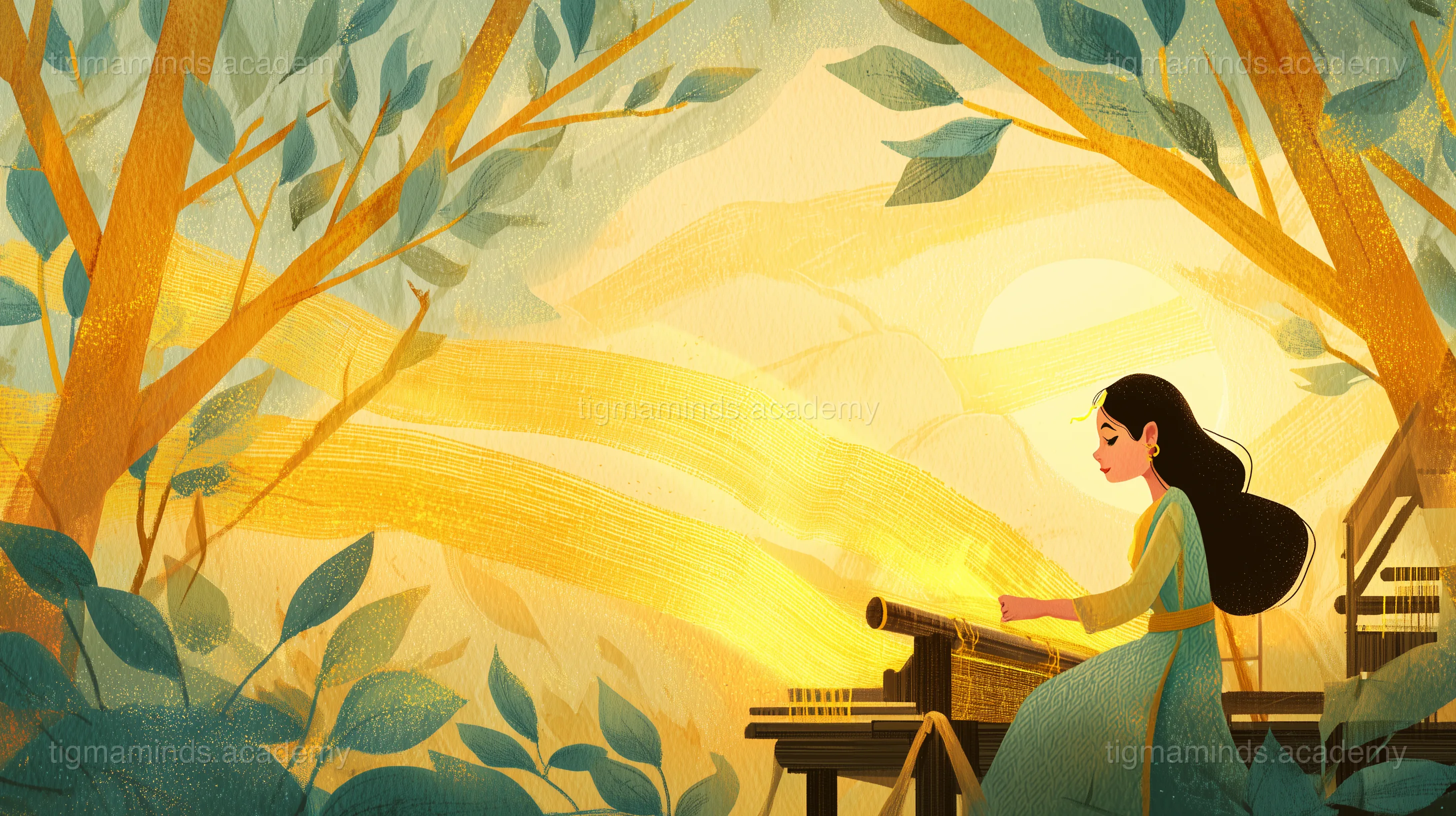
"Then spin me a scarf," said the Sun. "I get cold at night when I go below the horizon. Spin me a scarf, and I will dip your thread in my light."

The Golden Thread

Muga spun all night — the finest, softest thread she had ever made. She spun it long enough to wrap around the Sun's neck twice. When dawn came, the Sun reached down with a single golden ray and touched Muga's spinnerets.

From that moment, every thread Muga spun was golden — not painted gold, not dyed gold, but gold from the inside, as if sunlight itself had been woven into the fibre.

Muga crawled back to the som tree above Malini's house and began to spin her cocoon. When Malini unwound it, she gasped. The thread glowed like a tiny sunrise in her hands.

The Gift That Lasts

Malini wove the golden thread into a mekhela chador so beautiful that people came from every village to see it. And when they asked where the gold came from, Malini pointed to the little som tree and said, "From a silkworm who was brave enough to ask the Sun for a favour."

To this day, muga silk is found only in Assam — the only golden silk in the world. It never fades, never loses its shimmer, because the Sun's promise never expires. And if you hold a piece of muga silk up to the light, you can still see the sunshine trapped inside.

The end.

Try It Yourself

Choose your level. Everyone starts with the story — the code gets deeper as you go.

Story Progress

0%

Ready to Start Coding?

Here is a taste of what Level 1 looks like for this lesson:

Level 1: Explorer — Python
import numpy as np
import matplotlib.pyplot as plt

# Compare fibre properties
fibres = ["Muga Silk", "Mulberry Silk", "Cotton", "Nylon", "Spider Silk"]
strength = [500, 600, 400, 900, 1400]    # MPa
density  = [1.3, 1.3, 1.5, 1.1, 1.3]    # g/cm3

# Strength-to-weight ratio
specific = [s/d for s, d in zip(strength, density)]

plt.barh(fibres, specific, color=["#C8962E","#E5E7EB","#A3E635","#3B82F6","#EF4444"])
plt.xlabel("Specific Strength (MPa per g/cm3)")
plt.title("Which fibre is strongest for its weight?")
plt.show()  # Muga is strong AND golden AND biodegradable

This is just the first of 6 coding exercises in Level 1. By Level 4, you will build: Materials Science Investigation.

By Level 4, enrolled students build: Materials Science Investigation

Free

Level 0: Listener

Stories, science concepts, diagrams, quizzes. No coding.

You are here

Enrolled

Levels 1-4

Python, NumPy, Matplotlib, real projects, mentorship.

Sign Up Free

Stay Updated

Join Waitlist

Get notified when enrollment opens for your area.

Notify Me

Level 0 is always free. Coding levels (1-4) are part of our 12-Month Curriculum.