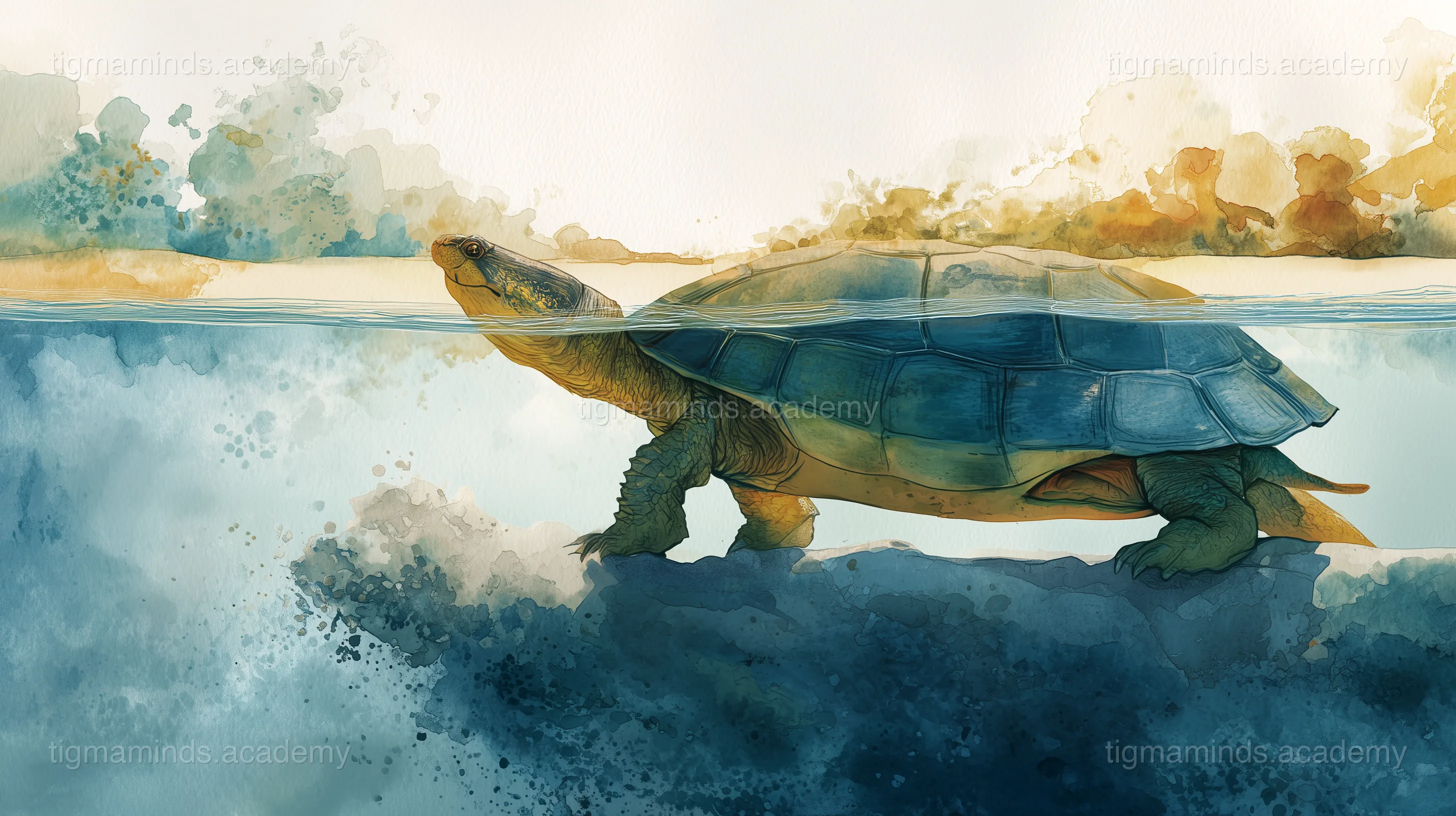
Evolution and body plan trade-offs.
The Speed Market
Long ago, before the world was fully made, there was a Speed Market on the banks of the Brahmaputra where every animal could buy speed. The market was run by the River Spirit, a shimmering figure made of mist and current, who measured out speed in little clay pots.
Each animal got ten pots of speed. They could spend them however they liked — all on land, all on water, or split between the two. But once spent, the pots were gone forever.
The deer spent all ten pots on land speed. “I live in the meadows,” she said. “I’ll never need to be fast in water.” The otter spent eight pots on water and two on land — a sensible split. The hare spent all ten on land and then tried to haggle for an eleventh. The River Spirit said no.
The Turtle’s Choice
A young Indian roofed turtle named Kachim sat at the edge of the market, staring at her ten pots for a very long time. She lived in the Brahmaputra — the mightiest river in the land — and she knew its dangers. Strong currents. Hungry crocodiles. Fishing nets that appeared without warning.
“I need to be fast in the water,” she said. “Very, very fast.”
She poured nine pots into water speed and only one into land speed.
“Are you sure?” asked the River Spirit. “One pot on land means you’ll be very slow. Walking to a new pond will take you all day.”
“I’m sure,” said Kachim. “The river is my home. That’s where I need my speed.”
The Crocodile Chase
The very next morning, Kachim’s choice was tested. A young gharial — long-snouted and fast — decided Kachim would make a fine breakfast. He lunged through the water, jaws snapping.
Kachim dove. She shot through the river like a green torpedo, her webbed feet churning, her shell cutting through the current with barely a ripple. She darted left, spun right, dove deep into a tangle of underwater roots where the gharial couldn’t follow.
The gharial gave up, bewildered. “Since when are turtles fast?” he grumbled.
“Since I spent my speed wisely,” Kachim called from her hiding spot.
The Long Walk
But speed has a price. When the monsoon flooded Kachim’s favourite stretch of river and she had to walk overland to a quiet beel, the journey was painfully slow. Step. Step. Step. The sun moved faster than she did. A snail passed her and gave a sympathetic look.
“You could have been faster on land,” said a mynah bird perched on a fence post. “Why didn’t you split your speed evenly?”
“Because I don’t live on land,” said Kachim, one slow step at a time. “I visit it. There’s a difference between where you live and where you visit. You invest your best in where you live.”
The mynah bird thought about that and flew away without an answer, because Kachim was right.
The Lesson of the River
Kachim reached the beel by sunset. She slid into the cool water and felt her speed return — smooth, effortless, joyful. She glided past sleeping fish, circled a sunken log, and settled into a warm patch of mud to rest.
And that is why, to this very day, turtles are slow on land but fast in water. They made a choice — a smart, deliberate choice — to put their strength where it matters most. The next time you see a turtle plodding slowly across a road, don’t feel sorry for her. She’s just visiting. Wait until she reaches the river, and then watch her fly.
The end.
Choose your level. Everyone starts with the story — the code gets deeper as you go.
Here is a taste of what Level 1 looks like for this lesson:
import numpy as np
import matplotlib.pyplot as plt
# Your first data analysis with Python
data = [45, 52, 38, 67, 41, 55, 48] # measurements
mean = np.mean(data)
plt.bar(range(len(data)), data)
plt.axhline(mean, color='red', linestyle='--', label=f'Mean: {mean:.1f}')
plt.xlabel("Sample")
plt.ylabel("Value")
plt.title("Evolution & Body Plans — Sample Data")
plt.legend()
plt.show()This is just the first of 6 coding exercises in Level 1. By Level 4, you will build: Model the Speed-vs-Armor Trade-Off in Evolution.
Free
Level 0: Listener
Stories, science concepts, diagrams, quizzes. No coding.
You are here
Level 0 is always free. Coding levels (1-4) are part of our 12-Month Curriculum.
Evolution and body plan trade-offs.
The big idea: "Why Turtles Are Slow on Land" teaches us about Evolution & Body Plans — and you don't need to write a single line of code to understand it.
Turtles are ectotherms — their body temperature is determined primarily by the environment rather than by internal heat production. This is not a weakness; it is an energy strategy. An ectotherm at 25 °C uses roughly one-tenth the energy (measured in calories per gram per hour) of an endotherm (warm-blooded animal) of the same size, because it does not burn food to maintain a constant high body temperature.
This low metabolic rate has profound consequences. Turtles need far less food: a turtle can survive on a fraction of the calories a similarly sized mammal requires. During cold periods, they can enter brumation (the reptile equivalent of hibernation), slowing metabolism to nearly undetectable levels. Some freshwater turtles survive winter frozen in pond mud, their heart beating once every few minutes, by switching to anaerobic metabolism and absorbing small amounts of oxygen through their skin.
The trade-off is speed and sustained activity. Muscles powered by a low metabolic rate produce less force per unit time, which means slower movement and shorter bursts of activity. A turtle cannot chase prey or flee predators quickly — instead, it relies on armor (the shell), camouflage, and patience. This is not an inferior strategy; it is a different one, optimized for energy efficiency rather than speed.
Key idea: Ectotherms like turtles use roughly one-tenth the energy of same-sized mammals — the trade-off is lower speed and activity capacity, compensated by armor and extreme energy efficiency.
In biology, a life history trade-off means that investing energy in one trait reduces energy available for another. Organisms face fundamental choices: grow fast or grow large? Reproduce early or invest in survival? Produce many small offspring or few large ones? These trade-offs are constrained by the total energy budget, which is set by metabolic rate.
Turtles exemplify the slow life history: late maturity (many species take 10–20 years to reach reproductive age), low annual reproduction (small clutches relative to body size), but very high adult survival and extreme longevity. A Galápagos giant tortoise can live over 175 years. Even common freshwater turtles routinely live 40–80 years. The logic: if your armor makes adult mortality very low, it is worth investing decades in growth before reproducing.
This contrasts with the fast life history of mice: mature at 6 weeks, produce litters of 6–12 pups, live 1–2 years. Mice invest everything in rapid reproduction because their mortality rate is very high — most die from predation, disease, or cold within months. Neither strategy is "better" — each is optimized for a different mortality regime. Turtles bet on personal survival; mice bet on sheer numbers.
Key idea: Life history trade-offs link metabolic rate, growth, reproduction, and longevity — turtles invest in armor and long life rather than speed and rapid reproduction, the opposite strategy from small mammals.
Access all 130+ lessons, quizzes, interactive tools, and offline activities
**Kleiber's law** states that an animal's metabolic rate scales with body mass raised to the **three-quarter power** (M^0.75). This means a 10-kg anim...