
A Bodo creation tale — plate tectonics.
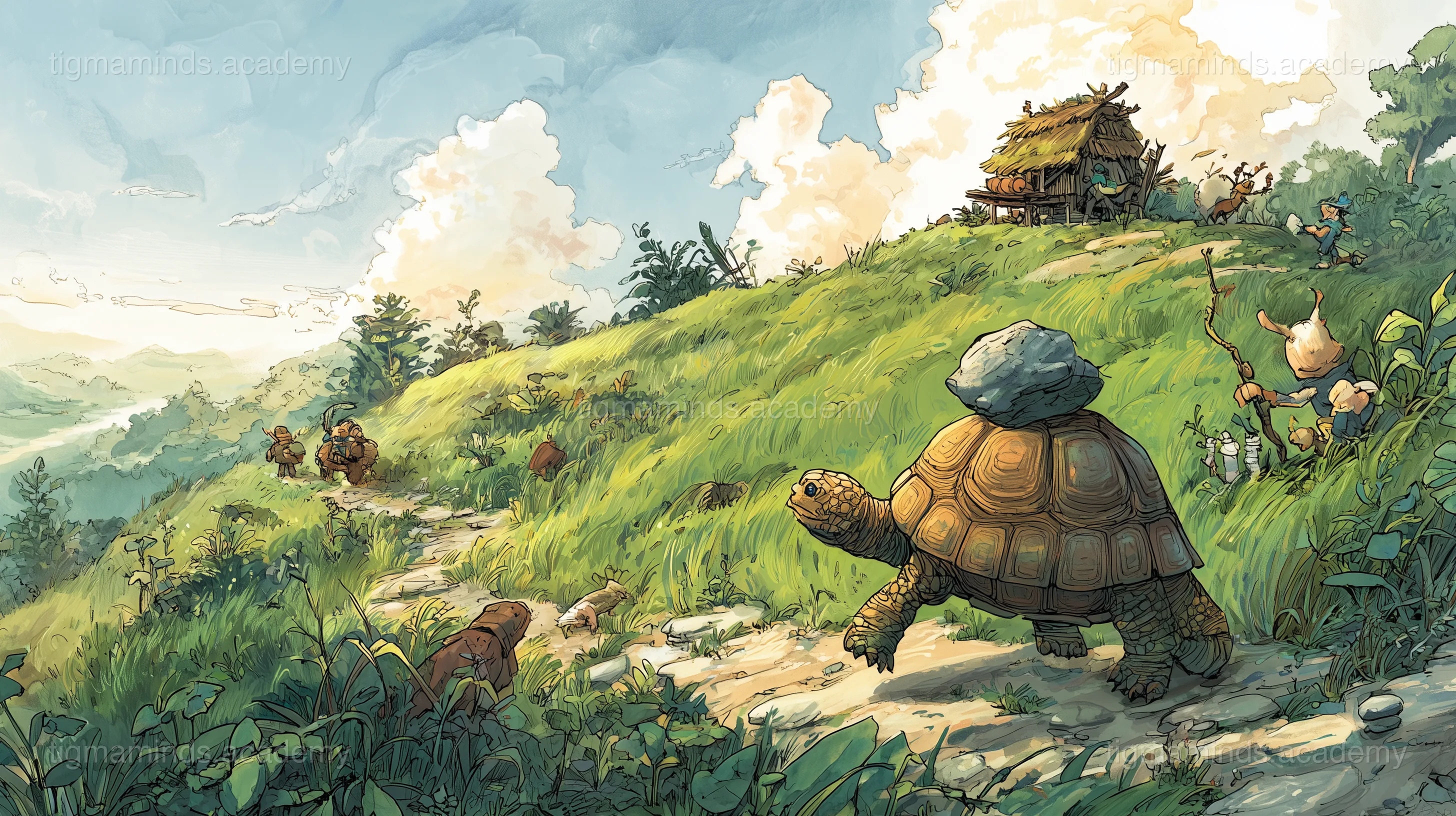
The Sacred Stone
In the foothills of Bhutan-Assam border country, where the Bodo people have farmed rice for centuries, there once stood a stone as tall as a man and as round as the moon. The elders called it the Dwi Gathwi — the Heart Stone — and they said it had fallen from the sky a thousand years ago.
For generations, the Heart Stone sat at the bottom of Hagrama Hill. But the village priest said the stone belonged at the top. "It fell from above," he said. "It wants to go back up. If we carry it to the summit, the rains will come on time and the harvests will be kind."
Everyone agreed. The trouble was, nobody wanted to carry it.
The Volunteers Who Quit
The village ox tried first. He was the strongest animal in the district — thick-necked, broad-shouldered, proud. He pushed the Heart Stone ten paces up the hill and then collapsed, panting. "Too heavy," he said. "Find someone else."
The village elephant — a working elephant from the nearby timber camp — tried next. She wrapped her trunk around the stone and heaved. She managed twenty paces before her legs trembled and she set it down. "Impossible," she said. "The hill is too steep."
The buffalo, the horse, and even a team of twelve men tried. Each one moved the stone a little further, then gave up. The Heart Stone sat a quarter of the way up Hagrama Hill, abandoned.
The Turtle's Promise
A small turtle named Oma lived in the stream at the bottom of the hill. She was no bigger than a dinner plate, her shell scratched and worn from years of crawling over rocks. Nobody paid her much attention.
One morning, Oma crawled up to the Heart Stone and pressed her nose against it. "I will carry this stone to the top," she said.
The ox laughed so hard he snorted. The elephant flapped her ears in disbelief. Even the sparrows on the fence cackled. "You?" they all said. "You can't even carry your own shell up a staircase!"
"I didn't say I would carry it fast," said Oma. "I said I would carry it."
One Step Per Day
Oma began the next morning at dawn. She wedged her thick, flat head under the base of the Heart Stone and pushed. The stone moved — barely. Perhaps the width of a single grain of rice. Then Oma rested for the remainder of the day.
The next morning, she pushed again. Another grain of rice.
The animals stopped laughing after the first week. They stopped watching after the first month. The monsoon came and went. The rice was planted and harvested. Festivals were celebrated, babies were born, and old people passed on. And every single morning, without fail, Oma pushed the stone one tiny step further up the hill.
By the end of the first year, the stone had moved five arm-lengths. By the end of the third year, it was halfway up. By the fifth year, it was three-quarters of the way there. Oma's shell was cracked in two places. Her legs ached every night. But she never skipped a morning.
The Summit
On a cool winter morning in the seventh year, with mist clinging to the hilltop like cotton, Oma gave one final push. The Heart Stone rolled forward, settled into a shallow hollow at the summit, and stopped.
It was done.
The village priest climbed the hill and wept when he saw it. The ox, now old and grey, bowed his great head. The elephant placed a garland of marigolds around Oma's neck — a garland so large it dragged on the ground behind her like a golden cape.
"How?" asked the elephant. "How did you do what none of us could?"
Oma blinked her small, dark eyes. "You all tried to carry the mountain in one day," she said. "I just carried it one step at a time. A mountain is only a pile of steps."
To this day, the Bodo people of Assam tell the story of Oma when a task seems too large to finish. Be the turtle, they say. One step per day, and the mountain will move.
The end.
Choose your level. Everyone starts with the story — the code gets deeper as you go.
Here is a taste of what Level 1 looks like for this lesson:
import matplotlib.pyplot as plt
million_years_ago = [120, 100, 80, 60, 50, 40, 20, 0]
speed_cm_yr = [2, 5, 10, 15, 18, 10, 5, 4]
latitude = [-40, -30, -15, 0, 10, 18, 25, 28]
fig, (ax1, ax2) = plt.subplots(1, 2, figsize=(12, 5))
ax1.plot(million_years_ago, speed_cm_yr, "o-", color="red")
ax1.set_xlabel("Million years ago")
ax1.set_ylabel("Speed (cm/year)")
ax1.set_title("India Plate Speed")
ax1.invert_xaxis()
ax2.plot(million_years_ago, latitude, "s-", color="blue")
ax2.set_xlabel("Million years ago")
ax2.set_ylabel("Latitude (N)")
ax2.set_title("India Position")
ax2.invert_xaxis()
plt.tight_layout()
plt.show() # When did the collision happen?This is just the first of 6 coding exercises in Level 1. By Level 4, you will build: Model How the Himalayas Formed.
Free
Level 0: Listener
Stories, science concepts, diagrams, quizzes. No coding.
You are here
Level 0 is always free. Coding levels (1-4) are part of our 12-Month Curriculum.
A Bodo creation tale — plate tectonics.
The big idea: "The Turtle Who Carried a Mountain" teaches us about Geology & Plate Tectonics — and you don't need to write a single line of code to understand it.
The crust is only 5–70 km thick — thinner than an apple’s skin relative to the apple. Below it: the mantle (2,800 km of slowly flowing hot rock), outer core (liquid iron making the magnetic field), and inner core (solid iron ball hotter than the Sun’s surface).
The mantle makes up 84% of Earth’s volume. Though solid, it flows very slowly — like honey over geological time.
Check yourself: If the crust is like an apple’s skin, what would the mantle be? (The flesh. The core is the seed pocket at the center.)
Key idea: Earth has four layers: thin crust, thick flowing mantle, liquid outer core (creates magnetic field), and solid inner core (hotter than the Sun).
Hot water rises from the bottom of a pot, spreads, cools, and sinks. The same happens in Earth’s mantle — but with rock, moving centimeters per year.
These convection currents drag tectonic plates. Where hot rock rises, plates are pushed apart. Where cool rock sinks, plates are pulled together.
Predict: If Earth’s core cooled completely, would tectonics continue? (No — Mars lost its heat and its tectonics stopped billions of years ago.)
Key idea: Core heat drives mantle convection: hot rock rises, pushes plates sideways, cools, sinks. This slow circulation moves continents.
Access all 130+ lessons, quizzes, interactive tools, and offline activities
When two continental plates collide, the crust **crumples upward** like a rug pushed against a wall. The Himalayas formed when India hit Eurasia ~50 m...
**Friction locks plates together** at boundaries. Stress builds as convection keeps pushing. Eventually stress exceeds friction and plates suddenly **...