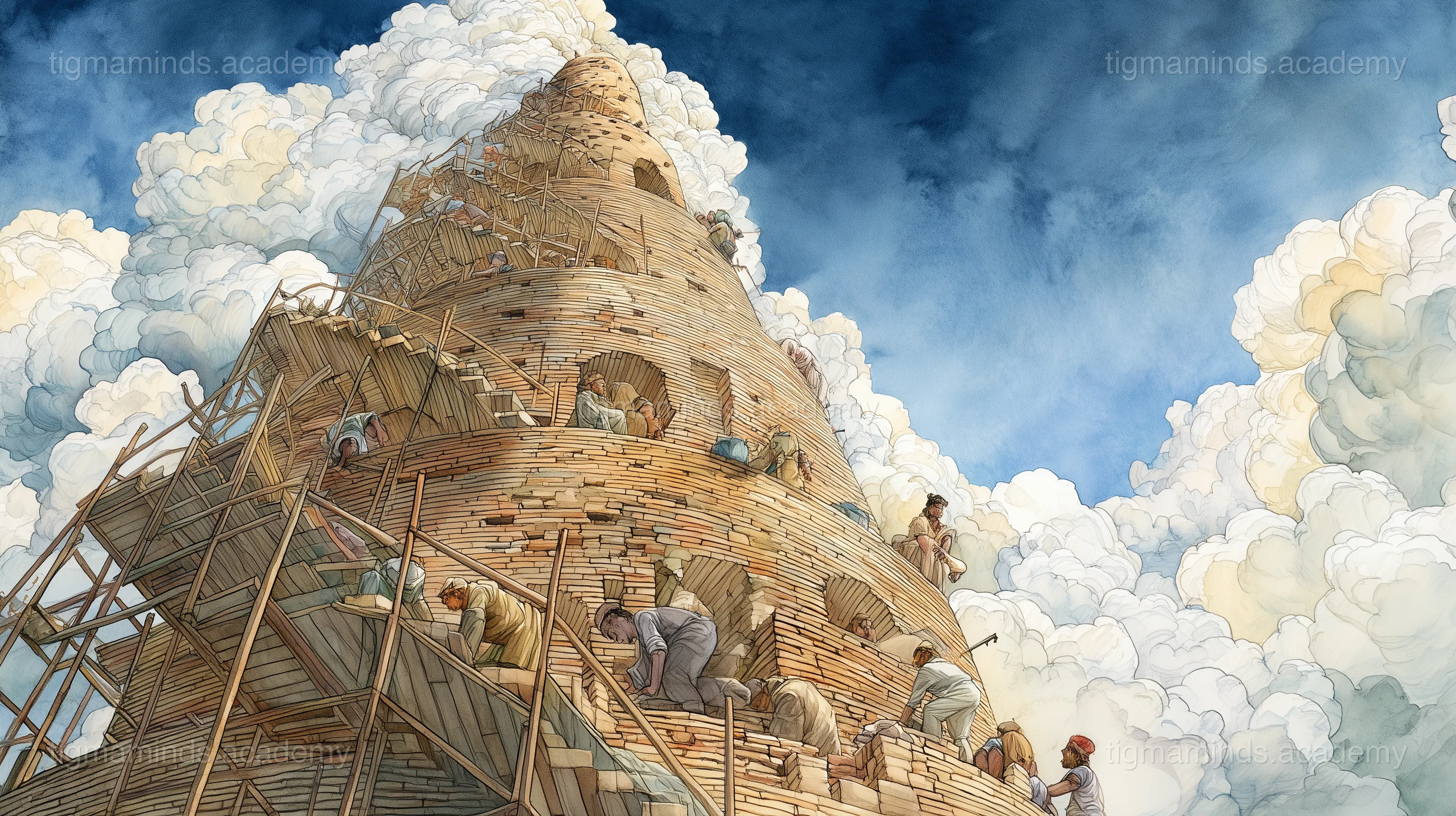
A tower that reached for heaven and a language that shattered — the engineering of tall structures and the science of human communication.
One Language, One Purpose
In the generations after the great flood, the descendants of Noah spoke a single language. Every word meant the same thing to everyone. A builder in the east could call out instructions and a labourer in the west would understand perfectly. There was no confusion, no miscommunication, no barrier between one mind and another.
They settled on a broad plain in the land of Shinar, between the Tigris and Euphrates rivers — the rich alluvial flatland of ancient Mesopotamia. The soil was soft clay. There was no stone for hundreds of miles. But the people were resourceful. They discovered that river clay, shaped into blocks and dried in the fierce sun, made bricks. And they found that the black tar that seeped from the ground — bitumen — could be heated and used as mortar to bind the bricks together.
"Come," they said to one another. "Let us build ourselves a city, with a tower that reaches to the heavens, so that we may make a name for ourselves and not be scattered across the face of the whole earth."
The Construction
The work began. Thousands of people carried clay from the riverbanks, pressed it into wooden moulds, and laid the bricks in the sun to bake. Others heated bitumen in great cauldrons until it bubbled and flowed like black honey. Layer by layer, course upon course, the tower rose from the plain.
The base was enormous — a square platform as wide as a city block, built to carry the weight of everything above. The bricks were laid in careful patterns, each course slightly inset from the one below, so that the tower tapered as it climbed. From a distance, it looked like a staircase to the sky.
Workers carried bricks up ramps that spiralled around the outside of the tower. Those at the top could see the entire plain stretching to the horizon in every direction — the green strips of irrigated farmland, the brown thread of the river, the white shimmer of the salt flats. They were higher than any human had ever stood on something built by human hands.
But the higher they built, the more problems appeared. The weight of the upper levels pressed down on the lower bricks until some began to crack. The tower swayed in the wind — a gentle movement at the base, but terrifying at the top. Cracks appeared along the south face where the afternoon sun baked the bricks unevenly, causing one side to expand while the other stayed cool.
The Scattering
The Lord came down to see the city and the tower the people were building. "If as one people speaking the same language they have begun to do this," He said, "then nothing they plan to do will be impossible for them. Come, let us go down and confuse their language so they will not understand each other."
And so it happened. The bricklayers called for mortar and received bricks. The architects drew plans that the builders could not read. The workers on the north face shouted warnings that the workers on the south face heard as nonsense. A foreman giving orders found his words met with blank stares.
The work stopped. Not because the materials failed or the design was flawed, but because the people could no longer communicate. Without shared language, coordination collapsed. Without coordination, the tower could not rise another brick.
The people scattered across the earth, each group carrying their own fragment of the original language. The city was called Babel — from the Hebrew word balal, meaning "to confuse" — and the tower stood unfinished on the Mesopotamian plain, slowly crumbling back into the clay from which it rose.
What Remained
Archaeologists believe the Tower of Babel may be based on the great ziggurat of Babylon — a stepped pyramid called Etemenanki, meaning "the foundation of heaven and earth." It stood roughly 91 metres tall with a base of 91 metres square, built of mud bricks and bitumen, exactly as the Bible describes.
The story endures because it asks a question that still matters: what are the limits of human ambition? The builders had unity, resources, and determination. They lacked two things: the engineering knowledge to build beyond the limits of their materials, and — after God’s intervention — the ability to work together.
Today, we have both. The Burj Khalifa stands 828 metres tall. Machine translation bridges 7,000 languages. The tower of Babel failed, but the dream of reaching the sky and understanding every tongue is closer to reality than the ancient builders could have imagined.
The end.
Choose your level. Everyone starts with the story — the code gets deeper as you go.
Here is a taste of what Level 1 looks like for this lesson:
# Tower Stress Calculator
height = 100 # metres
base_area = 10 * 10 # m²
density = 1800 # kg/m³ (mud brick)
g = 9.8
mass = base_area * height * density
force = mass * g
stress = force / base_area / 1e6 # MPa
print(f"Tower: {height}m tall on {base_area}m² base")
print(f"Mass: {mass:,.0f} kg")
print(f"Base stress: {stress:.1f} MPa")
print(f"Mud brick limit: 2.0 MPa")
if stress > 2.0:
print("FAILS — bricks crushed at base!")
else:
print(f"OK — {(2.0 - stress)/2.0*100:.0f}% safety margin")This is just the first of 6 coding exercises in Level 1. By Level 4, you will build: Build a Tower Strength Simulator.
By Level 4, enrolled students build: Build a Tower Strength Simulator
Free
Level 0: Listener
Stories, science concepts, diagrams, quizzes. No coding.
You are here
Level 0 is always free. Coding levels (1-4) are part of our 12-Month Curriculum.
The physics of building tall — compression, tension, buckling, and wind loads — plus the science of language diversity and machine translation.
The big idea: "The Tower of Babel" teaches us about Structural Engineering & Linguistics — and you don't need to write a single line of code to understand it.
Pick up a brick and hold it above your head. Your arms are being compressed — squeezed by the weight pushing down. Now imagine stacking ten bricks on your head. The compression on your neck and spine increases with every brick. This is the most basic structural force: compression, the squeezing force caused by weight pressing downward.
Now imagine tying a rope to two trees and hanging a heavy basket from the middle. The rope pulls taut. The molecules in the rope are being dragged apart. This is tension — the pulling-apart force. A rope is excellent at handling tension (you can hang enormous weights from it) but useless at compression (try pushing a rope and it just buckles).
Finally, take a deck of cards and push the top card sideways while holding the bottom card still. The cards slide past each other. This is shear — the sliding force. Wind blowing on the side of a building creates shear: the top of the building wants to slide sideways relative to the base.
Every structure on Earth must handle all three forces simultaneously. The Tower of Babel’s mud bricks were decent at compression but catastrophically weak at tension and shear. That single weakness limited how high the builders could reach.
Check yourself: When you sit on a chair, which parts are in compression (squeezed) and which are in tension (stretched)? The legs are compressed by your weight. If the chair flexes, the underside of the seat is in tension. If you lean sideways, the joints experience shear.
Key idea: All structures face three fundamental forces: compression (squeezing), tension (pulling apart), and shear (sliding). Ancient builders only understood compression, which is why their towers had strict height limits.
Stand a pencil upright on its flat end and press down on the tip. If you press gently, it stays straight. Press harder and suddenly the pencil bows sideways and snaps. This is buckling — the most dangerous failure mode for tall, thin structures. The pencil did not crush from top to bottom; it failed sideways.
The mathematician Leonhard Euler worked out the rule in 1757: the maximum load a column can carry before buckling depends on 1/L² — one divided by the height squared. Double the height, and the buckling load drops to one quarter. Triple the height, and it drops to one ninth. This is devastating for tower builders.
This is why the Great Pyramid of Giza (height 146 m, base 230 m) has survived 4,500 years. Its height-to-base ratio is just 0.63:1 — it is wider than it is tall. The Eiffel Tower (330 m tall, 125 m base) has a ratio of 2.6:1 — slender, but stabilised by its iron lattice. The Burj Khalifa (828 m tall, 73 m base) has a ratio of 11.3:1 — astonishingly slender, made possible only by its Y-shaped buttressed core and modern materials.
The Tower of Babel’s estimated dimensions (91 m tall, 91 m base, ratio 1:1) would have been marginally stable for mud brick. But any attempt to build higher without widening the base would have caused buckling — the tower bowing outward and collapsing under its own weight.
Try this: Stack books on a table. A short, wide stack is stable. Now make the stack narrow and tall. It topples. The tipping point is roughly when the height exceeds 3× the base width for solid stacks. Real buildings use engineering tricks (bracing, tapering, core walls) to push that ratio much higher.
Key idea: Buckling limits how tall a structure can be for a given width. The load capacity drops with the square of the height — double the height, quarter the capacity. Wide bases, tapering shapes, and internal bracing fight buckling.
Access all 130+ lessons, quizzes, interactive tools, and offline activities
The Burj Khalifa is 828 metres tall — nine times the height of the Tower of Babel. How do modern engineers solve the problems that defeated the ancien...
The Tower of Babel story explains why humans speak 7,000 different languages. Linguists offer a scientific explanation: languages **diverge over time*...