
The classic race retold with rhinos and a surprise ending.
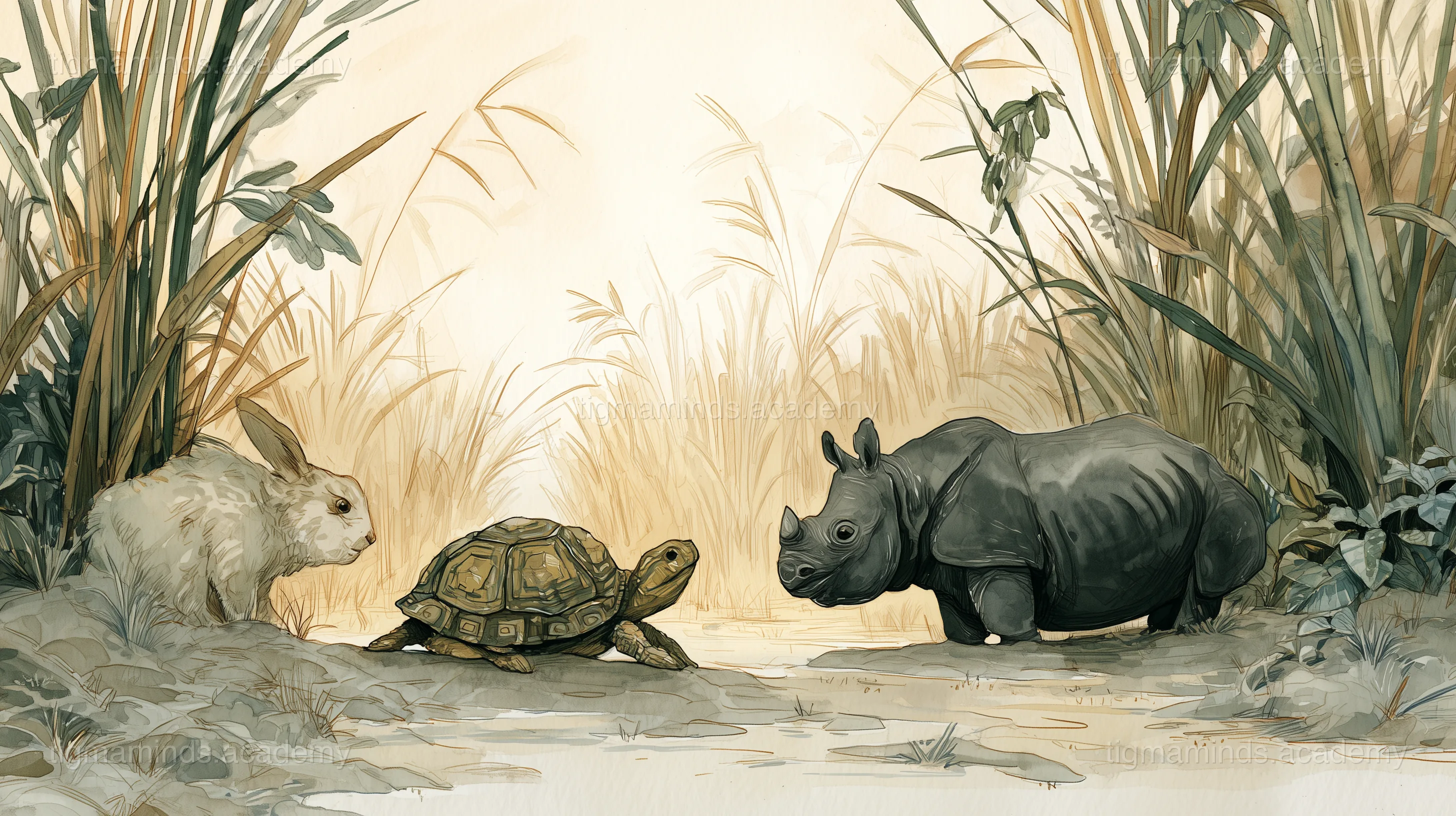
The Challenge
In Pobitora Wildlife Sanctuary, where rhinos outnumber almost everything else, a young wild hare named Khargosh was bragging again.
"I am the fastest animal in Pobitora!" he announced, standing on a termite mound so everyone could see him. "Faster than the deer! Faster than the buffalo! I could outrun a jeep if I wanted to!"
A small Indian flapshell turtle named Kaaso looked up from the mud and said, quietly, "I'll race you."
Everyone laughed. A turtle racing a hare? In Pobitora? Ridiculous.
"Fine!" said Khargosh, barely able to contain his giggles. "Tomorrow morning. From the old banyan tree to the main waterhole. Whoever gets there first, wins."
The Race Begins
The next morning, every animal in Pobitora gathered to watch. Even the rhinos stopped eating — which, if you know rhinos, tells you how exciting this was.
The old elephant dropped his trunk as the starting signal. THWUMP!
Khargosh shot off like a furry brown arrow. Within seconds, he was out of sight. Kaaso took one slow step. Then another. Then another.
"This will take all day," muttered a buffalo.
"That's the plan," said Kaaso, and kept walking.
The Detours
Khargosh was so far ahead that he decided to take a detour through the tall grass. But the tall grass in Pobitora isn't just grass — it's elephant grass, taller than a human, and it all looks the same. Within minutes, Khargosh was lost.
He turned left. More grass. He turned right. More grass. He ran in circles for an hour before he stumbled out the other side — behind where he started.
Meanwhile, Kaaso walked slowly along the river path. She didn't take shortcuts. She didn't show off. She just kept moving, one steady step at a time.
The Mud Problem
Khargosh finally found the right path again and sprinted toward the waterhole. But it had rained the night before, and the ground near the waterhole was thick, sticky mud. Khargosh's long legs sank in up to his belly. He struggled and kicked and got muddier and muddier.
Kaaso arrived at the mud five minutes later. She looked at Khargosh thrashing around and smiled. Then she simply retracted into her shell and slid across the mud like a smooth, flat stone on a frozen pond.
She slid right past the stuck hare and plopped into the waterhole with a gentle splash.
The Winner
"How?!" spluttered Khargosh, mud dripping from his ears.
"You ran fast," said Kaaso. "I knew the ground. There's a difference between speed and knowing where you're going."
The rhinos nodded approvingly. In Pobitora, knowing the land matters more than being fast. The mud is deep, the grass is tall, and the paths are never straight. The animals who thrive aren't the quickest — they're the ones who pay attention.
Khargosh never bragged about speed again. And Kaaso? She went back to sitting in the mud, which is exactly where she wanted to be.
The end.
Choose your level. Everyone starts with the story — the code gets deeper as you go.
Here is a taste of what Level 1 looks like for this lesson:
import numpy as np
import matplotlib.pyplot as plt
# Race simulation: hare vs tortoise
time = np.arange(0, 300, 1) # 5 minutes in seconds
# Hare: sprints at 19 m/s, rests, sprints again
hare_speed = np.where(time < 15, 19, np.where(time < 60, 0, np.where(time < 75, 19, 0)))
hare_pos = np.cumsum(hare_speed)
# Tortoise: steady 0.3 m/s, never stops
tortoise_pos = 0.3 * time
plt.figure(figsize=(10, 5))
plt.plot(time, hare_pos, label="Hare", color="orange")
plt.plot(time, tortoise_pos, label="Tortoise", color="green")
plt.xlabel("Time (s)")
plt.ylabel("Position (m)")
plt.title("The Pobitora Race")
plt.legend()
plt.show() # Who wins at 300 seconds?This is just the first of 6 coding exercises in Level 1. By Level 4, you will build: Simulate a Race Between Animals of Different Speeds.
By Level 4, enrolled students build: Simulate a Race Between Animals of Different Speeds
Free
Level 0: Listener
Stories, science concepts, diagrams, quizzes. No coding.
You are here
Level 0 is always free. Coding levels (1-4) are part of our 12-Month Curriculum.
The classic race retold with rhinos and a surprise ending.
The big idea: "The Tortoise and the Hare of Pobitora" teaches us about Speed, Acceleration & Biomechanics — and you don't need to write a single line of code to understand it.
When Khargosh the hare bolted ahead at the start of the Pobitora race, everyone said he was "fast." But what does that actually mean in physics? Let’s start with the simplest version: speed is how much distance you cover per unit of time. If you walk 100 metres in 50 seconds, your speed is 100 ÷ 50 = 2 metres per second (2 m/s). If the hare covers 100 metres in 5 seconds, its speed is 20 m/s. Simple.
But here is where it gets interesting. Imagine Khargosh sprints 200 metres north, realises he is lost in the elephant grass, turns around and sprints 200 metres south — back to where he started. He has covered 400 metres (that is his distance), so his speed was high. But his final position is the same as his starting position — he has gone nowhere. His displacement (the straight-line change in position) is zero.
This is the difference between speed and velocity: Khargosh’s speed was 20 m/s. His velocity? Zero — because his displacement was zero. Direction matters. A quantity that includes direction is called a vector; one that does not is called a scalar. Temperature, mass, and speed are scalars. Velocity, force, and acceleration are vectors.
Check yourself: A bird flies 3 km east, then 4 km north. Its total distance is 7 km. But what is its displacement? (Hint: think of a right triangle — you will need the 3-4-5 rule from geometry.)
Key idea: Speed is distance over time (scalar — no direction). Velocity is displacement over time (vector — direction matters). An animal can have high speed but zero velocity if it ends up where it started.
Speed tells you how fast something is moving right now. But animals don’t just move at one speed — they speed up and slow down. The hare explodes off the starting line; the tortoise takes a minute to reach its cruising pace. The rate at which velocity changes is called acceleration. If the hare goes from 0 to 20 m/s in 2 seconds, its acceleration is (20 − 0) ÷ 2 = 10 m/s². That means every second, its velocity increases by 10 m/s.
Now compare a cheetah and a tortoise. A cheetah can accelerate from 0 to 30 m/s (108 km/h) in about 3 seconds — that is 10 m/s², close to the acceleration of gravity. It is one of the highest accelerations in the animal kingdom. A tortoise might take 10 seconds to reach its top speed of 0.08 m/s — an acceleration of 0.008 m/s².
But acceleration has a cost. High acceleration requires enormous force from muscles. Newton’s second law says F = m × a — to accelerate a 50 kg cheetah at 10 m/s², its legs must push with 500 newtons of force just for forward acceleration, on top of supporting its body weight. This is why sprinters (animal or human) have huge leg muscles relative to their body.
Acceleration can also be negative — we call that deceleration or braking. When the cheetah tires after 15 seconds and slows from 30 m/s to 10 m/s over 5 seconds, its acceleration is (10 − 30) ÷ 5 = −4 m/s². The negative sign means it is slowing down. On a velocity-time graph, acceleration is the slope — steep upward slope means high acceleration, flat means constant velocity, downward slope means deceleration.
Check yourself: A car goes from 0 to 60 km/h in 6 seconds. What is its acceleration in m/s²? (Hint: convert 60 km/h to m/s first.)
Key idea: Acceleration is how quickly velocity changes. High acceleration requires large forces (F = ma). On a velocity-time graph, acceleration is the slope of the line.
Access all 130+ lessons, quizzes, interactive tools, and offline activities
The cheetah is the fastest land animal in absolute terms — 108 km/h. But is a cheetah really "faster" than an ant? It depends on how you measure. If y...
Every time an animal moves, its muscles need fuel. That fuel is a molecule called **ATP** (adenosine triphosphate) — the universal energy currency of ...