The Tiny Frog of the Rainforest
Amphibian Biology & Size Extremes

The Tiny Frog of the Rainforest

Miniature frogs — where small size means big science.
Amphibian Biology & Size Extremes12-Month Curriculum 12h

The Story

Smaller Than Small

In the Namdapha rainforest of Arunachal Pradesh — one of the wildest, wettest, most tangled jungles left on Earth — there lived a frog named Mechi. Mechi was small. Not regular-frog small. Incredibly small. She could sit on a one-rupee coin with room to spare. She could hide behind a single raindrop. A beetle once stepped on her by accident and didn't even notice.

"Excuse me!" Mechi had yelled. But the beetle was already gone.

That was the problem. Nobody noticed Mechi. She was too tiny to be seen, too light to be felt, and — she assumed — too small to be heard.

The Council of Voices

Every monsoon season, the animals of Namdapha held a Council of Voices. It was a tradition as old as the forest itself. Each species sent its best singer to the great banyan tree at the centre of the jungle, and they sang together all night to welcome the rains.

The hoolock gibbon sang — a wild, soaring howl that echoed off the mountains. The barking deer sang — a sharp, staccato bark that cracked through the undergrowth. The cicadas sang — a buzzing drone that filled every gap between the other sounds. Even the elephants sang, rumbling so low that the ground itself vibrated.

Mechi wanted to sing too. But when she arrived at the banyan tree, the gibbon looked down and said, "Where's the frog? I don't see anyone."

"I'm here," said Mechi, from the top of a fallen leaf. "Down here."

The gibbon squinted. "Oh. You. Little one, this is the Council of Voices. You need a voice to be here. What sound can something your size possibly make?"

The Smallest Singer

Mechi felt her throat tighten — not with fear, but with the thing she had been holding inside her whole life. A sound. A big sound. She had never let it out because she assumed that small creatures could only make small noises.

But standing on that leaf, under the great banyan, with every animal in the forest looking at her (or trying to find her), Mechi decided to try.

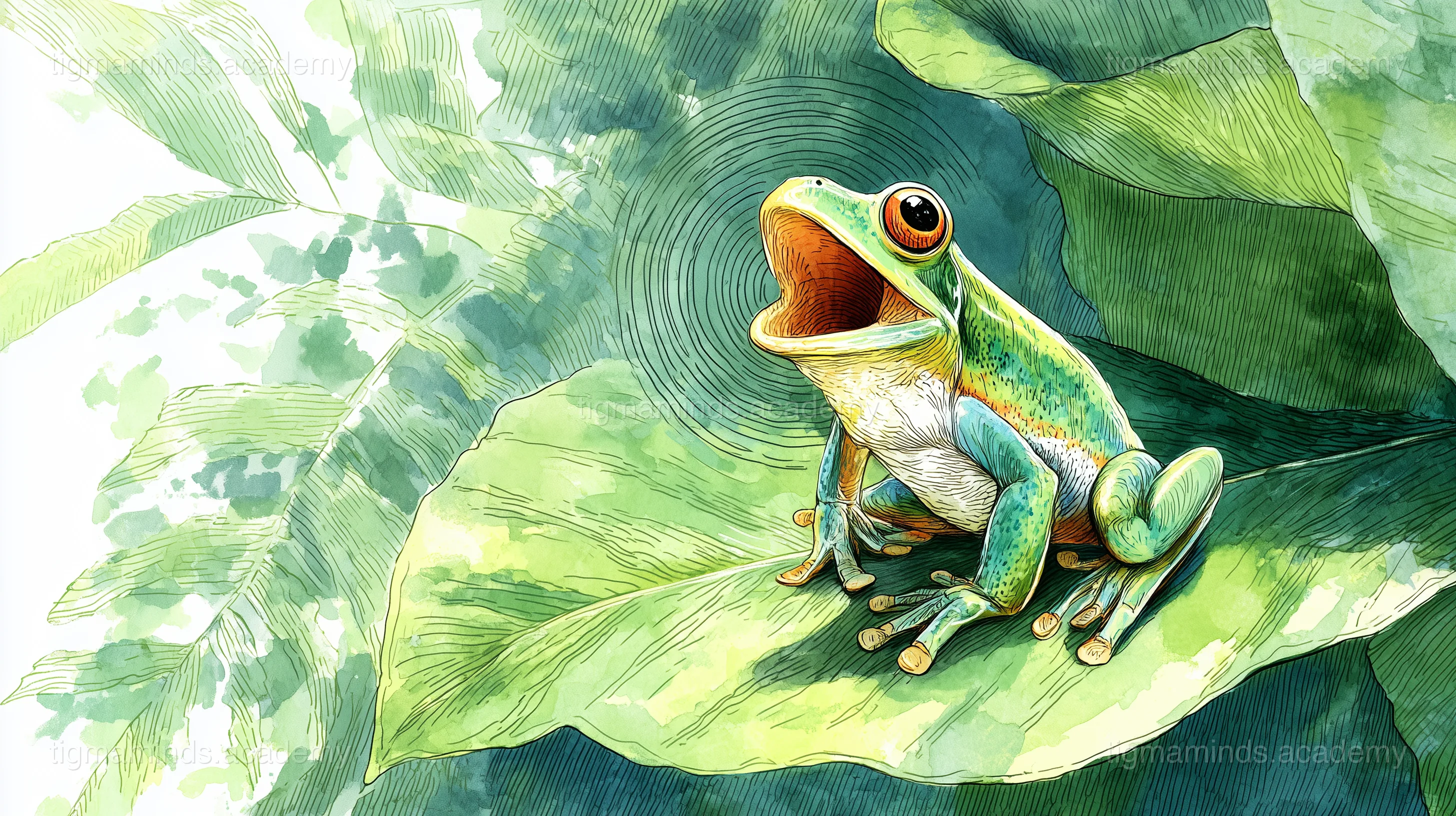
She filled her tiny lungs. She puffed out her throat sac — which expanded to three times the size of her entire body, like a translucent pink balloon. And she sang.

"KREEEEEE-KREEE-KREEE-KREEEEEEE!"

The sound was astonishing. It cut through the gibbon's howl, sliced over the cicadas' buzz, pierced the elephant's rumble. It was the highest, clearest, most penetrating sound in the entire rainforest — a note so sharp and bright that it seemed to come from everywhere at once.

The jungle went silent. Every animal stared at the tiny frog on the leaf.

The Forest Listens

"That," said the old elephant, after a very long pause, "is the most extraordinary voice I have ever heard."

"How?" sputtered the gibbon. "She's the size of my thumbnail."

The elephant smiled — which is a wonderful thing to see, if you ever get the chance. "Sound doesn't care about size. It cares about resonance. This little frog has found a frequency that travels further than any of ours. She may be the smallest creature here, but her voice reaches the farthest."

Mechi blinked. She hadn't known that. She had just... sung.

The Loudest Voice

From that night on, Mechi sang at every Council of Voices. She became the opening singer — the first voice to call the rains — because her high, clear note travelled out of the forest, up over the hills, and into the sky where the rain clouds gathered. The clouds heard her before they heard anyone else.

And in the Namdapha rainforest to this day, if you visit during the monsoon and press into the thick, green tangle of vines and ferns, you will hear it — a piercing, beautiful kreee rising above every other sound. That is Mechi's granddaughter, or her great-granddaughter, or her great-great-great-granddaughter. The frog is always tiny. The voice is always enormous.

Because size, as the people of Northeast India have always known, has nothing to do with being heard. You just have to open your mouth and mean it.

The end.

Try It Yourself

Choose your level. Everyone starts with the story — the code gets deeper as you go.

Story Progress

0%

Ready to Start Coding?

Here is a taste of what Level 1 looks like for this lesson:

Level 1: Explorer — Python
import numpy as np
import matplotlib.pyplot as plt

# The cube-square law in action
# How does the SA:V ratio change with size?
sides = np.linspace(0.5, 10, 100)  # cm
sa = 6 * sides**2                   # surface area
vol = sides**3                      # volume
ratio = sa / vol                    # SA:V ratio

plt.figure(figsize=(10, 5))
plt.plot(sides, ratio, linewidth=2, color='#22c55e')
plt.fill_between(sides, ratio, alpha=0.15, color='#22c55e')
plt.axhline(y=1, color='gray', linestyle=':', linewidth=0.5)
plt.xlabel("Cube side length (cm)")
plt.ylabel("Surface area / Volume ratio")
plt.title("Why Tiny Frogs Dry Out Fast")
plt.show()  # What happens to the ratio as size shrinks?

This is just the first of 6 coding exercises in Level 1. By Level 4, you will build: Explore How Body Size Affects Biology.

By Level 4, enrolled students build: Explore How Body Size Affects Biology

Free

Level 0: Listener

Stories, science concepts, diagrams, quizzes. No coding.

You are here

Enrolled

Levels 1-4

Python, NumPy, Matplotlib, real projects, mentorship.

Sign Up Free

Stay Updated

Join Waitlist

Get notified when enrollment opens for your area.

Notify Me

Level 0 is always free. Coding levels (1-4) are part of our 12-Month Curriculum.